-
Use Cases
-
Resources
-
Pricing
Mycenaean Greece was the last phase of the Bronze Age in ancient Greece (c. 1600–1100 BCE), characterized by powerful palace-centered states such as Mycenae, Pylos, and Tiryns. The Mycenaeans built massive citadels with cyclopean walls, developed the earliest written form of Greek (Linear B), engaged in wide-ranging Mediterranean trade, and inspired later Greek epic traditions like Homer's Iliad. Their civilization collapsed around 1100 BCE, ushering in the Greek Dark Ages. More Less
6000 BC
% complete
The Neolithic agrarian village (6000 BC) constituted the foundation of Bronze Age political culture in Greece, laying the social and economic groundwork upon which later civilizations, including the Mycenaeans, would build.
Image source: Mycenaean Greece
3200 BC - 2000 BC
% complete
The Early Helladic period (c. 3200–2000 BC) was a time of prosperity with the use of metals and a growth in technology, economy and social organization in mainland Greece.
2600 BC - 2000 BC
% complete
Sequenced genomes of Middle Bronze Age individuals from northern Greece had ~50% Pontic-Caspian Steppe-related ancestry; the gene flow was estimated at ~2300 BC (c. 2600–2000 BC), consistent with theories explaining the emergence of Proto-Greek.
2000 BC - 1675 BC
% complete
The Middle Helladic period (c. 2000–1700/1675 BC) faced a slower pace of development, as well as the evolution of megaron-type dwellings and cist grave burials.
1750 BC - 1675 BC
% complete
The final phase of the Middle Helladic period, known as Middle Helladic III (c. 1750–1675 BC), roughly overlaps with the beginning of the Late Helladic period (c. 1700/1675–1050 BC), which corresponds to the era of Mycenaean Greece.
1750 BC
% complete
The mainstream consensus among modern Mycenologists is that Mycenaean civilization began around 1750 BC, earlier than the Shaft Graves, originating and evolving from the local socio-cultural landscape of the Early and Middle Bronze Age in mainland Greece with influences from Minoan Crete.
1750 BC - 1400 BC
% complete
Alex Knodell (2021) divides the whole Mycenaean time into three cultural periods, beginning with the Early Mycenaean period (c. 1750–1400 BC).
1700 BC - 1675 BC
% complete
Towards the end of the Middle Bronze Age (c. 1700/1675 BC), a significant increase in the population and the number of settlements occurred across mainland Greece.
1500 BC
% complete
The tholos was introduced during the early 15th century BC as the new and more imposing form of elite burial; nine such tholos tombs are found in the region of Mycenae, six belonging to Late Helladic IIA (c. 1400–1300 BC).
1450 BC
% complete
Before the mainland conquest of Crete c. 1450 BC, finer seals could be classified as Cretan and cruder ones as mainland manufacture, but this criterion no longer applied after the conquest.
1400 BC - 1200 BC
% complete
According to Alex Knodell (2021), the Palatial Bronze Age (c. 1400–1200 BC) was the second cultural period of Mycenaean Greece, marked by palace-centered states.
1200 BC - 1050 BC
% complete
According to Alex Knodell (2021), the Postpalatial Bronze Age (c. 1200–1050 BC) was the final cultural period of Mycenaean Greece, following the collapse of the palatial system.
1650 BC - 1350 BC
% complete
The drug trade in Mycenaean Greece is traced as early as 1650–1350 BC, with opium poppies being traded in the eastern Mediterranean.
1600 BC - 1500 BC
% complete
In the 16th and early 15th century BC, commerce intensified, with Mycenaean pottery found on Lipari and Vivara, the coasts of Asia Minor (including Miletus, Troy, and Aulae), Cyprus, Palestine, Byblos, and Egypt.
1500 BC
% complete
Starting in the 15th century BC, the Mycenaeans began to spread their influence throughout the Aegean and Western Anatolia.
1450 BC
% complete
By c. 1450 BC, the palace of Knossos was ruled by a Mycenaean elite who formed a hybrid Minoan-Mycenaean culture.
Image source: Knossos
1450 BC - 1100 BC
% complete
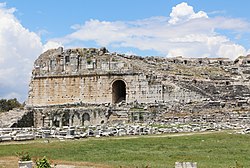
Excavations at Miletus, southwest Asia Minor, indicate the existence of a Mycenaean settlement there already from c. 1450 BC, replacing previous Minoan installations; it became a sizable and prosperous Mycenaean center until the 12th century BC.
Image source: Miletus
1437 BC
% complete
Egyptian records mention a T(D)-n-j or Danaya (Tanaju) land for the first time c. 1437 BC, during the reign of Pharaoh Thutmoses III.
1400 BC - 1220 BC
% complete
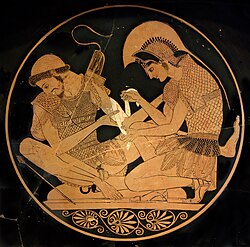
In the official records of the Hittite Empire in Anatolia, various references from c. 1400 BC to 1220 BC mention a country named Ahhiyawa, commonly identified with the Mycenaean (Achaean) world.
Image source: Achaeans (Homer)
1400 BC - 1300 BC
% complete
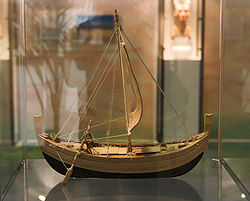
The 14th century BC Uluburun shipwreck, off the coast of southern Anatolia, displays the established trade routes that supplied the Mycenaeans with raw materials such as copper and tin for bronze production.
Image source: Uluburun shipwreck
1390 BC - 1352 BC
% complete
During the reign of Pharaoh Amenhotep III (r. c. 1390–1352 BC), Egyptian records mention a number of Danaya cities covering the largest part of southern mainland Greece.
1300 BC - 1200 BC
% complete
Mycenaean bronze double axes and other objects dating from the 13th century BC have been found in Ireland and in Wessex and Cornwall in England.
1267 BC - 1237 BC
% complete
Under Hittite king Tudhaliya IV (r. 1267–1237 BC), the king of Ahhiyawa is recognized as a 'Great King' of equal status with the kings of Egypt, Babylonia and Assyria.
1200 BC - 1100 BC
% complete
Another similar ethnonym, Ekwesh, in twelfth century BC Egyptian inscriptions has been commonly identified with the Ahhiyawans.
Image source: Achaeans (Homer)
1600 BC
% complete
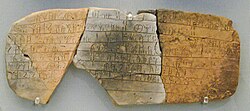
In c. 1600 BC, the Mycenaean Greeks borrowed from the Minoan civilization its syllabic writing system (i.e., Linear A) and developed their own syllabic script known as Linear B.
Image source: Linear B
1400 BC
% complete
From c. 1400 BC, the palace of Knossos has yielded the earliest records of the Greek Linear B script, based on the previous Linear A of the Minoans; an isolated reference to a-ka-wi-ja-de presumably refers to a Mycenaean state on the Greek mainland.
1400 BC
% complete
Stirrup jars, first invented on Crete during the 16th century BC, were used widely by the Mycenaeans from 1400 BC onward for transporting and storing wine and oil; they were usually pear-shaped or globular.
1300 BC - 1200 BC
% complete
The cultic center of Mycenae seems to have been a later development of the 13th century BC.
Image source: Mycenae
800 BC
% complete
The decipherment of Linear B demonstrated the continuity of Greek speech from the second millennium BC into the eighth century BC when a new Phoenician-derived alphabetic script emerged.
800 BC
% complete
In the 8th century BC, after the end of the so-called Greek Dark Ages, Greece emerged with a network of myths and legends, the greatest of all being that of the Trojan Epic Cycle.
800 BC - 700 BC
% complete
Various collective terms for the inhabitants of Mycenaean Greece were used by Homer in his 8th-century BC epic the Iliad in reference to the Trojan War.
Image source: Iliad
1450 BC - 1400 BC
% complete
A representative piece of Mycenaean armor is the Dendra panoply (c. 1450–1400 BC), which consisted of a cuirass of a complete set of armor made up of several elements of bronze.
Image source: Dendra panoply
1400 BC
% complete
Palaces proper are datable from c. 1400 BC, when Cyclopean fortifications were erected at Mycenae and nearby Tiryns.
1400 BC
% complete
In c. 1400 BC, Hittite records mention the military activities of an Ahhiyawan warlord, Attarsiya, possibly related to the mythic character of Atreus.
Image source: Attarsiya
1315 BC
% complete
In 1315 BC, an anti-Hittite rebellion headed by Arzawa, a Hittite vassal state, received support from Ahhiyawa.
1300 BC - 1200 BC
% complete
Later in the 13th century BC, Mycenaean warfare underwent major changes both in tactics and weaponry; armed units became more uniform and flexible, while weapons became smaller and lighter.
1300 BC - 1200 BC
% complete
Chariots were initially used as fighting vehicles during the 16th to 14th centuries BC, but later, in the 13th century BC, their role was limited to battlefield transport.
1220 BC
% complete
In c. 1220 BC, the king of Ahhiyawa is again reported to have been involved in an anti-Hittite uprising in western Anatolia.
1250 BC
% complete
Around 1250 BC, the first wave of destruction apparently occurred in various centres of mainland Greece for reasons that cannot be identified by archaeologists.
1210 BC - 1040 BC
% complete
The Late Helladic IIIC period (c. 1210–1040 BC) followed the palatial collapse; due to the obscure archaeological picture of 12th–11th century BC Greece, scholars continue to debate whether the impoverished successor societies were newcomers or existing populations.
1200 BC - 1100 BC
% complete
Athens and the eastern coast of Attica were still occupied in the 12th century BC and were not destroyed or abandoned, pointing to new decentralized coastal and maritime networks attested by the cemetery of Perati and the LHIIIC cemetery of Drivlia at Porto Rafti.
1190 BC
% complete
A second wave of destruction occurred around 1190 BC or shortly thereafter, contributing to the collapse of the Mycenaean palatial system.
1100 BC - 800 BC
% complete
The period from 1100–800 BC is generally termed the 'Greek Dark Ages', following the collapse of Mycenaean palatial society.
Image source: Greek Dark Ages
1050 BC
% complete
Mycenaean Greece, the last phase of the Bronze Age in ancient Greece, came to an end around 1050 BC, transitioning into the Sub-Mycenaean period.
1050 BC - 1000 BC
% complete
The transition period from the Bronze Age to the Iron Age in Greece is known as Sub-Mycenaean (c. 1050–1000 BC).
Image source: Sub-Mycenaean pottery
1800 AD - 1900 AD
% complete
The legends of Homer's Epics were generally accepted as part of the Greek past until the 19th century, when scholars began to question Homer's historicity.
Image source: Homeric Question
1876 AD
% complete
German archaeologist Heinrich Schliemann undertook the first modern archaeological excavations in Greece at the site of Mycenae in 1876.
Image source: Heinrich Schliemann
1900 AD
% complete
The Linear B tablets were first discovered in Crete by English archaeologist Sir Arthur Evans c. 1900.
Image source: Arthur Evans
1952 AD
% complete
English architect and cryptographer Michael Ventris deciphered Linear B in 1952, demonstrating it was adapted for the Indo-European Greek language of the Late Bronze Age.
Image source: Michael Ventris
1989 AD
% complete
A 1989 study published in The Angle Orthodontist showed remarkable similarity in craniofacial morphology between ancient Greeks (including Mycenaeans) and modern Greeks, suggesting stability over the last 4,000 years.
2014 AD
% complete
A 2014 study published in Anthropologischer Anzeiger indicated craniological similarities between modern Greeks and ancient Greeks (including Mycenaeans), indicating continuity.
2017 AD
% complete
A 2017 genetic study conducted by Lazaridis et al. found that Minoans and Mycenaean Greeks were genetically highly similar but not identical; modern Greeks resembled the Mycenaeans with some additional dilution of early Neolithic ancestry.
2020 AD
% complete
In a 2020 study, Polish historian Łukasz Niesiołowski-Spanò linguistically identified the Levites, a group known from the Bible, with the Greek term *la-wo (later laoi) – 'the people' or 'armed men'.
Image source: Levite
2021 AD
% complete
A 2021 study found that in the Early Bronze Age, the populations of the Minoan, Helladic, and Cycladic civilizations in the Aegean were genetically homogeneous.
Image source: Minoan civilization
2022 AD
% complete
A 2022 study analysed 21 new Mycenaean samples and one new Minoan sample along with previously published samples; one Mycenaean individual from Crete (c. 1370–1340 BC) had 24±6% EHG ancestry.
2022 AD
% complete
Paul Heggarty of the Max Planck Institute expressed doubts regarding the connection between the small contribution of Yamnaya-related ancestry in Mycenaean Greece and the steppe as the earliest source of Indo-European languages.
Image source: Indo-European migrations
2023 AD
% complete
A 2023 study generated genome-wide data from 95 Bronze Age individuals from mainland Greece and the Aegean, estimating ~22.3% steppe-related ancestry in southern mainland Mycenaeans and tracing possible sources including Corded Ware Germany and Western Steppe groups.
Or browse the full history timeline directory, with more than 2,000 topics.
This Mycenaean Greece timeline was generated with the help of AI, using information found on the internet.
We work hard to keep these timelines accurate, but mistakes do get through. If you spot one, email us at [email protected] and we'll fix it for future visitors.
Generate yours with AI or build it from scratch, for free.
Export your timeline, add your own events, edit or remove AI-generated events, and much more
No credit card required.
Cancel anytime.
Cancel anytime.
You can create an unlimited number of timelines with up to 10 events on each one, customize how they look, export them to PDF, PNG, PowerPoint, CSV, and Excel, and share them with a link. Paid plans raise the event limit and add features like spreadsheet imports and collaborators.
Yes. You can cancel your subscription from your account page at any time, and you will not be charged again. Your subscription stays active for the rest of the period you already paid for.
Yes. We will email you a reminder before the annual renewal, and we will also email you a receipt.
Yes. You can email us within 15 days of any payment, and we will issue you a full refund.
Check out our pricing docs or send us an email anytime: [email protected].