
-
Use Cases
-
Resources
-
Pricing
Duke Ellington was an American composer, pianist, and bandleader who became one of the most influential figures in jazz history. Over his five-decade career, he composed thousands of works, including 'Take the A Train,' led his renowned orchestra at Harlem's Cotton Club, and elevated jazz to an art form recognized worldwide. More Less
Apr 29, 1899
% complete
Edward Kennedy Ellington was born to James Edward Ellington and Daisy Kennedy Ellington in Washington, D.C. Raised in a loving middle-class family, he was nicknamed 'Duke' by a childhood friend for his elegant manner and style, a name that would follow him throughout his legendary career.
Image source: Duke Ellington
Jan 1, 1908
% complete
Around age seven, Ellington began taking piano lessons from Marietta Clinkscales. Though he initially preferred baseball, his mother's encouragement and the vibrant musical culture of Washington, D.C. helped nurture his growing interest in music.
Jan 1, 1917
% complete
Ellington formed his first group, The Duke's Serenaders, playing for dances and parties around Washington, D.C. and Virginia. The young band built a strong local reputation, laying the groundwork for Ellington's move to New York City.
Jul 2, 1918
% complete
Ellington married his high school sweetheart Edna Thompson, who had been his neighbor in Washington, D.C. Their son Mercer Ellington, who would later become a trumpeter and bandleader himself, was born in March 1919.
Jan 1, 1923
% complete
Drawn by the flourishing Harlem Renaissance, Ellington moved to New York City with his bandmates. After an initial struggle, the group secured a four-year engagement at the Hollywood Club (later the Kentucky Club) on Broadway, where they made their first recordings.
Jan 1, 1939
% complete
Composer and pianist Billy Strayhorn joined Ellington's organization after being introduced backstage in Pittsburgh. Over nearly three decades, Strayhorn became Ellington's indispensable collaborator, co-writing many of the orchestra's greatest works including 'Lush Life' and 'Chelsea Bridge.'
Image source: Billy Strayhorn
Jan 1, 1940
% complete
Tenor saxophonist Ben Webster joined Ellington's band, completing what many consider its greatest lineup alongside Jimmy Blanton, Rex Stewart, Johnny Hodges, and Barney Bigard. This ensemble produced a remarkable run of classics in the early 1940s.
Image source: Ben Webster
Jan 1, 1914
% complete
While working as a soda jerk at Poodle's Café, Ellington wrote his first composition, 'Soda Fountain Rag.' He created it by ear, as he had not yet learned to read or write music, and performed it as 'Poodle Dog Rag' during intermissions at the True Reformer's Hall.
Image source: Duke Ellington
Nov 29, 1926
% complete
Ellington recorded 'East St. Louis Toodle-Oo' with his orchestra, featuring the distinctive growling plunger mute work of trumpeter Bubber Miley. The song became one of his signature early hits and showcased the 'jungle style' sound that defined his band.
Image source: East St. Louis Toodle-Oo
Oct 1, 1928
% complete
Ellington recorded 'The Mooche,' another celebrated example of his jungle-style compositions featuring Bubber Miley's muted trumpet. The piece became one of the orchestra's most enduring early works and demonstrated his maturing compositional voice.
Image source: The Mooche
Oct 17, 1930
% complete
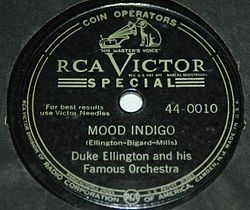
'Mood Indigo' became one of Ellington's most famous compositions, notable for its unusual voicing that placed the clarinet and bass clarinet below the trumpet. The song sold well and established Ellington as a major composer, not merely a bandleader.
Image source: Mood Indigo
Feb 2, 1932
% complete
Recorded with vocalist Ivie Anderson, this collaboration with lyricist Irving Mills anticipated the swing era by several years. Its title phrase became a jazz credo, and the song is now considered one of the most influential standards in American music.
Image source: It Don't Mean a Thing (If It Ain't Got That Swing)
Sep 12, 1935
% complete
Following the death of his beloved mother Daisy, Ellington composed the four-part extended work 'Reminiscing in Tempo.' At over twelve minutes long, it was among the earliest ambitious extended jazz compositions, though it divided critics at the time.
Dec 19, 1936
% complete
Co-written with valve trombonist Juan Tizol, 'Caravan' introduced an exotic Latin-tinged sound to jazz. It became one of the most recorded jazz standards of all time and a staple of the Ellington repertoire.
Image source: Caravan of Love
Jan 1, 1940 - Dec 31, 1942
% complete
Between 1940 and 1942, Ellington's orchestra recorded a string of masterpieces including 'Take the A Train,' 'Cotton Tail,' 'Ko-Ko,' and 'Concerto for Cootie.' This period is widely regarded as the artistic peak of the Ellington orchestra.
Feb 15, 1941
% complete
Composed by Billy Strayhorn, 'Take the A Train' became Ellington's theme song after radio broadcasters required a tune to open broadcasts. Its success cemented the extraordinary collaborative partnership between Ellington and Strayhorn.
Dec 3, 1941
% complete
The orchestra recorded 'Perdido,' an up-tempo Juan Tizol composition that became a favorite vehicle for soloists like tenor saxophonist Ben Webster. It remains one of the band's best-known instrumentals.
Image source: Perdido (song)
Jan 23, 1943
% complete
Ellington premiered his ambitious 'tone parallel' chronicling African American history at Carnegie Hall, beginning a series of annual concerts there. Although critics gave it mixed reviews, the premiere marked a milestone in elevating jazz to concert-hall stature.
Sep 16, 1965
% complete
Ellington presented his first Sacred Concert at Grace Cathedral in San Francisco, blending jazz, choir, and dance in a devotional work. He called it the most important thing he had done, and two more Sacred Concerts followed in 1968 and 1973.
Feb 1, 1971
% complete
One of Ellington's final major suites, 'The Afro-Eurasian Eclipse' reflected his fascination with global cultures inspired by Marshall McLuhan's ideas. Recorded late in his career, it displayed undiminished creative ambition and sophistication.
Image source: The Afro-Eurasian Eclipse
Dec 4, 1927
% complete
Ellington's orchestra opened at Harlem's famous Cotton Club, launching a period of national fame. Radio broadcasts from the club brought his music into homes across America, and the demanding schedule of elaborate floor shows pushed him to compose prolifically.
Sep 20, 1930
% complete
Ellington and his orchestra appeared in the Amos 'n' Andy feature film 'Check and Double Check,' bringing their music to movie audiences nationwide. It was one of the earliest film appearances by a major African American orchestra.
Image source: Check and Double Check
Jul 2, 1933 - Jul 24, 1933
% complete
Ellington and his orchestra toured England and France to tremendous acclaim, performing for royalty including the Prince of Wales. The tour established his international reputation and began decades of worldwide touring.
Sep 15, 1933
% complete
Ellington appeared in the musical short film 'Bundle of Blues,' performing 'Stormy Weather' and other pieces. His screen appearances throughout the 1930s helped cement his status as a national celebrity.
Apr 9, 1943
% complete
Ellington and his orchestra appeared in Vincente Minnelli's all-Black musical film 'Cabin in the Sky' starring Ethel Waters and Lena Horne. The film was a landmark showcase for African American talent in Hollywood.
Image source: Cabin in the Sky (De La Soul album)
Jul 7, 1956
% complete
Ellington's electrifying Newport performance, featuring Paul Gonsalves' famous 27-chorus saxophone solo on 'Diminuendo and Crescendo in Blue,' revitalized his career. The live album 'Ellington at Newport' became his best-selling record and put him back on the cover of Time magazine.
Image source: Ellington at Newport
Sep 1, 1963 - Oct 31, 1963
% complete
Under sponsorship from the U.S. State Department, Ellington's orchestra toured Afghanistan, India, Jordan, Iran, and other nations as cultural ambassadors. The trip inspired later suites such as 'Far East Suite,' extending his global influence.
May 31, 1967
% complete
Ellington's longtime collaborator Billy Strayhorn died of cancer at age 51. Devastated, Ellington honored him with the album '...And His Mother Called Him Bill,' featuring some of Strayhorn's most cherished compositions performed by the grieving orchestra.
Apr 24, 1969
% complete
President Richard Nixon awarded Ellington the Presidential Medal of Freedom, America's highest civilian honor, at a star-studded 70th birthday celebration at the White House. The honor recognized his towering contributions to American culture.
Image source: Presidential Medal of Freedom
May 24, 1974
% complete
Ellington died of complications from lung cancer and pneumonia at age 75, leaving behind a catalog of more than 1,000 compositions. His funeral drew thousands, and his legacy endures through his music, which remains central to the American songbook.
May 31, 1999
% complete
On the centennial of his birth, the Pulitzer Prize board posthumously awarded Ellington a Special Citation honoring his immense contribution to American music, correcting a longstanding omission after he was famously passed over in 1965.
Or browse the full history timeline directory, with more than 2,000 topics.
This Duke Ellington timeline was generated with the help of AI, using information found on the internet.
We work hard to keep these timelines accurate, but mistakes do get through. If you spot one, email us at [email protected] and we'll fix it for future visitors.
Generate yours with AI or build it from scratch, for free.
Export your timeline, add your own events, edit or remove AI-generated events, and much more
No credit card required.
Cancel anytime.
Cancel anytime.
You can create an unlimited number of timelines with up to 10 events on each one, customize how they look, export them to PDF, PNG, PowerPoint, CSV, and Excel, and share them with a link. Paid plans raise the event limit and add features like spreadsheet imports and collaborators.
Yes. You can cancel your subscription from your account page at any time, and you will not be charged again. Your subscription stays active for the rest of the period you already paid for.
Yes. We will email you a reminder before the annual renewal, and we will also email you a receipt.
Yes. You can email us within 15 days of any payment, and we will issue you a full refund.
Check out our pricing docs or send us an email anytime: [email protected].