-
Use Cases
-
Resources
-
Pricing
The history of blues traces the evolution of a uniquely American musical genre born from the experiences of African American communities in the Deep South. Emerging in the late 19th century from work songs, spirituals, and field hollers, blues developed distinctive forms like Delta blues before electrifying and spreading northward during the Great Migration. Its twelve-bar structure, expressive lyrics, and emotive guitar work laid the foundation for jazz, rhythm and blues, rock and roll, and countless other genres, making it one of the most influential musical traditions in modern history. More Less
1750
% complete
The origins of spirituals go back much further than the blues, usually dating to the middle of the 18th century, when slaves were Christianized and began singing Christian hymns, particularly those of Isaac Watts.
Image source: Spirituals
1798
% complete
An early use of the term 'blue devils' in the sense of melancholy or sadness appears in George Colman's one-act farce Blue Devils, an early linguistic antecedent of the phrase that would later name a musical genre.
Image source: 2026 Duke Blue Devils football team
1800 - 1899
% complete
The musical forms and styles now considered the blues, as well as modern country music, arose in the same regions of the southern United States during the 19th century, sharing deep regional and cultural roots.
1827
% complete
In 1827, naturalist John James Audubon wrote to his wife that he 'had the blues', using the phrase in the sense of a sad state of mind, one of the earliest documented uses of the term.
Image source: John James Audubon
1845 - 1854
% complete
An account of a personal quest connected to the cultural background of the blues was written in 1845, although it was not published until 1854, providing early documentation relevant to the genre's roots.
Image source: Blues
Dec 14, 1862
% complete
The phrase 'the blues' was written by Charlotte Forten, then aged 25, in her diary on December 14, 1862, an early attestation of the expression associated with sadness.
Image source: Charlotte Forten Grimké
1863 - 1899
% complete
The first appearance of the blues is usually dated after the Emancipation Act of 1863, between the 1860s and 1890s, coinciding with post-emancipation life and the establishment of juke joints where African Americans gathered to listen to music, dance, or gamble.
1890
% complete
While reports of blues music date from the dawn of the 20th century, the origins of the blues were probably some decades earlier, around 1890, emerging from African-American communities in the Deep South.
1898
% complete
That blue notes predate their use in blues and have an African origin is attested by 'A Negro Love Song' by English composer Samuel Coleridge-Taylor, from his African Suite for Piano written in 1898, which contains blue third and seventh notes.
Image source: Samuel Coleridge-Taylor
1900 - 1919
% complete
The Diddley bow, a homemade one-stringed instrument found in parts of the American South, and the banjo are African-derived instruments that may have helped transfer African performance techniques into the early blues instrumental vocabulary.
Image source: Diddley bow
1900 - 1904
% complete
Chroniclers began to report about blues music at the dawn of the 20th century. Charles Peabody mentioned the appearance of blues at Clarksdale, Mississippi, and Gate Thomas reported similar songs in southern Texas around 1901–1902.
1902
% complete
These observations coincide with recollections of Jelly Roll Morton, who said he first heard blues music in New Orleans in 1902, and Ma Rainey, who remembered first hearing the blues the same year in Missouri.
Image source: Jelly Roll Morton
1903
% complete
W.C. Handy famously first heard the blues in Tutwiler, Mississippi, in 1903, an encounter that deeply influenced his later compositions and helped bring blues elements into published popular music.
Image source: W. C. Handy
1900 - 1929
% complete
Regional styles of country blues varied widely in the early 20th century, developing distinct traditions across the American South including Delta, Piedmont, and Texas blues.
1900 - 1929
% complete
It was only in the first decades of the 20th century that the most common current structure became standard: the AAB pattern, consisting of a line sung over the first four bars, its repetition over the next four, and then a longer concluding line over the last bars.
Image source: Twelve-bar blues
1900 - 1909
% complete
The first non-commercial recordings of blues music, termed proto-blues by Paul Oliver, were made by Odum for research purposes at the beginning of the 20th century, preserving early forms of the genre.
1905 - 1908
% complete
Odum published an anthology of folk songs from Lafayette County, Mississippi, and Newton County, Georgia, between 1905 and 1908, documenting secular songs from circa 1908–1910 featuring freely repeated or extended verses and flexible stanzaic forms.
Image source: Howard W. Odum
1908
% complete
The first publication of blues sheet music occurred in 1908, marking the beginning of the blues entering the commercial publishing world.
1912
% complete
Though the use of the phrase in African-American music may be older, it has been attested in print since 1912, when Hart Wand's 'Dallas Blues' became the first copyrighted blues composition.
Image source: Dallas Blues
1912
% complete
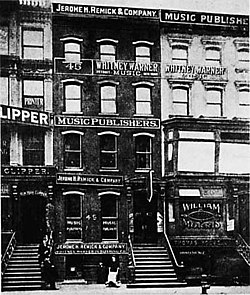
By 1912, the sheet music industry had published three popular blues-like compositions precipitating Tin Pan Alley's adoption of blues elements: 'Baby Seals' Blues' by Baby Franklin Seals, 'Dallas Blues' by Hart Wand, and 'The Memphis Blues' by W.C. Handy.
Image source: Tin Pan Alley
1914
% complete
W.C. Handy's 'Saint Louis Blues' was published in 1914 and exemplifies the AAB pattern that can be heard in some of the first published blues songs, alongside 'Dallas Blues'.
Image source: Saint Louis Blues (song)
1920 - 1929
% complete
In the early 20th century, the blues was considered disreputable, especially as white audiences began listening to the blues during the 1920s, reflecting social tensions around the genre.
1920 - 1929
% complete
A record of blues music as it existed before 1920 can also be found in the recordings of artists such as Lead Belly and Henry Thomas, preserving older folk styles of the genre.
Image source: Lead Belly
1920
% complete
In 1920, vaudeville singer Lucille Hegamin became the second black woman to record blues when she recorded 'The Jazz Me Blues', expanding the presence of black women in early blues recording.
1920
% complete
Mamie Smith, more a vaudeville performer than a blues artist, became the first African American to record a blues song in 1920; her rendition of Perry Bradford's 'Crazy Blues' sold 75,000 copies in its first month.
Image source: Crazy Blues
1923
% complete
Kentucky-born Sylvester Weaver was in 1923 the first to record the slide guitar style, in which a guitar is fretted with a knife blade or the sawed-off neck of a bottle, a technique central to country blues.
Image source: Sylvester Weaver (musician)
1924
% complete
Other recordings of blues that are still available were made in 1924 by Lawrence Gellert, contributing to the documentary record of early blues music.
Image source: Lawrence Gellert
1926 - 1966
% complete
Victoria Spivey, sometimes called Queen Victoria or Za Zu Girl, had a recording career that began in 1926 and spanned forty years, making her a significant figure in classic female blues.
Image source: Victoria Spivey
1928
% complete
Tampa Red and Georgia Tom's 'It's Tight Like That' (1928) is a sly wordplay with the double meaning of being 'tight' with someone, coupled with a more salacious physical familiarity, exemplifying hokum blues.
1948
% complete
Chicago became a center for electric blues from 1948 on, when Muddy Waters recorded his first success, 'I Can't Be Satisfied', helping define the electrified urban blues sound.
1949
% complete
John Lee Hooker's first hit, 'Boogie Chillen', reached number 1 on the R&B charts in 1949, establishing his distinctive boogie style and national prominence.
Image source: Boogie Chillen'
1954
% complete
After Phillips discovered Elvis Presley in 1954, the Sun label turned to the rapidly expanding white audience and started recording mostly rock 'n' roll, shifting away from its blues roster.
Image source: Sun Records
1958
% complete
In England, electric blues took root during a much acclaimed Muddy Waters tour in 1958, inspiring a generation of British musicians who would launch the British blues movement.
Image source: British blues
1960
% complete
Howlin' Wolf, who had worked alongside B.B. King earlier in his career, moved to Chicago in 1960, becoming one of the towering figures of the city's electric blues scene.
Image source: Howlin' Wolf
1963
% complete
In 1963, Amiri Baraka, then known as LeRoi Jones, was the first to write a book on the social history of the blues in Blues People: The Negro Music in White America.
Image source: Blues People
1971
% complete
John Lee Hooker blended his blues style with rock elements and playing with younger white musicians, creating a musical style that can be heard on the 1971 album Endless Boogie.
Image source: Endless Boogie
1972
% complete
During the blues revival of the 1960s and 1970s, acoustic blues artist Taj Mahal and Texas bluesman Lightnin' Hopkins wrote and performed music that figured prominently in the critically acclaimed film Sounder (1972).
Image source: Sounder (film)
1980
% complete
Perhaps the most visible example of the blues style of music in the late 20th century came in 1980, when Dan Aykroyd and John Belushi released the film The Blues Brothers, bringing blues to mass audiences.
Image source: The Blues Brothers (film)
1982 - 1984
% complete
Hill's Down Home Blues (1982) and Little Milton's The Blues is Alright (1984) marked significant successes for soul-blues artists in the early 1980s.
Image source: Z. Z. Hill
1983
% complete
The first Stevie Ray Vaughan recording Texas Flood was released in 1983, and the Texas-based guitarist exploded onto the international stage, revitalizing mainstream interest in blues-rock.
Image source: Texas Flood
1986
% complete
In 1986, the album Strong Persuader announced Robert Cray as a major blues artist, bringing contemporary blues to a wide audience.
Image source: Strong Persuader
1989
% complete
John Lee Hooker's popularity was revived with the album The Healer in 1989, which paired him with younger rock and blues stars and won widespread acclaim.
Image source: The Healer (Sumac album)
1998
% complete
1998 brought a sequel, Blues Brothers 2000, that, while not holding as great a critical and financial success as the original, featured a much larger number of blues artists such as B.B. King.
Image source: Blues Brothers 2000
2001
% complete
Almost 30 years after Sounder, Taj Mahal wrote blues for, and performed a banjo composition claw-hammer style, in the 2001 movie release Songcatcher, focused on preserving the roots music of Appalachia.
Image source: Songcatcher
2003
% complete
In 2003, Martin Scorsese made significant efforts to promote the blues to a larger audience through a major documentary project celebrating the genre.
2006
% complete
Blues guitarist and vocalist Keb' Mo' performed his blues rendition of 'America, the Beautiful' in 2006 to close out the final season of the television series The West Wing.
Image source: Keb' Mo'
2012
% complete
The blues was highlighted in season 2012, episode 1 of In Performance at the White House, entitled 'Red, White and Blues', celebrating the genre at the highest level of public recognition.
2017
% complete
A study of the devil's role in the blues was published in 2017, called Beyond the Crossroads: The Devil & The Blues Tradition, exploring the mythology surrounding blues musicians and the devil.
2022
% complete
A Jazzman's Blues by Tyler Perry (2022) is a film that provides a cinematic reflection of the blues, set against the background of the 1940s Deep South.
Image source: A Jazzman's Blues
2025
% complete
The 2025 vampire horror film Sinners explores the blues genre through a supernatural narrative placed in the 1930s Mississippi Delta, bringing renewed attention to blues history and culture.
Image source: Sinners (2025 film)
Or browse the full history timeline directory, with more than 2,000 topics.
This History of Blues timeline was generated with the help of AI, using information found on the internet.
We work hard to keep these timelines accurate, but mistakes do get through. If you spot one, email us at [email protected] and we'll fix it for future visitors.
Generate yours with AI or build it from scratch, for free.
Export your timeline, add your own events, edit or remove AI-generated events, and much more
No credit card required.
Cancel anytime.
Cancel anytime.
You can create an unlimited number of timelines with up to 10 events on each one, customize how they look, export them to PDF, PNG, PowerPoint, CSV, and Excel, and share them with a link. Paid plans raise the event limit and add features like spreadsheet imports and collaborators.
Yes. You can cancel your subscription from your account page at any time, and you will not be charged again. Your subscription stays active for the rest of the period you already paid for.
Yes. We will email you a reminder before the annual renewal, and we will also email you a receipt.
Yes. You can email us within 15 days of any payment, and we will issue you a full refund.
Check out our pricing docs or send us an email anytime: [email protected].