-
Use Cases
-
Resources
-
Pricing
The Eastern Front, also known as the Great Patriotic War in the Soviet Union, was the largest and deadliest theater of World War II. It began with Nazi Germany's invasion of the Soviet Union in June 1941 and ended with Germany's surrender in May 1945 after brutal battles at Stalingrad, Kursk, and Berlin. More Less
Aug 23, 1939
% complete
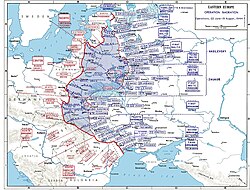
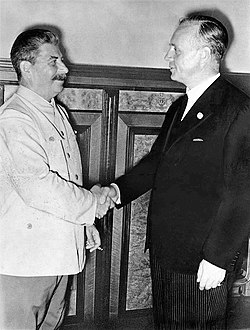
Germany and the Soviet Union signed a non-aggression pact that secretly divided Eastern Europe into spheres of influence, clearing the way for both powers to invade Poland and setting the diplomatic stage for the future Eastern Front.
Image source: Molotov–Ribbentrop Pact
Sep 17, 1939 - Oct 6, 1939
% complete
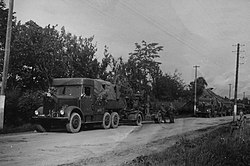
Following the German invasion from the west, the Red Army invaded eastern Poland in accordance with the Molotov-Ribbentrop Pact's secret protocol. Polish resistance collapsed as the country was partitioned between the two occupying powers.
Image source: Soviet invasion of Poland
Nov 30, 1939 - Mar 13, 1940
% complete
The Soviet Union attacked Finland after territorial demands were rejected. Despite overwhelming Soviet numerical superiority, Finnish defenders inflicted heavy losses before being forced to cede territory in the Moscow Peace Treaty.
Image source: Winter War
Jun 22, 1941
% complete
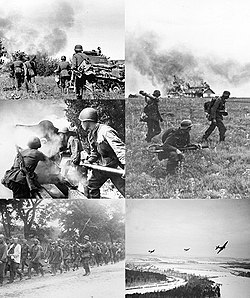
Nazi Germany launched the largest military invasion in history against the Soviet Union along a 2,900-kilometer front with over three million Axis troops. The surprise attack shattered the Nazi-Soviet pact and opened the Eastern Front.
Image source: Operation Barbarossa
Jun 22, 1941 - Jul 3, 1941
% complete
In one of the first major encirclements of Barbarossa, German Army Group Centre trapped and destroyed large Soviet formations around Białystok and Minsk, capturing hundreds of thousands of prisoners and opening the road toward Smolensk.
Jul 10, 1941 - Sep 10, 1941
% complete
German forces captured Smolensk after fierce fighting, inflicting severe losses on Soviet armies defending the approaches to Moscow. The battle delayed the German advance on the capital by several critical weeks.
Image source: Battle of Smolensk (1941)
Aug 23, 1941 - Sep 26, 1941
% complete
The largest single encirclement in history saw German forces trap four Soviet armies around Kiev, capturing over 600,000 soldiers. The catastrophic defeat left the Soviet southwestern front devastated.
Image source: Battle of Kiev (1941)
Sep 8, 1941 - Jan 27, 1944
% complete
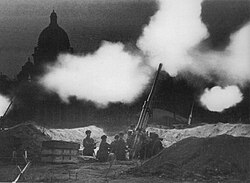
German and Finnish forces encircled Leningrad, beginning one of the longest and most destructive sieges in history. Over two years, roughly a million civilians died, many from starvation during the brutal winter, while the city never surrendered.
Image source: Siege of Leningrad
Oct 2, 1941
% complete
Operation Typhoon, the German drive on Moscow, began with massive armored thrusts that encircled millions of Soviet troops at Vyazma and Bryansk, bringing German panzer spearheads to within sight of the Soviet capital.
Image source: Battle of Moscow
Jun 28, 1942
% complete
Hitler's summer offensive aimed at the oil fields of the Caucasus and the Volga city of Stalingrad. German armies advanced rapidly across the Don steppe, reaching the foothills of the Caucasus mountains by August.
Image source: Case Blue
Apr 19, 1943 - May 16, 1943
% complete
Jewish resistance fighters in the Warsaw Ghetto rose up against deportations to extermination camps. SS forces razed the ghetto block by block, crushing the revolt after nearly a month but demonstrating armed Jewish resistance to the Holocaust.
Image source: Warsaw Ghetto Uprising
Dec 5, 1941 - Jan 7, 1942
% complete
Fresh Siberian divisions transferred after intelligence confirmed Japan would not attack the USSR launched a winter counterattack that threw German forces back from Moscow, inflicting Hitler's first major strategic defeat of the war.
May 12, 1942 - May 28, 1942
% complete
A premature Soviet attempt to recapture Kharkov ended in disaster when German forces counterattacked and encircled the attacking armies, destroying much of the Red Army's offensive strength in the south.
Image source: Second Battle of Kharkov
Feb 19, 1943 - Mar 15, 1943
% complete
Manstein's counterstroke blunted the Soviet advance across the Donets, retaking Kharkov and stabilizing the German southern front, which set the stage for the Kursk salient and the last great German offensive.
Image source: Third Battle of Kharkov
Jun 22, 1944 - Aug 19, 1944
% complete
Launched on the third anniversary of Barbarossa, this colossal Soviet offensive annihilated German Army Group Centre in Belorussia, destroying 28 divisions and advancing over 500 kilometers to the Vistula River.
Image source: Operation Bagration
Jul 13, 1944 - Aug 29, 1944
% complete
Coordinated with Bagration, Soviet forces liberated Lviv and established bridgeheads over the Vistula near Sandomierz, shattering German Army Group North Ukraine and opening western Ukraine to full liberation.
Image source: Lvov-Sandomierz Offensive
Aug 1, 1944 - Oct 2, 1944
% complete
The Polish Home Army rose against German occupation as Soviet forces neared the city, hoping to liberate Warsaw before the Red Army arrived. After 63 days of heroic fighting, the Germans razed the city and the uprising was crushed.
Image source: Warsaw Uprising
Aug 29, 1944 - Oct 28, 1944
% complete
Slovak resistance forces rose against the collaborationist government and German occupation, seizing central Slovakia before German troops suppressed the revolt, though partisan warfare continued until liberation.
Image source: Slovak National Uprising
Aug 23, 1942 - Feb 2, 1943
% complete
After devastating air raids, German Sixth Army fought its way into Stalingrad, where savage urban combat raged for months. The battle consumed entire divisions block by block and became a symbol of the war's brutality.
Image source: Battle of Stalingrad
Nov 19, 1942 - Nov 23, 1942
% complete
A massive Soviet pincer operation struck the weak Romanian flanks north and south of Stalingrad, meeting at Kalach-on-the-Don and trapping roughly 300,000 Axis troops inside an encirclement known as the Kessel.
Image source: Operation Uranus
Feb 2, 1943
% complete
Field Marshal Paulus surrendered the remnants of the Sixth Army, marking the first surrender of a German field army in the war. Roughly 91,000 starving prisoners went into captivity, and Germany's aura of invincibility was shattered.
Jul 5, 1943 - Aug 23, 1943
% complete
The largest tank battle in history saw German forces launch Operation Citadel against a heavily fortified Soviet salient. The failure of the offensive permanently ended German strategic initiative on the Eastern Front.
Image source: Battle of Kursk
Dec 24, 1944 - Feb 13, 1945
% complete
Soviet and Romanian forces encircled the Hungarian capital, where German and Hungarian defenders held out for seven weeks of brutal street fighting before the city fell, opening the road to Vienna.
Image source: Siege of Budapest
Jan 12, 1945 - Feb 3, 1945
% complete
A lightning Soviet offensive advanced from the Vistula to the Oder River in three weeks, covering hundreds of kilometers, liberating Kraków and Warsaw, and placing Red Army forces within 70 kilometers of Berlin.
Image source: Vistula–Oder offensive
Jan 13, 1945 - Apr 9, 1945
% complete
Soviet armies overran East Prussia, the historic heartland of German militarism. After fierce resistance, the fortress city of Königsberg capitulated in April 1945, completing the destruction of German Army Group Centre's remnants.
Image source: East Prussian offensive
Apr 16, 1945
% complete
Over two million Soviet soldiers stormed the Seelow Heights and pushed into the German capital. Hitler committed suicide on April 30 as Soviet troops fought through the ruined city toward the Reichstag.
Image source: Battle of Berlin
Apr 30, 1945 - May 2, 1945
% complete
Soviet soldiers raised the red banner over the burning Reichstag, the iconic image of victory over Nazi Germany. Berlin's garrison surrendered on May 2 after days of desperate house-to-house fighting.
Image source: Raising a Flag over the Reichstag
May 6, 1945 - May 11, 1945
% complete
The final major Soviet offensive of the war in Europe liberated Prague from German occupation days after Germany's surrender, trapping and destroying remaining German Army Group Centre forces.
Image source: Prague offensive
May 8, 1945
% complete
Germany unconditionally surrendered to the Allied powers in Berlin (after a preliminary signing at Reims), ending the war in Europe. May 8 is celebrated as Victory Day in Western nations and May 9 in Russia.
Image source: German Instrument of Surrender
Aug 9, 1945 - Sep 2, 1945
% complete
Honoring Yalta commitments, the USSR declared war on Japan and launched a massive offensive through Manchuria, overwhelming the Japanese Kwantung Army and contributing directly to Japan's decision to surrender.
Image source: Soviet invasion of Manchuria
Or browse the full history timeline directory, with more than 2,000 topics.
This Eastern Front of World War II timeline was generated with the help of AI, using information found on the internet.
We work hard to keep these timelines accurate, but mistakes do get through. If you spot one, email us at [email protected] and we'll fix it for future visitors.
Generate yours with AI or build it from scratch, for free.
Export your timeline, add your own events, edit or remove AI-generated events, and much more
No credit card required.
Cancel anytime.
Cancel anytime.
You can create an unlimited number of timelines with up to 10 events on each one, customize how they look, export them to PDF, PNG, PowerPoint, CSV, and Excel, and share them with a link. Paid plans raise the event limit and add features like spreadsheet imports and collaborators.
Yes. You can cancel your subscription from your account page at any time, and you will not be charged again. Your subscription stays active for the rest of the period you already paid for.
Yes. We will email you a reminder before the annual renewal, and we will also email you a receipt.
Yes. You can email us within 15 days of any payment, and we will issue you a full refund.
Check out our pricing docs or send us an email anytime: [email protected].