
-
Use Cases
-
Resources
-
Pricing
The electric motor converts electrical energy into mechanical motion through magnetic fields. Its development transformed industry, transportation, appliances, and modern technology. More Less
Build a timeline like this one in minutes, for free. Start Yours →
1771
Henry Cavendish discovered the theoretical principle later expressed as Coulomb's law in 1771, although he did not publish his findings. The work provided an important foundation for understanding electric forces.
Image source: Coulomb's law

1785
Charles-Augustin de Coulomb independently discovered and published the inverse-square law describing the force between electric charges. The law became known by his name and helped establish the mathematical framework for electromagnetism.
1799
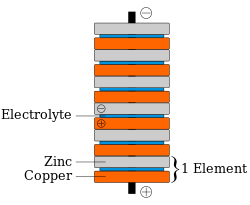
Alessandro Volta invented the electrochemical battery in 1799. The voltaic pile made persistent electric currents available, creating the continuous power source needed for practical experiments with electric motors.
Image source: Voltaic pile
1820
Hans Christian Ørsted discovered that an electric current creates a magnetic field capable of exerting a force on a magnet. This observation connected electricity and magnetism and became a basic principle of electric motors.
Image source: Hans Christian Ørsted

Sep 3, 1821
Michael Faraday gave the first demonstration of continuous electromagnetic rotary motion on 3 September 1821 in the basement of the Royal Institution. The experiment is widely regarded as the first demonstration of an electric motor effect.
Image source: Michael Faraday

1824
François Arago formulated the existence of rotating magnetic fields, later called Arago's rotations. His insight anticipated the operating principle of induction motors.
Image source: Arago's rotations

1827
Hungarian physicist Ányos Jedlik began experimenting with electromagnetic coils in 1827. His work contributed to the development of self-rotating electromagnetic devices and later practical motor components.
Image source: Ányos Jedlik

1827 - 1828
Between 1827 and 1828, Jedlik built a device based on principles similar to those of his electromagnetic self-rotors that was capable of useful work. It represented an early step from demonstration apparatus toward functional motors.
1828
In 1828, Jedlik demonstrated a device containing the three main elements of a practical direct-current motor: a stator, a rotor, and a commutator. Although intended only for teaching, it anticipated the architecture of later DC machines.
1832
English scientist William Sturgeon invented the first commutator DC electric motor capable of turning machinery in 1832. The commutator made continuous rotary operation more practical.
Image source: William Sturgeon

Build a timeline like this one in minutes, for free. Start Yours →
This Electric Motor timeline was generated with the help of AI, using information found on the internet.
We work hard to keep these timelines accurate, but mistakes do get through. If you spot one, email us at [email protected] and we'll fix it for future visitors.
Generate yours with AI or build it from scratch, for free.


