
-
Use Cases
-
Resources
-
Pricing
Emily Dickinson was one of America's greatest poets, born in Amherst, Massachusetts. Though she lived a largely reclusive life and published fewer than a dozen poems during her lifetime, she wrote nearly 1,800 poems that revolutionized American literature with their unconventional style, slant rhyme, and profound exploration of themes like death, immortality, love, and nature. After her death, her sister Lavinia discovered her manuscripts, leading to posthumous publication and Dickinson's eventual recognition as a foundational figure of American poetry. More Less
Dec 10, 1830
% complete
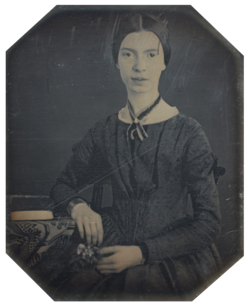
Emily Elizabeth Dickinson was born on December 10, 1830, in Amherst, Massachusetts, to Edward Dickinson, a lawyer and treasurer of Amherst College, and Emily Norcross Dickinson. She would spend nearly her entire life in this New England town, which deeply shaped her worldview and poetry.
Image source: Emily Dickinson
1839 - 1846
% complete
Dickinson assembled an herbarium, a bound album of more than 400 pressed and labeled plants, demonstrating her passion for botany. The collection survives today at Harvard University and reflects the scientific precision evident in her later poetry.
1840
% complete
When Emily was nine, the family moved from the Homestead to a house on North Pleasant Street, where she spent her adolescence. The home overlooked the West Cemetery and the town's main street, giving her a view of Amherst's daily life.
1840 - 1847
% complete
Emily Dickinson studied for seven years at Amherst Academy, a school known for its rigorous curriculum. She excelled in composition and the sciences, particularly botany, and formed close friendships with classmates including Jane Humphrey and Abiah Root.
Sep 1847 - Aug 1848
% complete
Dickinson enrolled at Mount Holyoke Female Seminary in South Hadley, Massachusetts, under founder Mary Lyon. She thrived academically but left after ten months, possibly due to homesickness, religious pressures, or her father's request to return.
1850 - 1851
% complete
During a period of intense evangelical revival in Amherst, many of Dickinson's friends and family professed faith in Christ. Emily alone declined to convert, a decision that marked her as spiritually independent and influenced her lifelong questioning of orthodox belief.
1855
% complete
After Edward Dickinson purchased and restored the Homestead, the family moved back to the house where Emily was born. She would live there for the rest of her life, increasingly withdrawing from public life.
Image source: Emily Dickinson Museum
1864 - 1865
% complete
Dickinson experienced serious eye trouble, likely iritis, and traveled to Cambridge, Massachusetts, for several months of treatment by an ophthalmologist. The condition caused her pain and light sensitivity, and some scholars link it to her growing seclusion.
Jun 16, 1874
% complete
Edward Dickinson, Emily's domineering but beloved father, collapsed and died while in Boston. His death profoundly affected Emily, who wore white in mourning and wrote movingly of her grief in letters and poems.
Image source: Edward Dickinson
1875
% complete
Emily Norcross Dickinson suffered a stroke that left her an invalid. Emily and her sister Lavinia cared for their mother at the Homestead for years, a duty that deepened Emily's domestic confinement.
Image source: Emily Norcross Dickinson
Nov 14, 1882
% complete
After seven years of illness, Dickinson's mother died at the Homestead. Emily's health also began to decline around this time, and she wrote of feeling her 'life closed twice before its close.'
1884 - 1886
% complete
In her final years, Dickinson's health deteriorated, with symptoms suggesting Bright's disease. She became increasingly bedridden, though she continued to write letters and poems until shortly before her death.
1850
% complete
Dickinson met Susan Gilbert, who would marry her brother Austin in 1856. Susan became Emily's closest confidante and most important literary critic, receiving nearly 250 poems from Emily over their decades-long correspondence.
Image source: Susan Huntington Gilbert Dickinson
Apr 1862
% complete
Dickinson wrote to Atlantic Monthly editor Thomas Wentworth Higginson asking if her verse was 'alive.' He advised her to delay publishing, but the two sustained a remarkable correspondence for the rest of her life; he later co-edited her first poetry collection.
Image source: Thomas Wentworth Higginson
1878 - 1884
% complete
Dickinson developed a deep romantic relationship with Otis Phillips Lord, a Salem judge and family friend, after the death of his wife. Their passionate letters, some in her distinctive 'letter-poem' style, reveal late-life emotional intensity.
Oct 5, 1883
% complete
The death of eight-year-old Gib Dickinson, her brother Austin's son, from typhoid devastated Emily, who adored the boy. His loss marked a turning point in her own declining health.
Mar 13, 1884
% complete
Judge Otis Phillips Lord died after a stroke. Dickinson mourned him deeply, writing that his loss left her 'a palsy' and composing elegiac verses about their bond.
Aug 12, 1885
% complete
Helen Hunt Jackson died of cancer, depriving Dickinson of her most ardent literary advocate. Jackson had called Dickinson's poetry the strongest work to appear in America since Whitman.
Image source: Helen Hunt Jackson
1998
% complete
Ellen Louise Hart and Martha Nell Smith published Open Me Carefully, a collection of Dickinson's passionate letters to Susan Dickinson, fueling scholarly debate about the romantic nature of their relationship and reshaping Dickinson biography.
1861
% complete
One of Dickinson's most famous poems, 'Safe in their Alabaster Chambers,' was written in 1861 and shared with Susan Dickinson, who critiqued it. Emily revised it in response, illustrating the important role Susan played in her creative process.
1863
% complete
1863 was Dickinson's most prolific year, during which she composed an estimated 295 poems, including many of her most celebrated works. Her output during the Civil War years, roughly 1861 to 1865, comprised more than half of her total corpus.
Image source: List of Emily Dickinson poems
1876
% complete
The successful author Helen Hunt Jackson, a childhood friend from Amherst, visited Dickinson and became one of the few people to recognize her genius. Jackson persistently urged Emily to publish, even arranging for one poem to appear anonymously in an anthology.
1878
% complete
Helen Hunt Jackson persuaded Dickinson to allow 'Success is counted sweetest' to appear in A Masque of Poets, an anthology published without her name. It was one of the few poems published in her lifetime.
Image source: Success is counted sweetest
1886
% complete
After Emily's death, her sister Lavinia discovered a locked chest containing nearly 1,800 poems in fair copies, many sewn into handmade booklets called fascicles. Lavinia resolved to publish them all, defying Emily's instructions that her papers be burned.
May 15, 1886
% complete
Emily Dickinson died of Bright's disease at age 55 at the Homestead. She was buried in West Cemetery in Amherst. Her funeral service, held in the Homestead library, included her favorite hymn 'I'll praise my Maker while I've breath.'
Nov 1890
% complete
Edited by Thomas Wentworth Higginson and Mabel Loomis Todd, the first volume of Dickinson's poems appeared in 1890. The editors regularized her punctuation and rhyme, but the book was a commercial success and introduced her work to the world.
1891 - 1896
% complete
Mabel Loomis Todd edited additional volumes of Dickinson's poems in 1891 and 1896, along with published letters. These collections further expanded Dickinson's readership, though the editing continued to smooth her unconventional style.
1898 - 1929
% complete
A bitter dispute between Mabel Loomis Todd and Austin Dickinson's family over Austin's affair and the division of Emily's manuscripts led to litigation. Publication of Dickinson's poems was suspended for decades, and Todd retained many manuscripts in her possession.
Image source: Mabel Loomis Todd
1914 - 1932
% complete
Emily's niece Martha Dickinson Bianchi published several volumes of her aunt's poetry, including The Single Hound (1914), Further Poems (1929), and Unpublished Poems (1936, with Alfred Leete Hampson), bringing more of the corpus to light.
1955
% complete
The Poems of Emily Dickinson, edited by Thomas H. Johnson and Theodora Ward, restored Dickinson's original punctuation, capitalization, and line breaks for the first time. This three-volume scholarly edition transformed her reputation and modern understanding of her art.
1998
% complete
R. W. Franklin's three-volume variorum edition, The Poems of Emily Dickinson, presented all 1,789 poems with full textual apparatus, becoming the definitive scholarly reference and cementing Dickinson's place as one of America's greatest poets.
2003
% complete
The Dickinson Homestead and the Evergreens, her brother Austin's house next door, were merged to form the Emily Dickinson Museum. Today the museum welcomes visitors from around the world to explore the poet's life and work.
Or browse the full history timeline directory, with more than 2,000 topics.
This Emily Dickinson timeline was generated with the help of AI, using information found on the internet.
We work hard to keep these timelines accurate, but mistakes do get through. If you spot one, email us at [email protected] and we'll fix it for future visitors.
Generate yours with AI or build it from scratch, for free.
Export your timeline, add your own events, edit or remove AI-generated events, and much more
No credit card required.
Cancel anytime.
Cancel anytime.
You can create an unlimited number of timelines with up to 10 events on each one, customize how they look, export them to PDF, PNG, PowerPoint, CSV, and Excel, and share them with a link. Paid plans raise the event limit and add features like spreadsheet imports and collaborators.
Yes. You can cancel your subscription from your account page at any time, and you will not be charged again. Your subscription stays active for the rest of the period you already paid for.
Yes. We will email you a reminder before the annual renewal, and we will also email you a receipt.
Yes. You can email us within 15 days of any payment, and we will issue you a full refund.
Check out our pricing docs or send us an email anytime: [email protected].