
-
Use Cases
-
Resources
-
Pricing
Wu Zetian (624–705 CE) was the only woman in Chinese history to rule as emperor in her own right. Rising from a low-ranking concubine of Emperor Taizong to empress consort of Gaozong, she eventually declared herself 'Huangdi' (emperor) in 690, founding her own Zhou Dynasty. Her reign was marked by political intrigue but also significant achievements, including expanded civil service examinations, promotion of capable officials regardless of background, agricultural reforms, and territorial expansion. She ruled until 705, when she was forced to abdicate at age 81. More Less
Feb 17, 624
% complete
Wu Zetian was born in 624, likely in Lizhou (modern Guangyuan, Sichuan), to a relatively wealthy family. Her father Wu Shihuo was a timber merchant who had supported the founding of the Tang dynasty and risen to high office under Emperor Gaozu, giving her access to education and court connections.
Image source: Wu Zetian
635
% complete
The death of Wu Zetian's father when she was around eleven left her family vulnerable to the feuds of his sons by a first marriage. She and her mother reportedly endured mistreatment by half-brothers, an experience that may have shaped her later ruthless political style.
638
% complete
Around age fourteen, Wu was taken into the palace of Emperor Taizong of Tang as a low-ranking concubine with the title of cairen. She received the name Wu Mei and became known for her beauty and intelligence, though she never rose high in Taizong's favor.
640
% complete
A famous anecdote holds that Wu impressed Emperor Taizong by declaring she could tame his untamable horse with an iron whip, hammer, and dagger, showing her iron will. Historians debate whether this story reflects fact or later embellishment.
649
% complete
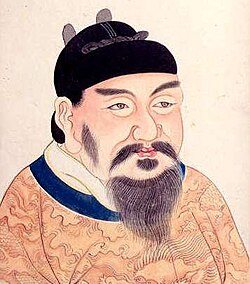
During Taizong's final illness, Wu formed a relationship with the crown prince Li Zhi, who would become Emperor Gaozong. This connection proved decisive for her future, as it gave her a path back into the imperial household after Taizong's death.
Image source: Emperor Gaozong of Tang
649
% complete
Following tradition after Emperor Taizong's death, childless concubines were sent to Buddhist temples. Wu was tonsured at Ganye Temple in Chang'an, where it seemed her political career would end permanently.
Image source: Road to Empress
651
% complete
Empress Wang, seeking a rival to distract Gaozong from his favored Consort Xiao, encouraged the emperor to bring Wu back to the palace. Wu returned while reportedly pregnant, and quickly displaced both rivals in the emperor's affections.
652
% complete
Wu gave birth to her first son, Li Hong, cementing her position in the palace. She would eventually have six children with Gaozong: four sons and two daughters, several of whom became emperors or key political figures.
654
% complete
Wu's infant daughter died shortly after a visit from Empress Wang. Wu accused the empress of strangling the child; traditional histories claim Wu herself smothered her daughter to frame her rival. The scandal destroyed Empress Wang's standing with Gaozong.
657 - 659
% complete
Wu systematically eliminated officials who had opposed her elevation, including the powerful chancellor Zhangsun Wuji, Taizong's brother-in-law. Accused on fabricated treason charges, Zhangsun was exiled and forced to commit suicide around 659, removing the last great obstacle to Wu's power.
Image source: Zhangsun Wuji
660
% complete
Emperor Gaozong began suffering debilitating headaches and vision problems, possibly hypertension or a stroke-like condition. He increasingly entrusted state affairs to Empress Wu, who handled administration competently and grew ever more powerful behind the throne.
664
% complete
Frustrated by Wu's dominance, Gaozong conspired with chancellor Shangguan Yi to depose her. The plot leaked; Shangguan Yi was executed and thereafter Wu attended state audiences behind a screen beside the emperor, effectively co-ruling in what came to be called the 'Two Sages' era.
666
% complete
Wu broke with tradition by personally performing part of the grand Fengshan sacrifice at Mount Tai alongside Gaozong, an unprecedented role for an empress that publicly affirmed her quasi-imperial status and religious authority.
675
% complete
Crown Prince Li Hong, increasingly at odds with his mother over politics and court affairs, died suddenly at age 23. Traditional historians suspected poisoning by Wu, though some modern scholars attribute his death to illness. His death opened the way for less capable heirs.
676 - 680
% complete
Li Xian became crown prince and proved a capable administrator, but rumors spread that he was not Wu's biological son. In 680 he was accused of treason, demoted, exiled, and later forced to commit suicide in 684, eliminating another potential rival to Wu's power.
Image source: Li Xian (actor)
Dec 27, 683
% complete
Emperor Gaozong died after more than three decades of rule, much of it shared with Wu. Their son Li Xian (posthumously Zhongzong) succeeded him, but Wu retained authority as empress dowager and regent, controlling the government outright.
686
% complete
Wu set up bronze boxes across the empire allowing any subject to submit petitions or denounce officials directly to her. This system empowered commoners and fueled networks of informants and secret police that terrorized the aristocracy during her rise to sole power.
686 - 692
% complete
Wu employed notorious interrogators such as Zhou Xing and Lai Junchen, who invented horrific torture methods to extract confessions of treason from nobles and officials. Hundreds of members of the Tang royal family and elite clans were killed or exiled before Wu turned on and eliminated these agents themselves.
688
% complete
Wu completed the Ming Hall, a monumental ceremonial structure in Luoyang symbolizing legitimate universal kingship. Its construction, unprecedented since antiquity, signaled her ambition to claim imperial legitimacy in her own right rather than merely as regent.
Image source: Wei-ming temple
688
% complete
Taking the title Shengmu Shenhuang ('Holy Mother Divine Sovereign'), Wu openly claimed sacred imperial authority. Buddhist texts such as the Great Cloud Sutra were circulated claiming a female bodhisattva would rule as monarch, providing ideological support for her eventual accession.
689 - 704
% complete
Wu commissioned the creation of novel Chinese characters, including one for her own name, to mark the new dynasty's cultural identity. Though the characters fell out of use after her death, they demonstrate her drive to establish legitimacy through innovation.
690 - 705
% complete
Throughout her reign, Wu expanded the examination system and recruited talented men regardless of birth, breaking the aristocratic monopoly on office. She instituted the palace examination and military examinations, cultivating a loyal bureaucracy of scholar-officials that reshaped Tang governance.
Image source: Imperial examination
Oct 16, 690
% complete
On October 16, 690, Wu Zetian deposed her son Ruizong and proclaimed herself emperor of a new dynasty called Zhou, taking the title Shengmu Shenhuang. She remains the only woman in Chinese history to rule as sovereign emperor in her own name.
Image source: Wu Zhou
692
% complete
Under general Wang Xiaojie, Wu's forces defeated the Tibetan Empire and recovered the Four Garrisons of Anxi in Central Asia, restoring Tang influence along the Silk Road. Her reign also saw campaigns against the Khitan and Turks with mixed results, but overall she preserved and extended the empire's frontiers.
Image source: Protectorate General to Pacify the West
697 - 705
% complete
In her old age, Wu favored the young brothers Zhang Yizhi and Zhang Changzong, whose influence at court bred resentment among officials and princes. Their dominance alienated the court elite and helped provoke the coup that ended her reign.
698
% complete
Facing pressure over succession and threats from northern nomads who demanded restoration of the Tang line, Wu recalled her exiled son Li Xian (Zhongzong) from Fangling and named him heir apparent, signaling the eventual return of the Li dynasty.
Image source: Emperor Zhongzong of Tang
Feb 20, 705 - Feb 22, 705
% complete
Chancellors Zhang Jianzhi and Cui Xuanwei led a coup that killed the Zhang brothers and forced the ailing 80-year-old Wu to abdicate. Emperor Zhongzong was restored to the throne, ending the Zhou dynasty and returning power to the Tang line.
Dec 16, 705
% complete
Wu Zetian died at age 81 in the Shangyang Palace in Luoyang. Per her wishes, she was buried with Emperor Gaozong at Qianling Mausoleum, marked by the famous Uncharactered Stele (Wuzi Bei) deliberately left blank for history to judge her.
Or browse the full history timeline directory, with more than 2,000 topics.
This Empress Wu Zetian timeline was generated with the help of AI, using information found on the internet.
We work hard to keep these timelines accurate, but mistakes do get through. If you spot one, email us at [email protected] and we'll fix it for future visitors.
Generate yours with AI or build it from scratch, for free.
Export your timeline, add your own events, edit or remove AI-generated events, and much more
No credit card required.
Cancel anytime.
Cancel anytime.
You can create an unlimited number of timelines with up to 10 events on each one, customize how they look, export them to PDF, PNG, PowerPoint, CSV, and Excel, and share them with a link. Paid plans raise the event limit and add features like spreadsheet imports and collaborators.
Yes. You can cancel your subscription from your account page at any time, and you will not be charged again. Your subscription stays active for the rest of the period you already paid for.
Yes. We will email you a reminder before the annual renewal, and we will also email you a receipt.
Yes. You can email us within 15 days of any payment, and we will issue you a full refund.
Check out our pricing docs or send us an email anytime: [email protected].