-
Use Cases
-
Resources
-
Pricing
Franz Joseph I was Emperor of Austria and later King of Hungary, reigning for nearly 68 years from 1848 until his death in 1916, making him one of the longest-reigning monarchs in European history. His rule spanned the transformation of the Austrian Empire into the Austro-Hungarian dual monarchy and the outbreak of World War I. More Less
Aug 18, 1830
% complete
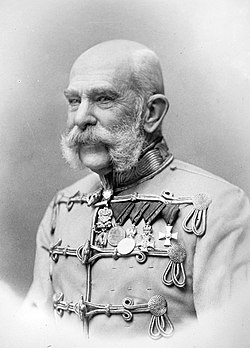
Franz Joseph was born on 18 August 1830 in the Schönbrunn Palace in Vienna as the eldest son of Archduke Franz Karl and Sophie, Princess of Bavaria. His name was chosen to bring back memories of his great-granduncle, Emperor Joseph II, remembered as a modernising reformer.
Image source: Franz Joseph I of Austria
Jul 6, 1832
% complete
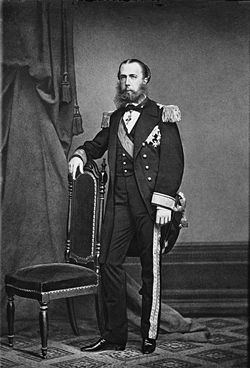
Franz Joseph was soon joined by three younger brothers, the first being Archduke Ferdinand Maximilian (born 1832), who would later become the ill-fated Emperor Maximilian of Mexico.
Image source: Maximilian I of Mexico
1835
% complete
Because his uncle, reigning from 1835 as Emperor Ferdinand, was disabled by seizures, and his father unambitious and retiring, Franz Joseph's mother brought him up as a future emperor, with emphasis on devotion, responsibility and diligence.
Image source: Ferdinand I of Austria
Mar 1848 - Apr 1848
% complete
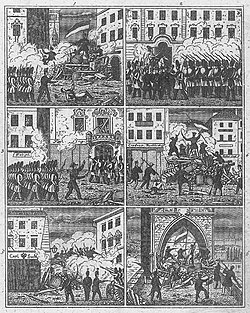
During the Revolutions of 1848, the Austrian Chancellor Prince Klemens von Metternich resigned in March–April 1848, marking a dramatic turning point for the Habsburg monarchy.
Image source: Revolutions of 1848 in the Austrian Empire
Apr 6, 1848
% complete
While he was appointed Governor of Bohemia on 6 April 1848, he never took up the post due to the ongoing revolutionary turmoil.
Dec 2, 1848
% complete
By the abdication of his uncle Ferdinand and the renunciation of his mild-mannered father, Franz Karl, Franz Joseph succeeded as Emperor of Austria at Olmütz on 2 December 1848. He would rule for almost 68 years until his death in 1916.
Jul 25, 1848
% complete
Following Austria's victory over the Italians at Custoza in late July 1848, the court felt it safe to return to Vienna, and Franz Joseph travelled with them.
Image source: Battle of Custoza (1848)
Dec 7, 1848
% complete
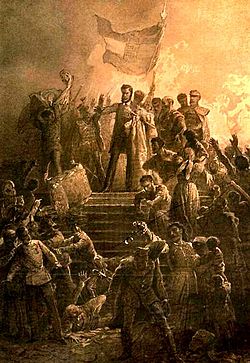
On 7 December 1848, the Diet of Hungary formally refused to acknowledge the title of the new king, declaring that without the knowledge and consent of the diet no one could sit on the Hungarian throne, and called the nation to arms.
Image source: Hungarian Revolution of 1848
Mar 1849
% complete
Franz Joseph almost immediately faced a renewal of fighting in Italy, with King Charles Albert of Sardinia taking advantage of setbacks in Hungary to resume the war in March 1849.
Image source: First Italian War of Independence
Mar 7, 1849
% complete
On 7 March 1849, an imperial proclamation issued in the name of Emperor Francis Joseph declared that the territory of the Kingdom of Hungary would be carved up and administered by five military districts, while Transylvania would be reestablished.
May 21, 1849
% complete
In exchange for Russian military support against the Hungarian revolutionaries, Franz Joseph kissed the hand of the tsar in Warsaw on 21 May 1849. The revolutions in the Austrian territories had been suppressed by 1849, but in Hungary Austrian defeat seemed imminent.
May 1, 1850 - Aug 24, 1866
% complete
From 1 May 1850 to 24 August 1866, Franz Joseph served as president of the German Confederation, holding a position justified on grounds of precedence, as the Habsburgs had generally held the German crown from 1452 to the end of the Holy Roman Empire.
Image source: German Confederation
Jun 24, 1859
% complete
The Second Italian War of Independence in 1859 forced the Austrian Empire to cede most of its claim to Lombardy–Venetia to the Kingdom of Sardinia, following defeats such as Magenta and Solferino.
Image source: Second Italian War of Independence
Jun 14, 1866 - Aug 23, 1866
% complete
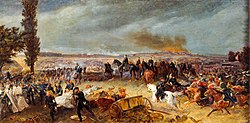
The setbacks continued in the 1860s with defeat in the Austro-Prussian War of 1866. Although Franz Joseph ceded no territory to Prussia, the Peace of Prague settled the German Question in favour of Prussia, preventing German unification under the House of Habsburg.
Image source: Austro-Prussian War
1873 - 1887
% complete
In 1873, two years after the unification of Germany, Franz Joseph entered into the League of Three Emperors with Wilhelm I of Germany and Alexander II of Russia. It lasted intermittently until 1887.
Image source: League of the Three Emperors
1878
% complete
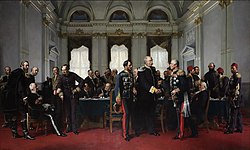
The 1878 Treaty of Berlin overturned earlier agreements and allowed sole Austrian occupation of Bosnia-Herzegovina but did not specify a final disposition of the provinces, an omission that would cause future tensions.
Image source: Congress of Berlin
1881
% complete
The omission regarding Bosnia-Herzegovina was addressed in the Three Emperors' League agreement of 1881, when both Germany and Russia endorsed Austria-Hungary's right to annex Bosnia-Herzegovina.
1897
% complete
By 1897, under a new tsar, the Russian Imperial government had again withdrawn its support for the Austrian annexation of Bosnia-Herzegovina, complicating Balkan diplomacy.
Image source: Bosnian Crisis
1903
% complete
In 1903, Franz Joseph's veto of Jus exclusivae against Cardinal Mariano Rampolla's election to the papacy was transmitted to the Papal conclave by Cardinal Jan Puzyna de Kosielsko.
Image source: 1903 conclave
Oct 6, 1908 - Apr 1909
% complete
Based upon assurances of the Buchlau Conference of 16 September 1908, Franz Joseph signed the proclamation announcing the annexation of Bosnia-Herzegovina on 6 October 1908. The resulting Bosnian Crisis was not resolved until the revision of the Treaty of Berlin in April 1909.
Mar 1849
% complete
Under the guidance of Prince Felix of Schwarzenberg, the new emperor initially pursued a cautious course, granting a constitution in March 1849. However, the constitution was soon suspended and a policy of absolutist centralism established under Interior Minister Alexander Bach.
Image source: March Constitution (Austria)
Dec 2, 1849
% complete
Franz Joseph founded the Order of Franz Joseph on 2 December 1849, one year after his accession to the throne.
Image source: Order of Franz Joseph
Apr 5, 1852
% complete
After Schwarzenberg's premature death in 1852, he could not be replaced by statesmen of equal stature, and the emperor himself effectively took over as prime minister.
Image source: Prince Felix of Schwarzenberg
Feb 26, 1861
% complete
Seeking to borrow money on foreign markets, Franz Joseph relented and issued the February Patent in 1861 which established the Empire's constitution. In 1861, negotiations with Bohemian representatives failed because of unsolved constitutional problems.
Image source: February Patent
1866
% complete
In contrast to his predecessor Ferdinand, Franz Joseph was never crowned separately as king of Bohemia. However, in 1866, a visit of the monarch to Prague following defeat at the Battle of Königgrätz was a huge success, testified by considerable numbers of photographs taken.
1867
% complete
He concluded the Austro-Hungarian Compromise of 1867, which both granted greater autonomy to Hungary and created the dual monarchy of Austria-Hungary, putting an end to 18 years of absolutist rule introduced after the Hungarian Revolution of 1848.
Image source: Austro-Hungarian Compromise of 1867
Sep 26, 1870
% complete
In an Imperial Rescript of 26 September 1870, Franz Joseph referred again to the prestige and glory of the Bohemian Crown and to his intention to hold a coronation, reviving Czech hopes of recognition of separate Bohemian state rights.
Image source: Coronation of the Bohemian monarch
1871
% complete
Under Minister-President Karl Hohenwart in 1871, the government of Cisleithania negotiated a series of fundamental articles spelling out the relationship of the Bohemian Crown to the rest of the Habsburg Monarchy.
1875
% complete
In 1875, Franz Joseph became the principal heir to the substantial fortune left by his predecessor and uncle, Ferdinand I, consisting mainly of the Bohemian estates of the Duke of Reichstadt.
1891 - 1914
% complete
Tomáš Masaryk served in the Reichsrat from 1891 to 1893 in the Young Czech Party and again from 1907 to 1914 in the Realist Party he founded in 1900, though he did not campaign for independence during this period. In Vienna in 1909 he helped Hinko Hinković's defense in a fabricated trial against prominent Croats and Serbs.
Image source: Tomáš Masaryk
Feb 18, 1853
% complete
On 18 February 1853, Franz Joseph survived an assassination attempt by the Hungarian nationalist János Libényi while walking in Vienna.
Image source: János Libényi
Jun 19, 1867
% complete
One of Franz Joseph's personal tragedies was the execution of his younger brother, Emperor Maximilian I of Mexico, in 1867, shot by a firing squad in Querétaro after the collapse of the Second Mexican Empire.
Jan 30, 1889
% complete
The death by suicide of his only son Rudolf in 1889 in the infamous Mayerling Incident was one of the great personal tragedies of Franz Joseph's life, leaving the succession uncertain.
Image source: Mayerling incident
Sep 10, 1898
% complete
His wife Elisabeth was stabbed to death by an Italian anarchist in Geneva in 1898 while on a visit there. Franz Joseph founded the Order of Elizabeth in her memory that same year.
Image source: Empress Elisabeth of Austria
Jun 28, 1914
% complete
On 28 June 1914, Franz Joseph's nephew and heir presumptive Archduke Franz Ferdinand and his wife Sophie were assassinated by Gavrilo Princip during a visit to Sarajevo, resulting in Austria-Hungary's declaration of war against Serbia, an ally of Russia.
Image source: Assassination of Archduke Franz Ferdinand
Apr 24, 1854
% complete
In 1854, Franz Joseph married his first cousin Duchess Elisabeth in Bavaria, known affectionately as Sisi. Their first daughter Sophie died as an infant, and their only son Rudolf died by suicide in 1889 in the infamous Mayerling Incident.
Mar 5, 1855 - May 29, 1857
% complete
Archduchess Sophie of Austria, the eldest child of Franz Joseph and Elisabeth, was born on 5 March 1855 and tragically died as an infant on 29 May 1857.
Image source: Archduchess Sophie of Austria
Jul 12, 1856
% complete
Archduchess Gisela of Austria was born on 12 July 1856. She later married Prince Leopold of Bavaria, her second cousin, in 1873, and lived until 27 July 1932.
Image source: Archduchess Gisela of Austria
Aug 21, 1858 - Jan 30, 1889
% complete
Rudolf, Crown Prince of Austria, was born on 21 August 1858. He married Princess Stephanie of Belgium in 1881 and died by suicide at Mayerling in January 1889.
Image source: Rudolf, Crown Prince of Austria
1885
% complete
In 1885, Franz Joseph met Katharina Schratt, a leading actress of the Vienna stage, and she became his friend and confidante for the remainder of his life.
Image source: Katharina Schratt
Jul 1, 1900
% complete
After long resistance to his nephew's desire to marry Countess Sophie Chotek, despite letters beseeching him throughout 1899, Franz Joseph finally gave his consent in 1900. The couple were married on 1 July 1900 at Reichstadt.
Image source: Sophie, Duchess of Hohenberg
1872
% complete
Franz Joseph founded in 1872 the Franz Joseph University in the city of Cluj-Napoca, at that time part of Austria-Hungary under the name of Kolozsvár.
Image source: Babeș-Bolyai University
1873
% complete
Franz Josef Land in the Russian Arctic was named in his honour in 1873 by the Austro-Hungarian North Pole expedition which first reported finding it.
Image source: Franz Josef Land
Nov 21, 1916
% complete
After ruling his domains for almost 68 years, Franz Joseph died in the Schönbrunn Palace on the evening of 21 November 1916, at the age of 86.
Nov 21, 1916 - Nov 11, 1918
% complete
Franz Joseph was succeeded by his grandnephew Charles I & IV, whom the late emperor had expressed greater confidence in, who reigned until the collapse of the empire following its defeat at the end of the First World War in 1918.
Image source: Charles I of Austria
Or browse the full history timeline directory, with more than 2,000 topics.
This Franz Joseph I timeline was generated with the help of AI, using information found on the internet.
We work hard to keep these timelines accurate, but mistakes do get through. If you spot one, email us at [email protected] and we'll fix it for future visitors.
Generate yours with AI or build it from scratch, for free.
Export your timeline, add your own events, edit or remove AI-generated events, and much more
No credit card required.
Cancel anytime.
Cancel anytime.
You can create an unlimited number of timelines with up to 10 events on each one, customize how they look, export them to PDF, PNG, PowerPoint, CSV, and Excel, and share them with a link. Paid plans raise the event limit and add features like spreadsheet imports and collaborators.
Yes. You can cancel your subscription from your account page at any time, and you will not be charged again. Your subscription stays active for the rest of the period you already paid for.
Yes. We will email you a reminder before the annual renewal, and we will also email you a receipt.
Yes. You can email us within 15 days of any payment, and we will issue you a full refund.
Check out our pricing docs or send us an email anytime: [email protected].