-
Use Cases
-
Resources
-
Pricing
Joseph Stalin was the authoritarian leader of the Soviet Union from the mid-1920s until his death in 1953. Rising from humble Georgian origins, he consolidated power after Lenin's death, transformed the USSR through rapid industrialization and collectivization, and led the nation through World War II. His rule was marked by political purges, forced labor camps (gulags), widespread repression, and millions of deaths, while also establishing the USSR as a global superpower during the early Cold War. More Less
Dec 18, 1878
% complete
Joseph Vissarionovich Stalin was born Ioseb Besarionis dze Jughashvili in Gori, Georgia, then part of the Russian Empire. The son of a cobbler and a washerwoman, he grew up in poverty and suffered a smallpox infection that left his face permanently scarred.
Image source: Joseph Stalin
1894 - 1899
% complete
Stalin enrolled in the Tiflis Theological Seminary on a scholarship, where he was exposed to forbidden Marxist literature. He became increasingly involved in revolutionary activity and left the seminary in 1899, never completing his studies for the priesthood.
Image source: Tbilisi Theological Seminary
1903
% complete
After the Russian Social Democratic Labour Party split, Stalin aligned himself with Vladimir Lenin's Bolshevik faction. He participated in strikes, bank robberies, and underground organizing in the Caucasus, earning a reputation as a committed and ruthless revolutionary operative.
Image source: Bolsheviks
Jun 26, 1907
% complete
Stalin helped organize an armed robbery of a stagecoach carrying money from the Imperial Bank in Tiflis (now Tbilisi). The violent heist killed dozens of people and netted roughly 250,000 rubles for the Bolshevik cause, though it caused friction with other party members.
Image source: 1907 Tiflis bank robbery
1913 - Mar 1917
% complete
Stalin was arrested multiple times by the Okhrana, the Tsarist secret police, and spent several years in internal exile in Siberia, including the remote village of Kureika near the Arctic Circle. He was released after the February Revolution of 1917 toppled the Tsarist regime.
Image source: Shushenskoye
Nov 7, 1917
% complete
The Bolsheviks seized power in Petrograd during the October Revolution, overthrowing the Provisional Government. Stalin played a supporting role in the uprising as a member of the party's Central Committee and later served in Lenin's first Soviet government as People's Commissar for Nationalities.
Image source: October Revolution
Nov 7, 1917 - Jun 16, 1923
% complete
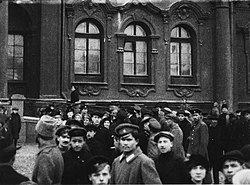
During the Russian Civil War between the Red Army and anti-Bolshevik White forces, Stalin served as a political commissar on several fronts, including at Tsaritsyn (later Stalingrad). His harsh measures and conflicts with military specialists foreshadowed his later authoritarian style of rule.
Image source: Russian Civil War
Apr 3, 1922
% complete
Stalin was appointed General Secretary of the Communist Party of the Soviet Union, a position initially seen as administrative. He used it to build a vast network of loyalists by controlling party appointments, laying the groundwork for his eventual dominance over the Soviet state.
Image source: General Secretary of the Communist Party of the Soviet Union
Jan 21, 1924
% complete
Vladimir Lenin died after a series of strokes, leaving a power vacuum at the top of the Soviet leadership. His Testament had criticized Stalin and recommended his removal, but Stalin managed to suppress the document and outmaneuver his rivals in the ensuing succession struggle.
Image source: Death and state funeral of Vladimir Lenin
1925 - Dec 1927
% complete
Through shifting alliances with Grigory Zinoviev and Lev Kamenev and later with Nikolai Bukharin, Stalin gradually isolated Leon Trotsky and the Left Opposition. By the end of 1927, Trotsky had been expelled from the Communist Party, cementing Stalin's control over the USSR.
Image source: Left Opposition
Oct 1, 1928 - Dec 31, 1932
% complete
Stalin launched the First Five-Year Plan, an ambitious program of forced industrialization aimed at rapidly transforming the agrarian Soviet Union into an industrial powerhouse. Production quotas were set extremely high, and the plan prioritized heavy industry such as steel, coal, and machinery.
Image source: First five-year plan
1929 - 1933
% complete
Stalin forced the consolidation of individual peasant farms into collective farms (kolkhozes), targeting 'kulaks' (wealthier peasants) as class enemies. Millions were deported, imprisoned, or executed, and the policy devastated agricultural output across the country.
Image source: Collectivization in the Soviet Union
1930 - 1953
% complete
Under Stalin, the Gulag system of forced labor camps expanded massively, holding millions of prisoners convicted of political and criminal offenses. Prisoners were used for large construction projects, mining, and logging under brutal conditions, with enormous death tolls from starvation, cold, and overwork.
Image source: Gulag
1932 - 1933
% complete
A catastrophic famine swept through Ukraine, Kazakhstan, and parts of Russia, killing millions. The Holodomor resulted from forced collectivization, excessive grain requisition quotas, and the regime's refusal to provide adequate relief, and is widely regarded as a man-made disaster.
Image source: Holodomor
Dec 1, 1934
% complete
Sergei Kirov, head of the Leningrad party organization and a popular Politburo member, was assassinated in Smolny Institute. Stalin used the murder as a pretext to intensify political repression, launching sweeping purges of real and imagined opponents that culminated in the Great Terror.
Image source: Sergei Kirov
1936 - 1938
% complete
The Great Purge saw Stalin eliminate perceived enemies through show trials, mass executions, and imprisonment. Old Bolsheviks like Zinoviev, Kamenev, and Bukharin were executed, and hundreds of thousands of ordinary citizens perished, creating an atmosphere of pervasive fear.
Image source: Great Purge
Aug 19, 1936 - Mar 13, 1938
% complete
In a series of staged public trials, prominent Bolshevik leaders confessed under coercion to fabricated crimes of treason and sabotage. The trials legitimized the purges, destroyed the remnants of Lenin-era leadership, and demonstrated Stalin's total control over the party and judiciary.
Image source: Moscow trials
May 1937 - 1938
% complete
Stalin purged the Red Army of its most capable commanders, executing Marshal Mikhail Tukhachevsky and thousands of senior officers on charges of treason. The decimation of the officer corps severely weakened Soviet military effectiveness in the early years of World War II.
Aug 23, 1939
% complete
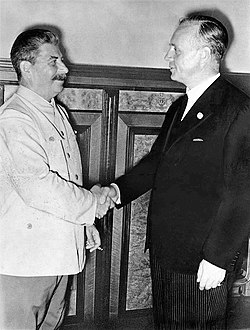
The Soviet Union and Nazi Germany signed a non-aggression pact that included secret protocols dividing Eastern Europe into spheres of influence. The agreement allowed Hitler to invade Poland without fear of Soviet intervention and gave Stalin time to prepare for an inevitable future conflict.
Image source: Molotov–Ribbentrop Pact
Sep 17, 1939 - Oct 6, 1939
% complete
Following Germany's invasion of western Poland, Soviet forces occupied eastern Poland in accordance with the Molotov–Ribbentrop Pact's secret protocols. The joint occupation led to the partition of Poland and the infamous Katyn massacre of Polish officers by the NKVD in 1940.
Image source: Soviet invasion of Poland
Nov 30, 1939 - Mar 13, 1940
% complete
Stalin ordered the invasion of Finland after demanding territorial concessions. Despite overwhelming numerical superiority, Soviet forces suffered humiliating losses against Finnish defenders, exposing weaknesses in the Red Army that had been exacerbated by the purges.
Image source: Winter War
Jun 22, 1941 - Dec 5, 1941
% complete
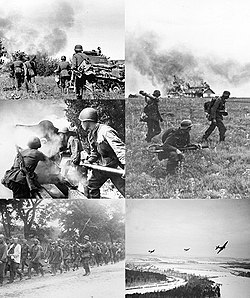
Nazi Germany launched a massive surprise invasion of the Soviet Union, shattering the Molotov–Ribbentrop Pact. Initially paralyzed by the attack, Stalin rallied the nation, moved industry eastward, and assumed supreme command, beginning what Soviets called the Great Patriotic War.
Image source: Operation Barbarossa
Sep 8, 1941 - Jan 27, 1944
% complete
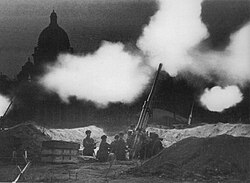
German and Finnish forces besieged Leningrad for nearly 900 days, cutting off supplies and subjecting the city to relentless bombardment. Over a million civilians died from starvation, cold, and shelling, but the city never surrendered, becoming a symbol of Soviet endurance.
Image source: Siege of Leningrad
Oct 2, 1941 - Jan 7, 1942
% complete
German forces came within sight of Moscow before being stopped by determined Soviet resistance, brutal winter conditions, and fresh Siberian divisions. The successful Soviet counteroffensive marked the first major defeat of the Wehrmacht and dispelled the myth of German invincibility.
Image source: Battle of Moscow
Aug 23, 1942 - Feb 2, 1943
% complete
One of the bloodiest battles in history, Stalingrad saw Soviet forces encircle and destroy the German Sixth Army under Field Marshal Paulus. The victory marked the turning point of the war in Europe, after which the Red Army began its long westward advance toward Berlin.
Image source: Battle of Stalingrad
Nov 28, 1943 - Dec 1, 1943
% complete
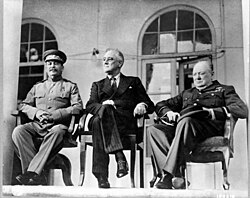
Stalin met with Franklin D. Roosevelt and Winston Churchill in Tehran, the first conference of the 'Big Three.' They agreed on plans for the Allied invasion of Western Europe (D-Day) and discussed postwar arrangements, with Stalin committing to enter the war against Japan after Germany's defeat.
Image source: Tehran Conference
Feb 4, 1945 - Feb 11, 1945
% complete
At Yalta in Crimea, Stalin, Roosevelt, and Churchill negotiated the postwar order, agreeing on the occupation zones for Germany, the creation of the United Nations, and Soviet promises of free elections in Eastern Europe—promises Stalin would soon break as he consolidated communist control over the region.
Image source: Yalta Conference
Apr 16, 1945 - May 2, 1945
% complete
Soviet forces stormed Berlin in one of the war's final major battles, raising the red flag over the Reichstag. Adolf Hitler committed suicide, and Germany surrendered unconditionally on May 8, 1945, marking victory in Europe and confirming the USSR as a dominant European power.
Image source: Battle of Berlin
Aug 8, 1945 - Sep 2, 1945
% complete
Fulfilling his pledge from Tehran and Yalta, Stalin declared war on Japan three months after Germany's defeat. Soviet forces swiftly overran Japanese positions in Manchuria, contributing to Japan's decision to surrender and ending World War II.
Image source: Soviet–Japanese War
Mar 5, 1946
% complete
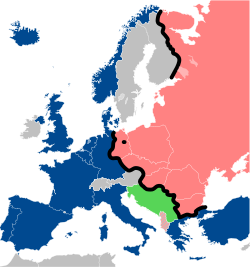
Winston Churchill's 'Iron Curtain' speech marked the onset of the Cold War, as Stalin solidified communist regimes across Eastern Europe behind a political and ideological barrier. Tensions between the Soviet Union and the West defined global politics for the next four decades.
Image source: Iron Curtain
Jun 24, 1948 - May 12, 1949
% complete
Stalin blockaded all ground access to West Berlin in response to Western currency reforms, attempting to force the Allies out of the city. The West responded with the massive Berlin Airlift, supplying the city by air for nearly a year until Stalin lifted the blockade—a major Cold War standoff.
Image source: Berlin Blockade
1949 - 1950
% complete
Stalin orchestrated a purge of Leningrad party officials, including Politburo member Nikolai Voznesensky, accusing them of treason and conspiracy. Several leading figures were executed, demonstrating that even in his final years Stalin remained willing to destroy top-ranking colleagues.
Aug 29, 1949
% complete
The Soviet Union detonated its first atomic bomb, codenamed RDS-1 ('First Lightning'), at the Semipalatinsk test site in Kazakhstan. Accelerated by espionage against the American Manhattan Project, the test ended the US nuclear monopoly and intensified the nuclear arms race of the Cold War.
Image source: RDS-1
Jan 13, 1953 - Apr 3, 1953
% complete
State media announced the arrest of a group of predominantly Jewish doctors accused of plotting to kill Soviet leaders. The fabricated case fueled antisemitic hysteria and suggested preparations for another purge, but it was dropped shortly after Stalin's death in March 1953.
Image source: Doctors' plot
Mar 5, 1953
% complete
Joseph Stalin died at his dacha at Kuntsevo after suffering a stroke, ending nearly three decades of absolute rule over the Soviet Union. His death triggered a power struggle among his successors, led to a partial de-Stalinization under Nikita Khrushchev, and prompted both mourning and quiet relief across the USSR and Eastern Europe.
Image source: Death and state funeral of Joseph Stalin
Or browse the full history timeline directory, with more than 2,000 topics.
This Joseph Stalin timeline was generated with the help of AI, using information found on the internet.
We work hard to keep these timelines accurate, but mistakes do get through. If you spot one, email us at [email protected] and we'll fix it for future visitors.
Generate yours with AI or build it from scratch, for free.
Export your timeline, add your own events, edit or remove AI-generated events, and much more
No credit card required.
Cancel anytime.
Cancel anytime.
You can create an unlimited number of timelines with up to 10 events on each one, customize how they look, export them to PDF, PNG, PowerPoint, CSV, and Excel, and share them with a link. Paid plans raise the event limit and add features like spreadsheet imports and collaborators.
Yes. You can cancel your subscription from your account page at any time, and you will not be charged again. Your subscription stays active for the rest of the period you already paid for.
Yes. We will email you a reminder before the annual renewal, and we will also email you a receipt.
Yes. You can email us within 15 days of any payment, and we will issue you a full refund.
Check out our pricing docs or send us an email anytime: [email protected].