-
Use Cases
-
Resources
-
Pricing
Oct 14, 1890
% complete
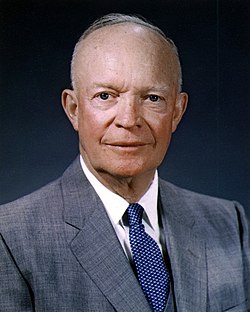
Dwight David Eisenhower was born in Denison, Texas, the third of seven sons of David Jacob Eisenhower and Ida Stover Eisenhower. The family soon moved to Abilene, Kansas, where Dwight spent his boyhood in modest circumstances that shaped his character.
Image source: Dwight D. Eisenhower
Jun 12, 1915
% complete
Eisenhower graduated from the United States Military Academy at West Point, ranking 61st in a class of 164. He was commissioned as a second lieutenant in the infantry and began a long military career.
Image source: United States Military Academy
Jul 1, 1916
% complete
Eisenhower married Marie 'Mamie' Geneva Doud in Denver, Colorado. Their marriage lasted until his death in 1969, and they had two sons, Doud Dwight (who died young) and John Sheldon Doud Eisenhower.
Image source: Mamie Eisenhower
Mar 1918 - Nov 1918
% complete
Eisenhower commanded Camp Colt at Gettysburg, Pennsylvania, the Army's first tank training center. Although he never saw combat in World War I, he developed expertise in armored warfare and earned the Distinguished Service Medal.
Image source: Camp Colt, Pennsylvania
1932 - 1939
% complete
Eisenhower served as senior aide to General Douglas MacArthur, first in Washington, D.C., and later in the Philippines, where he helped develop plans for the defense of the islands. This experience broadened his strategic and diplomatic skills.
Image source: Douglas MacArthur
Sep 29, 1941
% complete
Eisenhower was promoted to brigadier general after impressing Army Chief of Staff George C. Marshall with his organizational abilities during the Louisiana Maneuvers, setting the stage for his rapid rise during World War II.
Jun 25, 1942
% complete
Eisenhower was appointed to command the Allied invasion of North Africa, Operation Torch. In November 1942, Anglo-American forces landed in Morocco and Algeria, marking the first major Allied offensive against Axis forces in the Mediterranean theater.
Image source: Operation Torch
Jul 10, 1943 - Sep 9, 1943
% complete
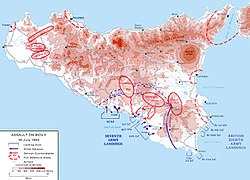
As Commander-in-Chief of Allied Forces in the Mediterranean, Eisenhower directed the invasions of Sicily in July 1943 and mainland Italy in September 1943, leading to the fall of Mussolini's government and Italy's eventual surrender.
Image source: Allied invasion of Sicily
Dec 1943
% complete
Eisenhower was named Supreme Commander of the Allied Expeditionary Force, tasked with planning and executing the invasion of Nazi-occupied Western Europe, the largest amphibious military operation in history.
Image source: Supreme Headquarters Allied Expeditionary Force
Jun 6, 1944
% complete
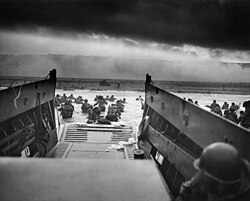
Eisenhower gave the go-ahead for the D-Day invasion of Normandy despite uncertain weather. Over 150,000 Allied troops stormed five beaches, establishing a foothold in France that began the liberation of Western Europe from Nazi occupation.
Image source: Normandy landings
May 7, 1945
% complete
Eisenhower accepted Germany's unconditional surrender at Reims on May 7, 1945, ending the war in Europe. He had ordered his forces to advance rapidly into Germany and had documented Nazi atrocities to prevent future denial.
Image source: German Instrument of Surrender
Nov 19, 1945 - Feb 7, 1948
% complete
Eisenhower succeeded George Marshall as Chief of Staff of the United States Army, overseeing demobilization after World War II and helping shape postwar defense policy amid emerging Cold War tensions with the Soviet Union.
Image source: Chief of Staff of the United States Army
1948
% complete
Eisenhower published his wartime memoir Crusade in Europe, which became a bestseller and was later adapted into an award-winning television series, cementing his status as a national hero.
Image source: Crusade in Europe
Jun 14, 1948 - Jan 19, 1953
% complete
Eisenhower served as president of Columbia University in New York City, though he remained active in national security affairs through informal government advisory roles during the early Cold War.
Image source: Columbia University
Apr 2, 1951 - May 30, 1952
% complete
Eisenhower became the first Supreme Allied Commander Europe of NATO, organizing the alliance's integrated military forces in Western Europe against the perceived threat of Soviet aggression.
Image source: Supreme Allied Commander Atlantic
Mar 28, 1969
% complete
Eisenhower died of congestive heart failure at age 78 in Washington, D.C. He received a full state funeral and was buried in Abilene, Kansas, at the place of his boyhood home, now the Eisenhower Presidential Library.
Image source: Dwight D. Eisenhower
Nov 4, 1952
% complete
Eisenhower, running as a Republican with Richard Nixon as his running mate, defeated Democrat Adlai Stevenson II in a landslide, promising to end the Korean War and campaigning under the slogan 'I Like Ike.'
Image source: 1952 United States presidential election
Jan 20, 1953
% complete
Dwight D. Eisenhower was inaugurated as the 34th president of the United States, becoming the first Republican to hold the office in twenty years and pledging to lead with integrity and purpose.
Image source: First inauguration of Dwight D. Eisenhower
Jul 27, 1953
% complete
Fulfilling a key campaign promise, Eisenhower helped bring about the signing of the Korean Armistice Agreement, ending active hostilities in Korea and dividing the peninsula along the Demilitarized Zone.
Image source: Korean Armistice Agreement
Aug 19, 1953
% complete
The Eisenhower administration authorized a CIA-led coup that overthrew Iranian Prime Minister Mohammad Mossadegh, restoring the Shah to power — a pivotal episode in Cold War interventionism with lasting consequences for U.S.-Iran relations.
Image source: 1953 Iranian coup d'état
Dec 8, 1953
% complete
In a landmark address to the UN General Assembly, Eisenhower proposed sharing peaceful nuclear technology internationally while controlling nuclear weapons, launching the Atoms for Peace program.
Image source: Atoms for Peace
May 17, 1954
% complete
The Supreme Court ruled that racial segregation in public schools was unconstitutional. Though Eisenhower personally disagreed with the ruling's pace, his administration would later be forced to enforce it.
Jun 29, 1956
% complete
Eisenhower signed the Federal Aid Highway Act, creating the Interstate Highway System — one of the largest public works projects in history — inspired partly by his 1919 cross-country convoy experience and observations of the German Autobahn.
Image source: Federal-Aid Highway Act of 1956
Nov 6, 1956
% complete
Eisenhower won reelection decisively, carrying 41 states against Adlai Stevenson despite having suffered a heart attack the previous year, demonstrating his enduring personal popularity.
Image source: 1956 United States presidential election
Sep 9, 1957
% complete
Eisenhower signed the first federal civil rights legislation since Reconstruction, establishing the Civil Rights Division of the Justice Department and the Commission on Civil Rights to protect voting rights.
Sep 24, 1957
% complete
Eisenhower dispatched the 101st Airborne Division to Little Rock, Arkansas, to enforce court-ordered desegregation and protect the Little Rock Nine, the first time federal troops protected African American civil rights since Reconstruction.
Image source: Little Rock Nine
Oct 1, 1958
% complete
After the Soviet launch of Sputnik in October 1957 shocked Americans, Eisenhower signed legislation creating NASA, launching the space race and expanding federal investment in science education through the National Defense Education Act.
Image source: NASA
Jan 3, 1959
% complete
Eisenhower signed the Alaska Statehood Act, making Alaska the 49th state. Hawaii followed later that year, completing the fifty-state union.
May 1, 1960
% complete
The Soviet Union shot down an American U-2 reconnaissance pilot Francis Gary Powers over its territory. Eisenhower initially denied knowledge but eventually acknowledged the program, causing the collapse of the Paris summit and straining superpower relations.
Image source: 1960 U-2 incident
Jan 17, 1961
% complete
In his televised farewell address, Eisenhower famously warned Americans about the growing power of the 'military-industrial complex,' urging vigilance so that liberty and democracy would not be endangered by unchecked defense spending.
Image source: Eisenhower's farewell address
Jan 20, 1961
% complete
After eight years in office, Eisenhower handed power to John F. Kennedy, retiring to his farm at Gettysburg, Pennsylvania, after guiding the nation through two terms marked by peace and prosperity.
Image source: Inauguration of John F. Kennedy
Or browse the full history timeline directory, with more than 2,000 topics.
This Dwight D. Eisenhower timeline was generated with the help of AI, using information found on the internet.
We work hard to keep these timelines accurate, but mistakes do get through. If you spot one, email us at [email protected] and we'll fix it for future visitors.
Generate yours with AI or build it from scratch, for free.
Export your timeline, add your own events, edit or remove AI-generated events, and much more
No credit card required.
Cancel anytime.
Cancel anytime.
You can create an unlimited number of timelines with up to 10 events on each one, customize how they look, export them to PDF, PNG, PowerPoint, CSV, and Excel, and share them with a link. Paid plans raise the event limit and add features like spreadsheet imports and collaborators.
Yes. You can cancel your subscription from your account page at any time, and you will not be charged again. Your subscription stays active for the rest of the period you already paid for.
Yes. We will email you a reminder before the annual renewal, and we will also email you a receipt.
Yes. You can email us within 15 days of any payment, and we will issue you a full refund.
Check out our pricing docs or send us an email anytime: [email protected].