-
Use Cases
-
Resources
-
Pricing
Harry S. Truman (1884–1972) was the 33rd President of the United States, serving from 1945 to 1953. Rising from a Missouri farm background and modest political career, he became president upon Franklin D. Roosevelt's death and made momentous decisions including authorizing the atomic bombings of Japan, implementing the Marshall Plan, founding NATO, and desegregating the U.S. military. His presidency shaped the post-World War II world and defined early Cold War American foreign policy. More Less
Apr 1917 - May 1919
% complete
Truman rejoined the Missouri National Guard when the United States entered World War I and was commissioned as a lieutenant, later rising to captain. He commanded Battery D of the 129th Field Artillery in France, earning a reputation for calm leadership under fire during the Meuse-Argonne offensive.
Jun 28, 1919
% complete
Truman married Elizabeth Virginia 'Bess' Wallace, his childhood sweetheart from Independence, Missouri, on June 28, 1919. The couple settled in Independence and had one daughter, Margaret, born in 1924. Bess remained Truman's closest confidante throughout his political career.
Image source: Bess Truman
Nov 1919 - 1922
% complete
After returning from the war, Truman opened a men's clothing store with army friend Eddie Jacobson in Kansas City. The business prospered initially but collapsed during the recession of 1921–22, leaving Truman with significant debts that he spent years repaying, enhancing his reputation for integrity.
Nov 7, 1922
% complete
With backing from Kansas City political boss Tom Pendergast, Truman was elected as an administrative judge of Jackson County, overseeing county finances and public works. He lost re-election in 1924 but returned to office in 1926 as presiding judge, serving until 1934 and building a reputation for honest administration.
Nov 7, 1934
% complete
Truman won election to the U.S. Senate from Missouri in 1934, again with Pendergast's support. Despite initial skepticism about him as 'the senator from Pendergast,' he proved himself a diligent New Deal supporter and earned respect for his work ethic and honesty.
Image source: Harry S. Truman
Mar 1941 - 1944
% complete
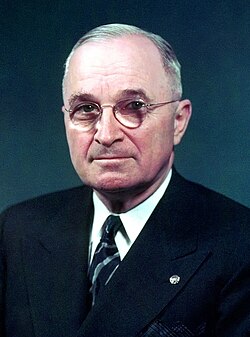
As chairman of the Special Committee to Investigate the National Defense Program, known as the Truman Committee, Truman exposed waste and fraud in defense contracting. His work saved billions of dollars and made him a national figure, positioning him for higher office.
Image source: Truman Committee
Jul 21, 1944
% complete
At the Democratic National Convention in Chicago, party leaders chose Truman as vice president on Roosevelt's fourth-term ticket, replacing Henry A. Wallace. The Roosevelt-Truman pair won decisively in November 1944 against Republican Thomas E. Dewey.
Image source: 1944 Democratic Party presidential primaries
Apr 12, 1945
% complete
Franklin D. Roosevelt died suddenly on April 12, 1945, making Truman the 33rd president of the United States. Having been kept largely uninformed about major wartime decisions, including the atomic bomb project, Truman faced enormous challenges: ending the war in Europe and Asia and shaping the postwar world.
Image source: First inauguration of Harry S. Truman
May 8, 1945
% complete
Less than a month into Truman's presidency, Nazi Germany surrendered unconditionally, marking Victory in Europe Day. Truman proclaimed May 8 as V-E Day, celebrating the Allied victory while warning that much fighting remained in the Pacific theater.
Image source: German Instrument of Surrender
Jul 17, 1945 - Aug 2, 1945
% complete
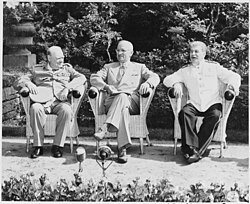
Truman met Soviet leader Joseph Stalin and British leaders Winston Churchill and Clement Attlee at Potsdam, Germany, to negotiate terms for postwar Europe. During the conference, Truman informed Stalin of the successful atomic bomb test, and the Allies issued demands for Japan's surrender.
Image source: Potsdam Conference
Aug 6, 1945
% complete
Truman authorized the use of the atomic bomb against Japan. The Enola Gay dropped the bomb 'Little Boy' on Hiroshima, killing tens of thousands instantly. Truman defended the decision as necessary to end the war quickly and avoid a costly invasion of Japan.
Image source: Atomic bombings of Hiroshima and Nagasaki
Aug 9, 1945 - Sep 2, 1945
% complete
A second atomic bomb destroyed Nagasaki on August 9, and Japan announced its surrender on August 15, formally signing the instrument of surrender aboard the USS Missouri on September 2, 1945. World War II ended, with Truman presiding over America's emergence as a global superpower.
Image source: Surrender of Japan
Jul 28, 1945
% complete
The U.S. Senate ratified the United Nations Charter, which had been signed in San Francisco in June 1945. Truman strongly supported the new international organization as a cornerstone of American foreign policy aimed at preserving peace through collective security.
Image source: United Nations
Sep 6, 1945
% complete
In a message to Congress, Truman outlined plans for reconversion to a peacetime economy, including full employment legislation, an expanded Social Security system, and public works programs—early elements of what would become his Fair Deal agenda.
Mar 5, 1946
% complete
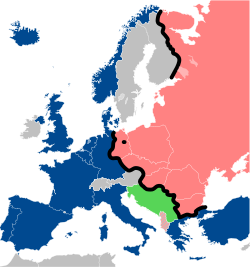
Former British prime minister Winston Churchill, speaking at Westminster College in Fulton, Missouri, with Truman present, warned that an 'iron curtain' had descended across Europe. The speech signaled growing East-West tensions and helped frame the emerging Cold War.
Image source: Iron Curtain
Mar 12, 1947
% complete
Truman asked Congress for aid to Greece and Turkey, declaring that the United States would support free peoples resisting subjugation by armed minorities or outside pressures. The Truman Doctrine marked the formal start of the American policy of containment of communism.
Image source: Truman Doctrine
Jun 5, 1947
% complete
Secretary of State George C. Marshall unveiled a plan to provide massive economic aid to rebuild Western Europe. Congress approved it in 1948, and the Marshall Plan channeled over $13 billion to European nations, bolstering their economies and containing communist influence.
Image source: Marshall Plan
May 14, 1948
% complete
Minutes after Israel declared independence, Truman extended de facto recognition of the new Jewish state, overriding objections from some advisors. His decision reflected humanitarian concern after the Holocaust and had lasting significance for Middle East diplomacy.
Image source: International recognition of Israel
Jun 24, 1948 - May 12, 1949
% complete
The Soviet Union blockaded West Berlin, cutting off land access to the city. Truman refused to withdraw and ordered the Berlin Airlift, in which American and British aircraft supplied the city for nearly a year until the Soviets lifted the blockade—a major Cold War victory without firing a shot.
Image source: Berlin Blockade
Jul 26, 1948
% complete
Truman issued Executive Order 9981, abolishing racial segregation in the U.S. armed forces. It was a landmark civil rights achievement, driven partly by his moral convictions and political need to appeal to Black voters, and it paved the way for eventual integration of the military.
Image source: Executive Order 9981
Nov 2, 1948
% complete
Defying polls predicting defeat, Truman campaigned aggressively against a 'do-nothing' Congress and defeated Thomas E. Dewey along with splinter candidates Henry Wallace and Strom Thurmond. His famous 'Dewey Defeats Truman' moment became one of the greatest upsets in American political history.
Image source: 1948 United States presidential election
Jan 5, 1949
% complete
In his 1949 State of the Union address, Truman unveiled the Fair Deal, expanding the New Deal with proposals for national health insurance, federal aid to education, increased minimum wage, public housing, and agricultural reform. Some measures passed, though conservative opposition blocked others.
Image source: Fair Deal
Apr 4, 1949
% complete
The United States, Canada, and ten European nations signed the North Atlantic Treaty in Washington, establishing NATO and committing members to mutual defense. Truman championed the alliance as central to containing Soviet power, marking America's first peacetime military alliance since 1800.
Image source: NATO
Aug 29, 1949
% complete
The Soviet Union detonated its first atomic bomb, ending the American nuclear monopoly years earlier than expected. In response, Truman accelerated U.S. weapons programs and approved development of the hydrogen bomb in January 1950, intensifying the nuclear arms race.
Image source: RDS-1
Jun 25, 1950
% complete
North Korean forces invaded South Korea across the 38th parallel. Truman committed U.S. forces under United Nations auspices within days, framing intervention as a test of collective security. The war lasted three years and defined his final term in office.
Image source: Korean War
Apr 11, 1951
% complete
After General Douglas MacArthur publicly demanded expansion of the Korean War into China, Truman removed him from command to preserve civilian control of the military and limit the war. The decision was hugely controversial but affirmed constitutional principles of civilian authority.
Image source: Relief of Douglas MacArthur
Mar 20, 1952
% complete
Weary after seven turbulent years and facing low approval ratings amid Korea and corruption scandals, Truman announced he would not run for another term. Adlai Stevenson became the Democratic nominee, losing to Dwight D. Eisenhower in November 1952.
Image source: 1952 United States presidential election
Jan 20, 1953
% complete
Truman attended Eisenhower's inauguration and returned to Independence, Missouri, where he lived modestly, wrote his memoirs, and worked to establish his presidential library. His reputation, once low, gradually rose as historians reassessed his decisive leadership during pivotal times.
Jul 6, 1957
% complete
The Harry S. Truman Presidential Library and Museum opened in Independence, Missouri, housing his papers and serving as a center for scholarship on his presidency. Truman maintained an active presence there, meeting visitors and scholars well into his retirement.
Image source: Harry S. Truman Presidential Library and Museum
Dec 26, 1972
% complete
Harry S. Truman died on December 26, 1972, at Research Medical Center in Kansas City, Missouri, at age 88. He was buried beside his wife Bess at the Truman Library. By the time of his death, public esteem for the plain-spoken president who confronted communism and desegregated the military had grown enormously.
Image source: Harry S. Truman
Or browse the full history timeline directory, with more than 2,000 topics.
This Harry S. Truman timeline was generated with the help of AI, using information found on the internet.
We work hard to keep these timelines accurate, but mistakes do get through. If you spot one, email us at [email protected] and we'll fix it for future visitors.
Generate yours with AI or build it from scratch, for free.
Export your timeline, add your own events, edit or remove AI-generated events, and much more
No credit card required.
Cancel anytime.
Cancel anytime.
You can create an unlimited number of timelines with up to 10 events on each one, customize how they look, export them to PDF, PNG, PowerPoint, CSV, and Excel, and share them with a link. Paid plans raise the event limit and add features like spreadsheet imports and collaborators.
Yes. You can cancel your subscription from your account page at any time, and you will not be charged again. Your subscription stays active for the rest of the period you already paid for.
Yes. We will email you a reminder before the annual renewal, and we will also email you a receipt.
Yes. You can email us within 15 days of any payment, and we will issue you a full refund.
Check out our pricing docs or send us an email anytime: [email protected].