-
Use Cases
-
Resources
-
Pricing
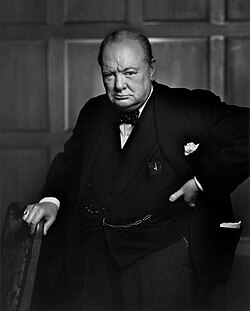
Winston Churchill (1874–1965) was a British statesman, army officer, and writer who served as Prime Minister of the United Kingdom twice, most famously leading Britain through World War II. Known for his powerful oratory and unwavering resolve, he remains one of the most influential figures in modern British history. More Less
Nov 30, 1874
% complete
Winston Leonard Spencer Churchill was born at Blenheim Palace in Oxfordshire, England, to Lord Randolph Churchill, a prominent aristocrat and politician, and Jennie Jerome, an American socialite. His birth into one of Britain's most distinguished families set the stage for a remarkable life in politics, military service, and literature.
Image source: Winston Churchill
Apr 1888 - 1893
% complete
Churchill attended Harrow School from 1888 to 1893. Though he was not a standout student academically, he excelled in English and history and developed his love of language, which would later define his career as a writer and orator.
Image source: Harrow School
Dec 1894
% complete
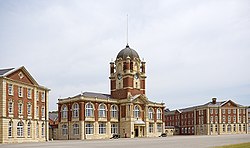
Churchill graduated eighth out of 150 cadets from the Royal Military Academy Sandhurst in December 1894, earning a commission as a second lieutenant in the 4th Queen's Own Hussars, launching his military career.
Image source: Royal Military Academy Sandhurst
1898
% complete
Churchill served as both a soldier and war correspondent during the Mahdist War in Sudan, participating in one of the last great cavalry charges by the British Army at the Battle of Omdurman and publishing accounts of his experiences that built his public profile.
Image source: Mahdist War
Nov 1899 - Dec 1899
% complete
While covering the Second Boer War as a correspondent for The Morning Post, Churchill was captured by Boer forces after an ambush on an armored train. He famously escaped from a prisoner-of-war camp in Pretoria, becoming a national hero upon his return to British lines.
Image source: Second Boer War
1900
% complete
Churchill won election to Parliament in October 1900 as the Conservative MP for Oldham, beginning a parliamentary career that would span more than six decades and see him serve under numerous prime ministers.
Image source: Oldham East and Saddleworth
1904
% complete
In 1904, Churchill defected from the Conservative Party to join the Liberals over his support for free trade, a bold political move that initially damaged his reputation but ultimately accelerated his rise through government ranks.
Image source: Liberal Party (UK)
Feb 1906 - Apr 1908
% complete
Churchill became President of the Board of Trade at age 31, introducing important social reforms including labor exchanges and unemployment insurance, marking him as a rising star of British progressivism.
Image source: President of the Board of Trade
Sep 12, 1908
% complete
Churchill married Clementine Hozier at St Margaret's Church in Westminster. Their marriage would endure for nearly six decades, with Clementine serving as his closest advisor and steadfast companion throughout his tumultuous career.
Image source: Clementine Churchill
1910 - 1911
% complete
As Home Secretary, Churchill oversaw significant reforms including prison improvements, but also faced controversy for his role in responding to labor unrest, including the Tonypandy riots and the Sidney Street siege.
Image source: Home Secretary
Oct 1911 - May 1915
% complete
Churchill became First Lord of the Admiralty, modernizing the Royal Navy by converting its fleet from coal to oil power and preparing it for war. His tenure was marked by vigorous naval expansion ahead of World War I.
Image source: First Lord of the Admiralty
Nov 1915
% complete
The disastrous Gallipoli campaign, which Churchill had championed as First Lord of the Admiralty, resulted in heavy Allied casualties and failure. He took responsibility, resigned from government, and even briefly commanded troops on the Western Front.
Image source: Gallipoli campaign
Jan 1916 - May 1916
% complete
After leaving government, Churchill rejoined the army and commanded the 6th Battalion of the Royal Scots Fusiliers on the Western Front in France, experiencing trench warfare firsthand before returning to London.
Image source: Western Front (World War I)
1924
% complete
After years as a Liberal, Churchill formally returned to the Conservatives, winning the seat of Epping in 1924 and being appointed Chancellor of the Exchequer by Stanley Baldwin.
1925
% complete
As Chancellor of the Exchequer, Churchill restored Britain to the gold standard at pre-war parity, a decision widely blamed for economic stagnation and contributing to the conditions that led to the 1926 General Strike.
Image source: 1926 United Kingdom general strike
Oct 1930
% complete
During the politically lean 'wilderness years,' Churchill published My Early Life, a memoir of his youth and early career that showcased his literary talent and became a popular classic.
Image source: My Early Life
1933 - 1939
% complete
Out of office during the wilderness years, Churchill persistently warned against Hitler's rearmament of Germany and criticized the policy of appeasement, including opposing the Munich Agreement, positioning himself as the leading voice against Nazi aggression.
Image source: Appeasement
Sep 3, 1939
% complete
On the day Britain declared war on Germany, Chamberlain appointed Churchill back to his old post of First Lord of the Admiralty. The Navy signaled his return with the famous message: 'Winston is back.'
May 10, 1940
% complete
With the German invasion of France underway, Churchill replaced Neville Chamberlain as Prime Minister. That same day he formed a coalition government, declaring 'I have nothing to offer but blood, toil, tears and sweat' in his first speech to Parliament.
Image source: Churchill war ministry
Jun 4, 1940
% complete
Following the Dunkirk evacuation, Churchill delivered one of history's most stirring orations, vowing that Britain would fight on land, sea, and air and never surrender, rallying the nation during its darkest hour.
Jun 18, 1940
% complete
Addressing the House of Commons as France fell to Nazi Germany, Churchill declared that the coming Battle of Britain would be remembered as Britain's 'finest hour,' preparing the nation for the aerial assault to come.
Jul 10, 1940 - Oct 31, 1940
% complete
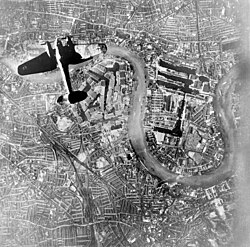
During the Luftwaffe's assault on Britain, Churchill's leadership and morale-boosting broadcasts sustained the nation. He honored RAF pilots with the immortal words: 'Never was so much owed by so many to so few.'
Image source: Battle of Britain
Aug 14, 1941
% complete
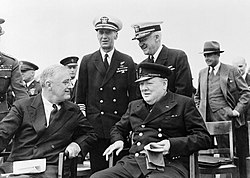
Meeting aboard warships off Newfoundland, Churchill and Roosevelt agreed on the Atlantic Charter, outlining shared principles for the post-war world, including self-determination and free trade, laying groundwork for the United Nations.
Image source: Atlantic Charter
Aug 15, 1945
% complete
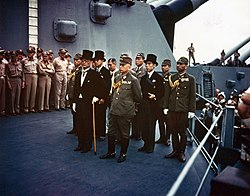
Japan's surrender brought World War II to an end. Churchill celebrated V-J Day with massive crowds in London, though his wartime premiership was nearing its end as voters prepared to decide his political fate.
Image source: Victory over Japan Day
Jul 26, 1945
% complete
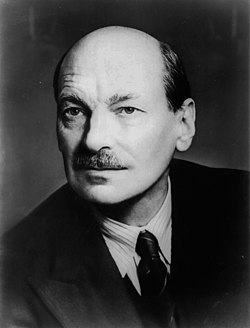
Despite his wartime leadership, Churchill's Conservative Party suffered a landslide defeat to Clement Attlee's Labour Party. The result shocked the world, but Churchill remained leader of the opposition.
Image source: 1945 United Kingdom general election
Mar 5, 1946
% complete
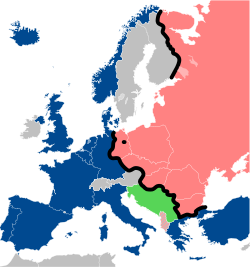
At Fulton, Missouri, Churchill declared that 'an iron curtain has descended across the Continent,' coining the phrase that defined the Cold War division of Europe and signaling his role as a global statesman.
Image source: Iron Curtain
1948 - 1953
% complete
Churchill published his monumental six-volume history of World War II, which combined personal narrative and official documents, earned critical acclaim, and contributed significantly to his later Nobel Prize.
Image source: The Second World War (book series)
Oct 26, 1951 - Apr 6, 1955
% complete
At age 76, Churchill returned to power after the Conservatives won the 1951 election. During his peacetime premiership, he oversaw the development of Britain's hydrogen bomb and pursued diplomacy with the Soviet Union.
Image source: Third Churchill ministry
Oct 15, 1953
% complete
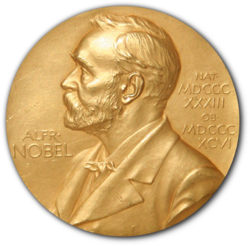
Churchill received the Nobel Prize in Literature for his mastery of historical and biographical writing and his brilliant oratory in defending human values, cementing his reputation as one of the great writers-statesmen of history.
Image source: Nobel Prize in Literature
Apr 5, 1955
% complete
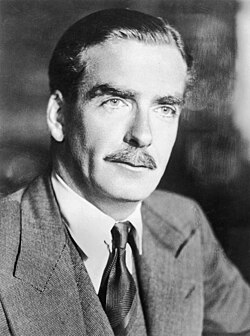
Suffering declining health and several strokes, Churchill resigned as Prime Minister, handing power to Anthony Eden. Queen Elizabeth II offered him a dukedom, which he declined, remaining in Parliament until 1964.
Image source: Anthony Eden
Jan 24, 1965
% complete
Churchill died at his London home at age 90, exactly seventy years after his father's death. He was given a grand state funeral, one of the largest in history, attended by leaders from around the world, and buried at Bladon near Blenheim Palace.
Image source: Death and state funeral of Winston Churchill
Or browse the full history timeline directory, with more than 2,000 topics.
This Winston Churchill timeline was generated with the help of AI, using information found on the internet.
We work hard to keep these timelines accurate, but mistakes do get through. If you spot one, email us at [email protected] and we'll fix it for future visitors.
Generate yours with AI or build it from scratch, for free.
Export your timeline, add your own events, edit or remove AI-generated events, and much more
No credit card required.
Cancel anytime.
Cancel anytime.
You can create an unlimited number of timelines with up to 10 events on each one, customize how they look, export them to PDF, PNG, PowerPoint, CSV, and Excel, and share them with a link. Paid plans raise the event limit and add features like spreadsheet imports and collaborators.
Yes. You can cancel your subscription from your account page at any time, and you will not be charged again. Your subscription stays active for the rest of the period you already paid for.
Yes. We will email you a reminder before the annual renewal, and we will also email you a receipt.
Yes. You can email us within 15 days of any payment, and we will issue you a full refund.
Check out our pricing docs or send us an email anytime: [email protected].