-
Use Cases
-
Resources
-
Pricing
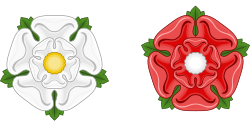
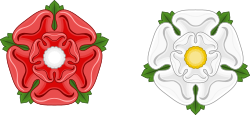
The Wars of the Roses were a series of civil wars fought in England between 1455 and 1487, primarily between two rival branches of the royal Plantagenet dynasty: the House of Lancaster, symbolized by a red rose, and the House of York, symbolized by a white rose. The conflict arose from disputes over succession to the English throne amid weak leadership under Henry VI. Key battles included St Albans, Towton, Barnet, Tewkesbury, and Bosworth Field. The wars ended when Henry Tudor defeated Richard III at Bosworth in 1485 and married Elizabeth of York, uniting the two houses and founding the Tudor dynasty. More Less
Aug 31, 1422
% complete
The death of the warrior king Henry V left his infant son Henry VI on the throne of England. The loss of strong leadership, combined with ongoing setbacks in the Hundred Years' War, created a power vacuum among the nobility that would eventually fuel the dynastic conflict between Lancaster and York.
Image source: Henry V of England
Nov 5, 1422
% complete
With Henry VI less than a year old, his uncles John, Duke of Bedford, and Humphrey, Duke of Gloucester, along with Cardinal Beaufort, governed England and France in his name. This long minority weakened royal authority and encouraged factional rivalry at court.
Image source: Regency government, 1422–1437
Apr 23, 1445
% complete
Henry VI married Margaret of Anjou as part of an unpopular peace settlement with France that ceded Maine. Margaret became a formidable political figure and fierce defender of Lancastrian interests against the growing power of Richard, Duke of York.
Image source: Margaret of Anjou
May 1450 - Jul 12, 1450
% complete
A popular uprising led by Jack Cade marched on London demanding reforms and protesting corruption and military failures under Henry VI. Though suppressed, the rebellion exposed deep discontent with Lancastrian rule and the king's unpopular advisors.
Image source: Jack Cade's Rebellion
Aug 1450
% complete
The final collapse of English rule in Normandy, culminating in the fall of Rouen, discredited the Lancastrian government. Public anger over military failure and misgovernment strengthened calls for reform led by Richard, Duke of York.
Oct 12, 1459
% complete
The Yorkist lords abandoned their positions when many of their soldiers refused to fight the king himself. York fled to Ireland while Salisbury, Warwick, and Edward escaped to Calais, leaving the Lancastrians seemingly triumphant.
Image source: Rout of Ludford Bridge
Nov 20, 1459
% complete
A Lancastrian-dominated parliament at Coventry passed acts of attainder disinheriting the Yorkist leaders of their lands and titles. This extreme measure pushed the Yorkists toward open rebellion, since they had little left to lose.
Image source: Parliament of Devils
Dec 30, 1460
% complete
Lancastrian forces ambushed and destroyed Richard of York's army near Sandal Castle. York himself was killed in battle or executed afterward, along with his son Edmund, Earl of Rutland. His eighteen-year-old son Edward now inherited the Yorkist claim to the throne.
Image source: Battle of Wakefield
Feb 17, 1461
% complete
Queen Margaret's northern army defeated Warwick and recaptured the mentally unstable King Henry VI, who had been found sitting under a tree during the fighting. Despite victory, London refused to admit the Lancastrian army, fearing plunder.
Image source: Second Battle of St Albans
Oct 3, 1470 - Apr 11, 1471
% complete
Warwick invaded England with French backing, forcing Edward IV to flee to Burgundy. Henry VI was restored to the throne in what became known as the Readeption, though real power lay with Warwick, and the restored regime proved weak and unstable.
Image source: Readeption of Henry VI
Dec 1470
% complete
Prince Edward of Westminster, Henry VI's only son, married Anne Neville to seal the Warwick-Margaret alliance. Delays caused by weather kept Margaret and the prince in France until spring, denying the restored Lancastrian regime their strongest reinforcements.
Image source: Edward of Westminster, Prince of Wales
May 22, 1455
% complete
Richard, Duke of York, defeated a Lancastrian force guarding King Henry VI, marking the first open battle of the Wars of the Roses. Edmund Beaufort, Duke of Somerset, and Henry Percy, Earl of Northumberland, were killed, and York assumed control of the government.
Image source: First Battle of St Albans
Nov 1455 - Feb 1456
% complete
After the king fell ill again, York was restored as Protector of the Realm. His second protectorate was brief, as Queen Margaret maneuvered to restore Lancastrian control and move the court away from Yorkist influence.
Image source: Richard of York, 3rd Duke of York
Sep 23, 1459
% complete
The Earl of Salisbury defeated a larger Lancastrian army under Lord Audley in Staffordshire, one of the first major engagements after the breakdown of the fragile peace. Audley was killed, but the Yorkists remained strategically vulnerable.
Image source: Battle of Blore Heath
Jun 26, 1460
% complete
Warwick, Salisbury, and Edward of March returned from Calais, landing at Sandwich with popular support. They entered London unopposed, gaining control of the capital and setting the stage for confrontation with the royal army.
Image source: Wars of the Roses
Jul 10, 1460
% complete
The Yorkists decisively defeated the royal army thanks to treachery by Lord Grey, who opened his lines to Warwick's men. King Henry VI was captured and taken to London, giving the Yorkists control of both the capital and the king.
Image source: Battle of Northampton (1460)
Oct 25, 1460
% complete
Richard of York returned from Ireland and claimed the throne outright. Parliament compromised with the Act of Accord, allowing Henry VI to reign for life but naming York and his heirs as successors — disinheriting Prince Edward and provoking Queen Margaret to continue the fight.
Image source: Act of Accord
Mar 4, 1461
% complete
Riding the momentum of public support in London, Edward of March was proclaimed King Edward IV by his supporters, formally deposing Henry VI. At nineteen years old, he became the first Yorkist king of England.
Image source: Edward IV of England
Mar 29, 1461
% complete
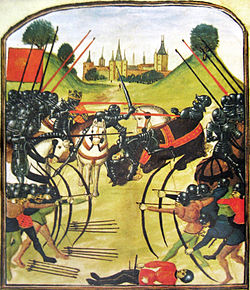
Fought in a snowstorm near York, Towton was the largest and bloodiest battle ever fought on English soil, possibly involving 50,000–80,000 men. Edward IV's decisive victory crushed Lancastrian resistance; Henry VI, Margaret, and their son fled to Scotland.
Image source: Battle of Towton
Jun 28, 1461
% complete
Edward IV was crowned at Westminster Abbey, cementing Yorkist rule. He rewarded his supporters, most notably elevating his brother George to Duke of Clarence and Richard to Duke of Gloucester, and began consolidating control over the realm.
Image source: Wars of the Roses
May 1, 1464
% complete
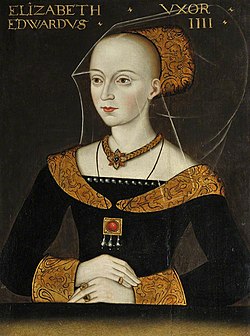
Edward secretly married the widowed Elizabeth Woodville, scandalizing the nobility. Her large family received generous marriages and offices, alienating powerful allies like Warwick 'the Kingmaker,' who favored a French alliance through marriage.
Image source: Elizabeth Woodville
Jul 1465
% complete
After years as a fugitive in northern England and Scotland, the former king Henry VI was captured near Clitheroe and imprisoned in the Tower of London. His captivity seemed to end Lancastrian hopes, though Queen Margaret continued plotting from abroad.
Image source: Henry VI of England
Apr 1469 - Jul 1469
% complete
An uprising in the north, likely orchestrated by Warwick and Clarence, challenged Edward IV's rule. Combined with Warwick's invasion, it led to the king's capture and temporary imprisonment by his own cousin, exposing deep divisions within the Yorkist regime.
Jul 26, 1469
% complete
Warwick's forces destroyed a royal army loyal to Edward IV, killing the king's father-in-law Richard Woodville, Earl Rivers, and his brother John. Edward was taken into Warwick's custody, though he soon regained his freedom as Warwick's rule collapsed.
Image source: Battle of Edgcote
Mar 12, 1470
% complete
Another rebellion linked to Warwick was crushed by Edward IV at Losecoat Field. Incriminating documents forced Warwick and Clarence to flee to France, where they made a shocking alliance with their old enemy, Queen Margaret of Anjou.
Image source: Battle of Losecoat Field
Mar 11, 1471 - Apr 11, 1471
% complete
Backed by Charles the Bold of Burgundy, Edward IV landed at Ravenspur and marched on London, gathering support. He entered the city, freed Henry VI from the Tower, and prepared to confront Warwick's army before Margaret could arrive from France.
Apr 14, 1471
% complete
In thick fog, Edward IV defeated and killed Warwick the Kingmaker. Confusion in the mist caused Lancastrian troops to attack their own allies. Warwick's death removed the most powerful kingmaker of the era and shattered the Lancastrian cause.
Image source: Battle of Barnet
May 4, 1471
% complete
Edward IV crushed Queen Margaret's army days after her landing in England. Prince Edward of Westminster, the Lancastrian heir, was killed either in battle or executed afterward, extinguishing the direct Lancastrian line of descent from Henry VI.
May 21, 1471
% complete
Henry VI died in the Tower of London on the night Edward IV returned in triumph, almost certainly murdered on the king's orders. With Henry and his son dead, the Lancastrian claim survived only through the obscure line of Henry Tudor, exiled in Brittany.
Feb 18, 1478
% complete
George, Duke of Clarence, convicted of treason after feuding with his brother Richard and the Woodvilles, was privately executed in the Tower, allegedly drowned in a butt of malmsey wine. Richard, Duke of Gloucester, grew increasingly powerful in the north.
Image source: George Plantagenet, Duke of Clarence
Apr 9, 1483
% complete
Edward IV died unexpectedly at age forty, leaving his twelve-year-old son Edward V as heir and naming his brother Richard as Lord Protector. The succession crisis reopened the dynastic conflict and set the stage for the dynasty's collapse.
Jun 25, 1483 - Jul 6, 1483
% complete
Titulus Regius declared Edward IV's children illegitimate due to alleged precontract of marriage. Young Edward V and his brother Richard were confined in the Tower of London and disappeared, presumed murdered. Richard, Duke of Gloucester, was crowned Richard III.
Image source: Princes in the Tower
Oct 1483 - Nov 1483
% complete
A revolt led by the Duke of Buckingham, with links to Henry Tudor and the Woodville faction, aimed to overthrow Richard III. It failed quickly — Buckingham was executed — but it drove many rebels into exile with Henry Tudor, strengthening his cause.
Apr 9, 1484
% complete
The death of Richard III's only legitimate son devastated the king and destabilized his regime, raising questions about the succession and encouraging defections to the exiled Henry Tudor, whose claim, however thin, gained credibility.
Image source: Edward of Middleham, Prince of Wales
Aug 7, 1485
% complete
Henry Tudor, Earl of Richmond, landed in Wales with a small force of French mercenaries and English exiles, claiming the throne through his Lancastrian descent and his pledge to marry Elizabeth of York, uniting the warring houses.
Image source: Henry VII of England
Aug 22, 1485
% complete
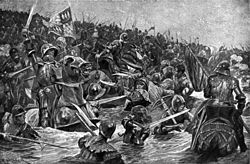
Henry Tudor defeated and killed Richard III, who died fighting heroically after the betrayal of the Stanley family. Bosworth is traditionally regarded as the end of the Wars of the Roses and the beginning of Tudor rule in England.
Image source: Battle of Bosworth Field
Jan 18, 1486
% complete
Henry VII fulfilled his promise to marry Elizabeth of York, daughter of Edward IV, symbolically uniting the red rose of Lancaster and the white rose of York. Their children combined both claims, helping to heal the dynastic divide.
Image source: Elizabeth of York
Jun 16, 1487
% complete
Henry VII defeated the pretender Lambert Simnel's army, backed by Yorkist diehards including John de la Pole, Earl of Lincoln, who was killed. Often called the last battle of the Wars of the Roses, it secured the Tudor dynasty against armed challenge.
Image source: Battle of Stoke Field
Or browse the full history timeline directory, with more than 2,000 topics.
This Wars of the Roses timeline was generated with the help of AI, using information found on the internet.
We work hard to keep these timelines accurate, but mistakes do get through. If you spot one, email us at [email protected] and we'll fix it for future visitors.
Generate yours with AI or build it from scratch, for free.
Export your timeline, add your own events, edit or remove AI-generated events, and much more
No credit card required.
Cancel anytime.
Cancel anytime.
You can create an unlimited number of timelines with up to 10 events on each one, customize how they look, export them to PDF, PNG, PowerPoint, CSV, and Excel, and share them with a link. Paid plans raise the event limit and add features like spreadsheet imports and collaborators.
Yes. You can cancel your subscription from your account page at any time, and you will not be charged again. Your subscription stays active for the rest of the period you already paid for.
Yes. We will email you a reminder before the annual renewal, and we will also email you a receipt.
Yes. You can email us within 15 days of any payment, and we will issue you a full refund.
Check out our pricing docs or send us an email anytime: [email protected].