
-
Use Cases
-
Resources
-
Pricing
The history of accounting traces how societies developed methods to record transactions, measure wealth, manage organizations, and communicate financial information. More Less
Build a timeline like this one in minutes, for free. Start Yours →
400 BC
By about the 4th century BC, ancient Egyptians and Babylonians had systems for auditing the movement of goods into and out of storehouses. Their oral audit reports contributed to the later association of auditing with hearing and the Latin verb audire.
Image source: Audit

200 - 299
The Heroninos Archive is a large collection of papyrus documents from Roman Egypt in the 3rd century AD. Alongside letters, it contains numerous accounts that provide evidence of administrative and financial record-keeping.
Image source: Heroninos Archive

700 - 799
In eighth-century Persia, scholars addressed the Qur’an’s requirement that Muslims keep records of indebtedness as part of their obligation to account to God for all matters of life.
Image source: Islamic Golden Age

700 - 999
Accounting knowledge was taught in the learning centers of Al-Andalus in Iberia. From the tenth century onward, it gradually entered European banking and accounting practice.
Image source: Al-Andalus

700 - 1200
Chinese innovators developed printing methods involving reversed text carved into wood blocks, inked, and pressed onto pages. They also created early movable type using carved wood characters and ceramic print blocks.
Image source: History of printing
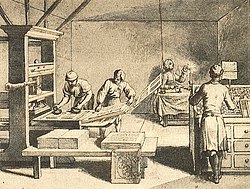
900 - 1499
From the tenth century forward, European banks increasingly used Hindu-Arabic numerals in accounting books, even though medieval church authorities sometimes prohibited them as sinful.
Image source: Hindu–Arabic numeral system

1000 - 1099
Bankers in Cairo used a double-entry bookkeeping system before the known Italian examples. Records of this practice survive among documents from the Cairo Geniza dating to the 11th century AD.
Image source: Cairo Geniza

1202
Beginning in 1202, Fibonacci’s Liber Abaci spread knowledge of Hindu-Arabic numerals and commercial calculation among merchants and bankers. Because copies were handwritten, access initially remained concentrated among a relatively small group, especially Italians.
Image source: Liber Abaci

1250 - 1399
Double-entry bookkeeping became widespread in Italy during the late 13th century and developed further during the 14th and 15th centuries.
1299 - 1300
The Farolfi ledger of 1299–1300 is the earliest extant evidence of a complete double-entry bookkeeping system.
Build a timeline like this one in minutes, for free. Start Yours →
This History of Accounting timeline was generated with the help of AI, using information found on the internet.
We work hard to keep these timelines accurate, but mistakes do get through. If you spot one, email us at [email protected] and we'll fix it for future visitors.
Generate yours with AI or build it from scratch, for free.


