-
Use Cases
-
Resources
-
Pricing
This timeline traces the rich and complex history of Algiers, the capital city of Algeria. From its founding as a Phoenician trading port known as Icosium, through Roman rule, the rise of the powerful Regency of Algiers under the Ottomans in the 16th century, French conquest in 1830, and its pivotal role in the Algerian War of Independence, to becoming the capital of modern independent Algeria in 1962. More Less
300 BC
% complete
Around the 3rd century BC, 'Ikosim' became a small port town in Carthage where Phoenicians were trading with other Mediterranean ports, marking the settlement's emergence as a place of commercial significance.
Image source: Icosium
600 AD
% complete
In the early 7th century, the Beni Mezghenna, a Berber tribe belonging to the Sanhaja as cited by Ibn Khaldoun, settled on the plains of Icosium and the surrounding areas.
Image source: Algiers
680 AD
% complete
In the late 7th century, the Muslim conquest of the Maghreb brought the Umayyad Caliphate into the region. The advancing armies faced resistance from Berber forces led by Kahina and Kusaila in the 680s.
Image source: Muslim conquest of the Maghreb
972 AD
% complete
Algiers was formally founded in 972 AD by Buluggin ibn Ziri, building on a much longer history as a Phoenician trading settlement dating back to between 1200 and 250 BC.
Image source: Buluggin ibn Ziri
1014 AD
% complete
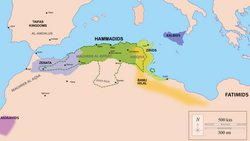
Around 1014 AD, under Badis ibn al-Mansur, the dynasty was divided between the Zirids at al-Qayrawan and the Hammadid dynasty at Qal'at Bani Hammad. 'Jazaʾir Banī Mazghanna', commonly known as Algiers, became the new name of Icosium and was absorbed into the Hammadid dynasty.
Image source: Hammadid dynasty
1067 AD
% complete
In 1067 AD the Hammadids relocated to Béjaïa and carried on lively trade while most of North Africa was in a state of anarchy.
1082 AD
% complete
After sending an army of 20,000 men from Marrakesh toward Tlemcen in 1079, Ibn Tashfin himself returned with an army in 1081 that captured Oujda and conquered Tlemcen, massacring the Maghrawa forces. By 1082 AD he had captured 'Jazaʾir Banī Mazghanna', bringing Algiers under Almoravid control.
Image source: Almoravid dynasty
1151 AD
% complete
In 1151 AD, Abd al-Mu'min launched an expedition eastward, conquering Béjaïa in August 1152, capital of the Hammadids. On their way, Beni Mezghanna did not succumb easily and came under the control of the Almohad Caliphate.
Image source: Abd al-Mu'min
1235 AD
% complete
The Almohad Caliphate suffered from states breaking out of its rule, most notably the Kingdom of Tlemcen in 1235 AD. The town of Algiers once again came under Ziyanid dominion but enjoyed considerable independence under Thaaliba amirs who settled the Mitidja plain around 1200 AD.
Image source: Kingdom of Tlemcen
1501 AD
% complete
Beginning in 1501 AD, the Kingdom of Tlemcen was the target of Spanish Empire and Portuguese Empire campaigns and conquests along its coasts.
1516 AD
% complete
Oruç Reis came to Algiers, ordered the assassination of the amir Selim b., seized the town, and ousted the Spanish in the Capture of Algiers (1516). That same year Algiers became the capital of the Ottoman Regency of Algiers.
Image source: Capture of Algiers (1516)
1518 AD
% complete
After Oruç Reis was killed in battle against the Spaniards during the 1518 fall of Tlemcen, Hayreddin succeeded him and founded the pashaluk, which subsequently became the beylik, of Algeria.
Image source: Hayreddin Barbarossa
1525 AD
% complete
The Arabic name al-Jazāʾir means 'the Islands', referring to four main islands off the western cape where people settled. On a map one can notice the islands were eventually connected to the mainland in 1525 AD via a pier now named Kheireddine pier.
1529 AD
% complete
Barbarossa lost Algiers in 1524 but regained it with the 1529 Capture of Peñón of Algiers, then formally invited Sultan Suleiman the Magnificent to accept sovereignty over the territory and annex Algiers to the Ottoman Empire.
Image source: Capture of Peñón of Algiers (1529)
Oct 1541 AD
% complete
In October 1541, King of Spain and Holy Roman Emperor Charles V sought to capture Algiers, but a storm destroyed many of his ships, and his army of some 30,000 men was defeated by the Algerians under their pasha, Hassan.
Image source: Battle of Algiers (1541)
1556 AD
% complete
In 1556, a citadel, the Palace of the Dey, was constructed at the highest point within the city wall. The main building in the Kasbah had been begun in 1516 on the site of an older building and served as the palace of the deys until the French conquest.
Image source: Casbah of Algiers
1576 AD
% complete
Le Bastion 23 – Palais des Rais was built in 1576 by Dey Ramdhan Pacha and located in the lower Casbah in the Bab El Oued neighborhood.
Image source: Palais des Rais
1612 AD
% complete
The primary source for knowledge of Algiers in this period, since there are no contemporary local sources, is Diego de Haedo's Topografía e historia general de Argel, published in 1612 but written earlier; its authorship is disputed.
Image source: Mercedes Sosa
1799 AD - 1800 AD
% complete
The old Bibliothèque Nationale d'Alger is a Moorish palace built in 1799–1800, later complemented by a new National Library built in a style reminiscent of the British Library.
Image source: National Library of Algeria
1832 AD
% complete
In 1830, Algiers was a Casbah, a fortified city built on ruins of earlier civilizations, but after the French conquest its walls were demolished and the city expanded into a European side, eventually unified in 1832 into a single municipality.
1835 AD
% complete
Following unification in 1832 came the creation of 14 additional communes around Algiers in 1835. The communes of El Biar and Mustapha were attached before being detached in 1870.
1858 AD
% complete
Notre Dame d'Afrique, accessible by cable car, is one of the city's most outstanding monuments: located in the district of Z'will ghara, the Roman Catholic basilica was built around 1858.
Image source: Notre-Dame d'Afrique
1870 AD
% complete
The church of the Holy Trinity, built in 1870, stands at the southern end of rue d'Isly near the site of the demolished Fort Bab Azoun. Its marbles contain memorial inscriptions relating to British residents of Algiers, including John Tipton, the first English consul in 1580, and a tablet recording the 1631 raid on Baltimore, Ireland.
Image source: List of churches in the Archdiocese of New Orleans
1900 AD
% complete
Algiers was a walled city from the time of the deys until the close of the 19th century. After their 1830 occupation, the French built ramparts with forts Bab Azoun and Bab-el-Oued. These forts and part of the ramparts were demolished at the beginning of the 20th century, replaced by a line of forts on the heights of Bouzaréah, at an elevation of 396 metres.
1904 AD
% complete
In 1904, the commune of Mustapha was definitively integrated into the city of Algiers, which was divided into 12 districts for a total area of 15.64 km².
1910 AD
% complete
The Grand Post Office, built in 1910 by Voinot and Tondoire, is a neo-Moorish type construction located in full centre town of Algiers.
Image source: Grande Poste d'Alger
1959 AD
% complete
In 1959, Greater Algiers was created with the grouping of 9 municipalities: Algiers, Saint-Eugène, Bouzareah, El Biar, Dely Brahim, Birmendreis, Kouba, Hussein-Dey and Maison-Carrée.
1982 AD
% complete
The monument was opened in 1982 on the 20th anniversary of Algeria's independence.
Image source: Maqam Echahid
Dec 1992 AD
% complete
In December 1992, the Kasbah of Algiers was enlisted as a cultural World Heritage site by UNESCO. The city remained a theatre of many political demonstrations of all descriptions until 1993.
1997 AD
% complete
In 1997, after expanding to include 24 new municipalities, the Wilaya of Algiers was granted special status and became the 'Governorate of Greater Algiers', headed by minister-governor Cherif Rahmani. The GGA was dissolved in 2000, deemed unconstitutional.
Image source: Algiers Province
Jul 5, 2006
% complete
On 5 July 2006, a new international air terminal was opened for service at Houari Boumediene Airport.
Image source: Houari Boumediene Airport
May 8, 2011
% complete
The Algiers tramway was opened on 8 May 2011, adding modern public transit alongside the Metro that would open later that year.
Image source: Algiers tramway
Nov 1, 2011
% complete
Opened on 1 November 2011, the Algiers Metro services 5 districts of the city (Bab El Oued, Sidi M'Hamed, Hussein Dey, El Harrach, Bir Mourad Raïs) via Line 1 providing 19 stations with a total length of 18.5 km.
Image source: Algiers Metro
2012 AD
% complete
Considerable land reclamation along the waterfront allowed for developments such as Marina Mall in 2012, followed by Sablettes Promenade in 2016, the El kettani waterfront in 2025, and ongoing projects like the Algiers Medina and New bay of Algiers.
Aug 27, 1816
% complete
On 27 August 1816, the Bombardment of Algiers took place by a British squadron under Lord Exmouth (descendant of Thomas Pellew, taken in an Algerian slave raid in 1715), assisted by Dutch men-of-war, destroying the corsair fleet harboured in Algiers.
Image source: Bombardment of Algiers (1816)
Apr 29, 1827
% complete
On 29 April 1827, foreign consuls gathered at the Palace of the Dey for a conference with Hussein Dey. Amid the Bakri-Busnach affair, a commercial-political conflict troubling France and the Regency, tensions escalated dramatically.
Image source: French conquest of Algeria
Jun 14, 1830
% complete
As tensions rose while the French Armed Forces prepared for invasion, the naval fleet departed Toulon on 25 May 1830 and successfully reached the western coast of the Regency near what is today Sidi Fredj on 14 June 1830.
Image source: Invasion of Algiers (1830)
Jun 19, 1830 - Jul 5, 1830
% complete
The Algerian forces met their French opponents in the Battle of Staouéli on 19 June 1830 and were defeated, enabling the colonial army to advance into the city. Hussein Dey surrendered to French General de Bourmont on 5 July 1830.
Jun 22, 1834
% complete
Under French rule, Algiers served as the capital of French Algeria, formally declared 'an integral part of the French Republic' through an annexation on 22 June 1834.
Image source: French Algeria
Jan 7, 1957
% complete
Starting on 7 January 1957, the 10th Parachute Division of the French Army, on orders of French Minister of Justice François Mitterrand who authorized any means 'to eliminate the insurrectionists', led attacks against Algerian independence fighters during the Algerian War (1954–1962), a bloody struggle in which hundreds of thousands died.
Image source: The Battle of Algiers
May 13, 1958
% complete
The demonstrations of 13 May during the crisis of 1958 provoked the fall of the Fourth Republic in France, as well as the return of General de Gaulle to power.
Image source: May 1958 crisis in France
Jul 5, 1962
% complete
Algeria achieved independence on 5 July 1962 following the Algerian Revolution, with Algiers as its capital. It has remained the capital of the modern Algerian state ever since.
Image source: Algerian War
Oct 1988 AD
% complete
In October 1988, one year before the fall of the Berlin Wall, Algiers was the site of demonstrations demanding the end of the single-party system and creation of real democracy, baptized the 'Spring of Algiers'.
1989 AD
% complete
The 1989 Algerian constitutional referendum adopted a new constitution that put an end to one-party rule and saw the creation of more than fifty political parties, as well as official freedom of the press.
Image source: Constitution of Algeria
1991 AD
% complete
In 1991, a political entity dominated by religious conservatives called the Islamic Salvation Front engaged in a political test of wills with the authorities. In the 1992 elections, the Islamists garnered large support in the first round. Mass protests from 1990/1991 led up to the Algerian Civil War, a result of a political and societal crisis.
Image source: Islamic Salvation Front
Dec 11, 2007
% complete
On 11 December 2007, two car bombs exploded in Algiers. As of 2008 it was speculated the attack was carried out by an Al Qaeda cell within the city. Indigenous terrorist groups have been active in Algeria since around 2002.
2019 AD
% complete
Sidi M'Hamed has always been the hub for expression and chants for change, having witnessed the Battle of Algiers, the mass riots of 1988, mass protests leading up to the Algerian Civil War, and Hirak Echaabi in 2019.
Image source: Hirak (Algeria)
2012 AD
% complete
Snow is very rare in Algiers; the last snowfall was in 2012, when the city received 100 millimetres of snowfall, its first snowfall in eight years.
Jul 21, 2023
% complete
The hottest temperature ever recorded in Algiers was 48.7 °C on 21 July 2023; the coldest temperature ever recorded was −3.3 °C.
Or browse the full history timeline directory, with more than 2,000 topics.
This History of Algiers timeline was generated with the help of AI, using information found on the internet.
We work hard to keep these timelines accurate, but mistakes do get through. If you spot one, email us at [email protected] and we'll fix it for future visitors.
Generate yours with AI or build it from scratch, for free.
Export your timeline, add your own events, edit or remove AI-generated events, and much more
No credit card required.
Cancel anytime.
Cancel anytime.
You can create an unlimited number of timelines with up to 10 events on each one, customize how they look, export them to PDF, PNG, PowerPoint, CSV, and Excel, and share them with a link. Paid plans raise the event limit and add features like spreadsheet imports and collaborators.
Yes. You can cancel your subscription from your account page at any time, and you will not be charged again. Your subscription stays active for the rest of the period you already paid for.
Yes. We will email you a reminder before the annual renewal, and we will also email you a receipt.
Yes. You can email us within 15 days of any payment, and we will issue you a full refund.
Check out our pricing docs or send us an email anytime: [email protected].