-
Use Cases
-
Resources
-
Pricing
Dakar, the capital of Senegal and one of West Africa's most important cities, has a history spanning over five centuries. Originally a small fishing village on the Cap-Vert Peninsula, it was colonized by the Portuguese in the 15th century and later became a major French colonial port. Dakar grew into a key center of Atlantic trade, served as the capital of French West Africa from 1902 to 1960, and after Senegal's independence emerged as a leading hub of African culture, music, politics, and commerce. More Less
1400
% complete
The Cap-Vert peninsula was colonized by the Portuguese in the early 15th century, marking the beginning of sustained European involvement in the region. The peninsula had been settled no later than the 15th century by the Lebu people, an aquacultural subgroup of the Wolof ethnic group.
Image source: Dakar
1444
% complete
In 1444, Portuguese explorers reached the Bay of Dakar, becoming among the first Europeans to arrive on the Cap-Vert peninsula, opening a new chapter of contact between Europe and West Africa.
1456
% complete
Peaceful contact was finally opened in 1456 by the Portuguese navigator Diogo Gomes, and the bay was subsequently referred to as the 'Angra de Bezeguiche', named after the local ruler.
Image source: Diogo Gomes
1500
% complete
In the early 16th century, the bay of Bezeguiche served as a critical stop for the Portuguese India Armadas, where large fleets stopped on outward and return journeys to repair, collect fresh water, and trade for provisions with local people.
1501
% complete
During one of the fleet stops in 1501, the Florentine navigator Amerigo Vespucci famously began constructing his 'New World' hypothesis about America while at the bay of Bezeguiche.
Image source: Amerigo Vespucci
1549
% complete
A town grew on the bay that was one of the major ports of Cayor, a constituent kingdom of the Jolof Empire which broke away in 1549, reshaping the regional political landscape.
Image source: Cayor
1600
% complete
In the 17th century, a new Lebou village called Ndakaaru was established directly across from Gorée to service the European trading factory with food and drinking water.
1536
% complete
The Portuguese founded a settlement on the island of Gorée (then known as Bezeguiche or Palma), and by 1536 they began using it as a base for the exportation of enslaved people.
1588
% complete
In 1588, Gorée was captured by the United Netherlands, which gave the island its present name (spelled Goeree, after Goeree-Overflakkee in the Netherlands).
Jan 23, 1664
% complete
After switching hands between the Portuguese and Dutch several times, Gorée fell to the English under Admiral Robert Holmes on January 23, 1664.
1677
% complete
In 1677, France took over the island of Gorée, beginning a long period of French colonial presence in the region that would shape the future development of Dakar.
Image source: Gorée
1776
% complete
The infamous 'House of Slaves' was built at Gorée in 1776, serving as a holding facility for enslaved Africans awaiting transport across the Atlantic. It is today a memorial to the Atlantic slave trade.
Image source: House of Slaves
Feb 1794
% complete
The slave trade was abolished by revolutionary France in February 1794, though this prohibition would prove short-lived amid the political turmoil of the era.
Image source: Slavery in France
1795
% complete
In 1795, the marabouts of Cayor revolted against the Damel, inspired by the Futanke revolution in Futa Toro, reflecting wider currents of religious and political upheaval in Senegambia.
May 1802
% complete
Napoleon Bonaparte reinstated the slave trade in May 1802, reversing the earlier abolition and allowing the trafficking of enslaved people through Gorée to resume.
Image source: Napoleon
1840
% complete
Traders from Gorée decided to move to the mainland, and a 'factory' with warehouses was established at Rufisque in 1840, signaling a shift of commercial activity toward the mainland.
Image source: Rufisque
1848
% complete
The slave trade continued at Gorée until 1848, when it was finally abolished throughout all French territories, ending the island's long role in the Atlantic slave trade.
1857
% complete
In 1857, the French established a military post at Ndakaaru (which they called 'Dakar') and annexed the Lebou Republic, though its institutions continued to function nominally.
Image source: History of Senegal
1872
% complete
In 1872, Gorée, including Dakar, was recognised as a French commune, making it one of the oldest Western-style municipalities in Africa, along with municipalities in Algeria and South Africa.
1885
% complete
Port facilities were improved with jetties, a telegraph line ran along the coast to Saint-Louis, and the Dakar-Saint-Louis railway was completed in 1885, making the city an important base for the French conquest of the Western Sudan.
Image source: Rail transport in Senegal
Jun 17, 1887
% complete
On June 17, 1887, the commune of Dakar was created by the French colonial administration by detaching it from the commune of Gorée. The commune of Dakar has been in continuous existence since then, preserved even after independence.
Image source: Dakar region
1902
% complete
In 1902, Dakar replaced Saint-Louis as the capital of French West Africa (Afrique Occidentale Française), cementing its status as a major city of the French colonial empire following the abolition of the slave trade and the annexation of the mainland.
Image source: French West Africa
1923
% complete
A second major railroad, the Dakar-Niger, was built between 1906 and 1923, linking Dakar to Bamako and consolidating the city's position at the head of France's West African empire.
Image source: Dakar–Niger Railway
1924 - 1934
% complete
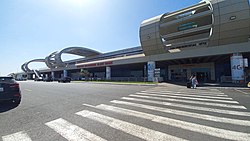
Blaise Diagne served as mayor of Dakar from 1924 to 1934, becoming the first black mayor of the city and a pioneering figure in French colonial politics representing Senegal's Four Communes.
Image source: Blaise Diagne International Airport
1864
% complete
The Mamelles Lighthouse was built in 1864 atop one of the two hills of the Mamelles on the Cap-Vert peninsula, becoming an important navigational aid and landmark for shipping approaching Dakar.
Image source: Les Mamelles Lighthouse
1883
% complete
Dakar is known as the birthplace of the Layene Brotherhood, a Sufi tariqa founded by Seydina Mouhammadou Limamou Laye in 1883 at the commune of Yoff, which remains a distinctive feature of the city's Islamic heritage.
1907
% complete
The Palais Présidentiel, the seat of government in Dakar, was constructed in 1907 during the height of French West Africa, and it remains the official residence and workplace of the President of Senegal.
Image source: Palace of the Republic, Dakar
1957
% complete
Cheikh Anta Diop University, also known as the University of Dakar, was established in 1957 and became a leading institution of higher learning in francophone West Africa, producing generations of scholars and leaders.
Image source: Cheikh Anta Diop
1964
% complete
The Grand Mosque of Dakar was built in 1964 at the heart of the Médina commune and stands as one of the most prominent landmarks of the city and a central site of Muslim worship in Senegal.
Image source: Grand Mosque of Dakar
1973
% complete
The Mosque of Divinity was constructed in 1973 in the Ouakam district of Dakar, distinguished by its characteristic triangular windows and its striking seaside location.
Image source: Mosque of Divinity
1978 - 2007
% complete
Beginning in 1978 and until 2007, Dakar frequently served as the ending point of the famous Dakar Rally. The event was moved to South America afterward due to security concerns in Mauritania.
Image source: Dakar Rally
1997
% complete
The Conseil Exécutif des Transports Urbains Durables (CETUD) was founded in 1997 to coordinate transportation in the Dakar region, addressing the growing mobility challenges of the expanding metropolitan area.
Image source: Transport in Senegal
2007
% complete
Dakar was selected as the Capital of Islamic Culture for the African Region for 2007 by ISESCO, honoring its rich Islamic heritage, including landmarks like the Layen Mausoleum entombing the founder of the Layene Sufi tariqa.
Image source: ICESCO
Jan 14, 2019
% complete
The Regional Express Train (TER) of Dakar conducted its first test run on January 14, 2019, introducing modern commuter rail service to the metropolitan region, with the first passenger train running in December 2021.
Image source: Train Express Régional Dakar
Sep 23, 1940 - Sep 25, 1940
% complete
In 1940, General de Gaulle of the Free French Forces sought to make Dakar the base of his resistance operations. With Vichy naval forces present and stubborn defences ashore, the proposals were resisted, and the Battle of Dakar ensued off the coast, lasting three days from September 23–25, 1940, between the Vichy defenders and the attacking Free French and British navy.
Nov 1944 - Dec 1, 1944
% complete
In November 1944, West African conscripts in the French army mutinied against poor conditions at the Thiaroye camp on the outskirts of Dakar. On December 1, 1944, French soldiers guarding the camp opened fire on the West African soldiers, in a tragic episode remembered as the Thiaroye massacre.
Image source: Thiaroye massacre
1959 - 1960
% complete
From 1959 to 1960, Dakar served as the capital of the short-lived Mali Federation, a brief union of French Sudan and Senegal that collapsed shortly before full independence.
Image source: Mali Federation
1960
% complete
In 1960, Dakar became the capital of the independent Republic of Senegal, and the commune of Dakar was preserved by the new state, continuing its administrative existence from the colonial era.
Image source: Senegal
Aug 30, 1996
% complete
Following a massive 1996 reform of Senegal's administrative divisions, and with its population approaching 1 million inhabitants deemed too large for central management, Dakar was divided into 19 communes d'arrondissement on August 30, 1996. The reforms also turned Senegal's régions into full-fledged political units with elected regional councils.
2022
% complete
According to the IPCC Sixth Assessment Report, Dakar is among 12 major African cities most severely affected by future sea level rise, with estimated cumulative damages of US$65 billion under RCP 4.5 and US$86.5 billion under RCP 8.5 by 2050. A 2021 CETUD study also revealed annual economic losses of nearly CFA 900 billion from poor air quality, congestion, hazardous roads, and noise pollution.
Image source: Climate change in Africa
2026
% complete
Dakar will host the 2026 Summer Youth Olympics. Originally set for 2022, the games were postponed to 2026, and they will be the first Olympic event ever held in Africa, a historic milestone for the continent and for Senegal.
Image source: 2026 Summer Youth Olympics
Or browse the full history timeline directory, with more than 2,000 topics.
This History of Dakar timeline was generated with the help of AI, using information found on the internet.
We work hard to keep these timelines accurate, but mistakes do get through. If you spot one, email us at [email protected] and we'll fix it for future visitors.
Generate yours with AI or build it from scratch, for free.
Export your timeline, add your own events, edit or remove AI-generated events, and much more
No credit card required.
Cancel anytime.
Cancel anytime.
You can create an unlimited number of timelines with up to 10 events on each one, customize how they look, export them to PDF, PNG, PowerPoint, CSV, and Excel, and share them with a link. Paid plans raise the event limit and add features like spreadsheet imports and collaborators.
Yes. You can cancel your subscription from your account page at any time, and you will not be charged again. Your subscription stays active for the rest of the period you already paid for.
Yes. We will email you a reminder before the annual renewal, and we will also email you a receipt.
Yes. You can email us within 15 days of any payment, and we will issue you a full refund.
Check out our pricing docs or send us an email anytime: [email protected].