-
Use Cases
-
Resources
-
Pricing
Amman, the capital of Jordan, is one of the oldest continuously inhabited cities in the world. Its history spans thousands of years, beginning as Rabbath Ammon, the capital of the Ammonites. The city later flourished under Roman rule as Philadelphia, part of the Decapolis league, and continued through Byzantine and Islamic periods before experiencing decline and a remarkable modern revival after becoming Jordan's capital in 1921. More Less
1300 BC - 1201 BC
% complete
In the 13th century BC, Amman was the capital of the Ammonite Kingdom, becoming known as 'Rabat Amman'. The city derives its name from the ancient people of the Ammonites, whose capital it had been since that era.
Image source: Amman
300 BC - 299 BC
% complete
In the 3rd century BC, the city was conquered by the Greeks and renamed Philadelphia. It later became part of the Nabataean and Roman realms.
300 BC - 299 BC
% complete
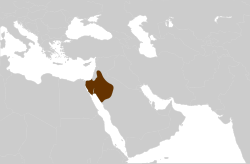
The Arab Nabataeans exploited the Seleucid-Ptolemaic wars to establish their Nabatean Kingdom centered in Raqmu (Petra) in the third century BC, which kept Philadelphia in a border zone.
Image source: Nabataean Kingdom
200 BC - 199 BC
% complete
The Nabataeans exercised a form of control in Philadelphia with Seleucid decline in the second century BC. Their presence in Decapolis cities was prominent, with substantial archaeological evidence found in Philadelphia from the first century AD.
63 BC
% complete
The Romans conquered much of the Levant under Pompey in 63 BC, inaugurating a period of imperial rule over Philadelphia that lasted for four centuries.
Image source: Pompey
100 - 199
% complete
The second century AD saw Philadelphia thriving, with the city rebuilt in the classical Roman style, featuring a large theater, an odeon, a nymphaeum, public baths, a forum, colonnaded streets, and a propylaeon connecting to a temple dedicated to Hercules on Citadel Hill.
Image source: Roman Theatre (Amman)
300 - 399
% complete
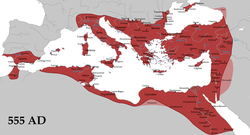
With the beginning of the 4th century AD, the Eastern Roman Empire adopted Christianity as the state religion under Constantine, starting the Byzantine period in Philadelphia.
Image source: Byzantine Empire
400 - 499
% complete
Philadelphia produced a well-known historian named Malchus in the 5th century AD, an Arab origin scholar who resided in Constantinople and produced a 500-page book about the history of the Byzantine Empire.
600 - 699
% complete
In the 7th century, Philadelphia was conquered by the Rashidun Caliphate, who restored its original Semitic name and called the city Amman.
Image source: Rashidun Caliphate
700 - 799
% complete
Amman's importance declined by the mid-8th century after damage caused by several earthquakes rendered the city uninhabitable for much of its former population.
1161 - 1166
% complete
William of Tyre recorded that in 1161 Philip of Milly received the castle of Ahamant (Amman) as part of the lordship of Oultrejordain. In 1166, Philip joined the Knights Templar and passed on to them a significant part of his fief including the castle.
Image source: Philip of Milly
1170
% complete
By 1170, Amman was in Ayyubid hands, ending Crusader control over the area.
Image source: Ayyubid dynasty
1356
% complete
In 1356, for unclear though likely financial reasons, the capital of Balqa was transferred from Hisban to Amman, which was considered a madina (city).
1357 - 1358
% complete
In 1357, Emir Sirghitmish bought Amman in its entirety, most likely to use revenues from the city to fund his madrasa in Cairo. Ownership passed to his descendants after his death in 1358.
Image source: Sirghitmish
1395 - 1396
% complete
In 1395, Sirghitmish's descendants sold Amman to Emir Baydamur al-Khwarazmi, the na'ib as-saltana (viceroy) of Damascus. Part of the cultivable lands were then sold to Emir Sudun al-Shaykhuni of Egypt.
1400 - 1878
% complete
Increasing division and sale of Amman's lands signalled declining revenues, while Hisban was restored as the major city of the Balqa in the 15th century. From then until 1878, Amman remained an abandoned site used periodically by seasonal farmers and Bedouin tribes.
1878
% complete
Amman began to be resettled in 1878 when several hundred Muslim Circassians arrived following their expulsion from the North Caucasus by the Russian Empire during the Russo-Circassian War.
Image source: Circassians in Jordan
1879
% complete
The English traveller Laurence Oliphant noted in his 1879 visit that most of the original Circassian settlers had left Amman by then, with about 150 remaining. They were joined by Circassians from the Kabardian and Abzakh tribes in 1880–1892.
1890
% complete
The French Dominican priest Marie-Joseph Lagrange commented in 1890: 'A mosque, the ancient bridges, all that jumbled with the houses of the Circassians gives Amman a remarkable physiognomy.'
Image source: Marie-Joseph Lagrange
1894
% complete
The new village became a nahiye (subdistrict) center of the kaza of al-Salt in the Karak Sanjak established in 1894.
Image source: Kaza
1903
% complete
Operational in central Transjordan since 1903, the Hejaz Railway helped transform Amman from a small village into a major commercial hub in the region.
Image source: Hejaz railway
1909
% complete
Amman's first municipal council was established in 1909, with Circassian Ismael Babouk elected as its first-ever mayor.
Image source: Ismael Babouk
1918
% complete
The First and Second Battles of Amman were part of the Middle Eastern theatre of World War I and the Arab Revolt, taking place in 1918.
Image source: First Battle of Amman
1921
% complete
In 1921, Hashemite emir Abdullah I designated Amman as the capital of the newly created Emirate of Transjordan, which became the Hashemite Kingdom of Jordan in 1950. After the railway made Amman a hub in 1914, merchant families from al-Salt also immigrated to the city.
Image source: Emirate of Transjordan
1930 - 1947
% complete
New arrivals from northern and southern Jordan and Palestine increased Amman's population from 30,000 in 1930 to 60,000 in 1947. A British report from 1933 showed around 1,700 Circassians living in Amman.
Image source: Amman Governorate
1946
% complete
Jordan gained its independence in 1946, and Amman was designated the country's capital.
Image source: Jordan
1948 - 1950
% complete
The 1948 Arab–Israeli War caused an exodus of Palestinian refugees, mostly from Jaffa, Ramla and Lydda, to Amman, swelling the population to 110,000. Many Palestinians had also migrated earlier from Safed, Haifa and Acre for economic opportunities.
Image source: 1948 Arab–Israeli War
1950 - 1967
% complete
With Jordan's capture of the West Bank during the 1948 war, many Palestinians steadily migrated to Amman between 1950 and 1966, before another mass wave arrived during the Six-Day War in 1967.
Image source: West Bank
Sep 1970 - 1971
% complete
In 1970, Amman was a battlefield during the conflict between the Palestine Liberation Organization and the Jordanian Army known as Black September. The army defeated the PLO in 1971, expelling it to Lebanon. By 1970, Amman's population reached about 550,000.
Image source: Black September
1991 - 2003
% complete
The first wave of Iraqi refugees settled in Amman after the Gulf War in 1991, with about 200,000 Palestinians expelled from Kuwait also arriving. A second wave came after the 2003 invasion of Iraq, bringing significant business flow into the city.
Nov 9, 2005
% complete
On 9 November 2005, Al-Qaeda under Abu Musab al-Zarqawi's leadership launched coordinated explosions in three hotel lobbies in Amman, resulting in 60 deaths and 115 injured.
Image source: 2005 Amman bombings
2011
% complete
A wave of Syrian refugees has arrived in Amman during the ongoing Syrian Civil War, which began in 2011. That year, roughly 1.8 million tourists visited the city, spending over $1.3 billion.
2015
% complete
The population of Amman reached 4,007,526 in 2015, containing about 42% of Jordan's entire population. With five million residents as of 2024, Amman became the largest city in the Levant and seventh-largest in the Arab world.
1959
% complete
The first radio station to originate in Amman was Hunna Amman in 1959; it mainly broadcast traditional Bedouin music.
Image source: Jordan Radio and Television Corporation
1974 - 1983
% complete
The 'Ain Ghazal archaeological site was discovered in 1974 by road construction workers. By 1982 excavations began, and in 1983 local archaeologists stumbled upon a large pit containing the famous human statues.
Image source: Ayn Ghazal statues
1982 - 1989
% complete
Among Amman's main mosques is the large King Abdullah I Mosque, built between 1982 and 1989.
Image source: King Abdullah I Mosque
2004
% complete
During the 2004 Amman Message conference, edicts from various clergy members afforded collective recognition to numerous schools of Islamic thought, including Hanafi, Hanbali, Maliki, Shafi'i, Ja'fari, Zahiri, Zaydi, Ibadi, Sufism, Muwahhidism and Salafism.
2007 - 2016
% complete
Amman hosted the 2007 Asian Athletics Championships and more than one edition of the IAAF World Cross Country Championships. In 2016, the city co-hosted the FIFA U-17 Women's World Cup along with Irbid and Zarqa.
2014
% complete
In 2014, German non-profit Make Life Skate Life completed the 7Hills Skatepark, a 650 square meter concrete skatepark at Samir Rifai park in Downtown Amman. Green Amman 2020 was also initiated that year, aiming to make the city a green metropolis.
2014 - 2015
% complete
Amman's Queen Alia International Airport is considered state-of-the-art, named 'the best airport in the Middle East' for 2014 and 2015, and 'the best improvement in the Middle East' for 2014 by the Airport Service Quality Survey.
Image source: Queen Alia International Airport
2015
% complete
In 2015, GAM and Zain Jordan began operating free Wi-Fi services at 15 locations, including Wakalat Street, Rainbow Street, The Hashemite Plaza, cultural centers and parks. Amman also joined the UNESCO Global Network of Learning Cities that year.
Image source: Amman
2015
% complete
In 2015, a ring road encompassing the city was constructed to connect the northern and southern parts of Amman, diverting traffic outside the city and improving environmental conditions.
Image source: List of roads in Amman
2018 - 2024
% complete
Approximately one million visitors arrived in Amman in 2018, making it the 89th most-visited city in the world and the 12th most-visited Arab city. By 2023, a major development project attracted some 500 companies across 27 sectors providing 15,000 jobs, with a second phase announced in May 2024 expected to create over 3,000 additional jobs annually.
Image source: Tourism in Jordan
2021 - 2024
% complete
Construction on Amman's BRT system started in 2010 but was halted amid feasibility concerns, resuming in 2015. The first route opened in 2021, the second in 2022, and another route connecting Amman with Zarqa began operations in May 2024.
Image source: Amman Bus Rapid Transit
Or browse the full history timeline directory, with more than 2,000 topics.
This History of Amman timeline was generated with the help of AI, using information found on the internet.
We work hard to keep these timelines accurate, but mistakes do get through. If you spot one, email us at [email protected] and we'll fix it for future visitors.
Generate yours with AI or build it from scratch, for free.
Export your timeline, add your own events, edit or remove AI-generated events, and much more
No credit card required.
Cancel anytime.
Cancel anytime.
You can create an unlimited number of timelines with up to 10 events on each one, customize how they look, export them to PDF, PNG, PowerPoint, CSV, and Excel, and share them with a link. Paid plans raise the event limit and add features like spreadsheet imports and collaborators.
Yes. You can cancel your subscription from your account page at any time, and you will not be charged again. Your subscription stays active for the rest of the period you already paid for.
Yes. We will email you a reminder before the annual renewal, and we will also email you a receipt.
Yes. You can email us within 15 days of any payment, and we will issue you a full refund.
Check out our pricing docs or send us an email anytime: [email protected].