-
Use Cases
-
Resources
-
Pricing
814 BC
% complete
According to legend, the Phoenician princess Elissa (Dido) founded the city of Carthage near modern Tunis around 814 BC. The city grew into one of the greatest commercial powers of the ancient Mediterranean, dominating trade routes across North Africa and beyond.
Image source: Carthage
264 BC - 146 BC
% complete
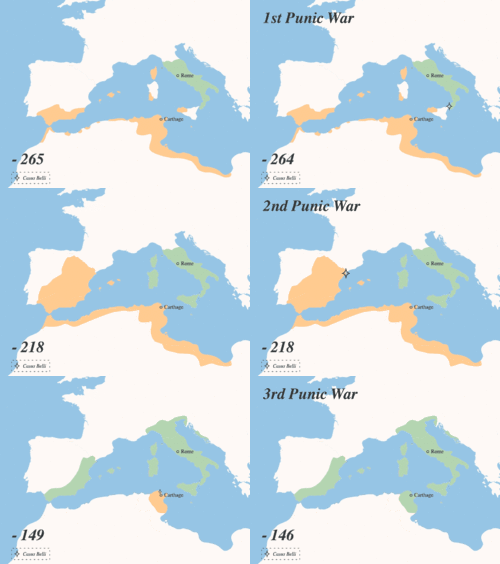
The Punic Wars were a series of three devastating conflicts between Rome and Carthage fought over control of the western Mediterranean. The wars included Hannibal's famous crossing of the Alps with war elephants and ended with Rome's total victory.
Image source: Punic Wars
146 BC
% complete
Roman forces under Scipio Aemilianus besieged and utterly destroyed Carthage in 146 BC, ending Punic civilization. The site lay largely abandoned until Rome later re-established a colony there, which grew into a major city of Roman Africa.
Image source: Siege of Carthage (Third Punic War)
44 BC
% complete
Julius Caesar refounded Carthage as Colonia Julia Carthago, and it flourished under Augustus. The rebuilt city became the capital of the province of Africa Proconsularis and one of the most important cities of the Roman Empire.
Image source: Carthage (municipality)
439
% complete
The Vandals under King Genseric captured Carthage in 439 AD and established a kingdom centered on the city. For about a century Carthage served as capital of Vandal North Africa before Byzantine forces reconquered the region.
Image source: Vandal Kingdom
533 - 534
% complete
The Byzantine general Belisarius defeated the Vandals and restored imperial rule over Carthage and North Africa. Carthage became the seat of the Exarchate of Africa, an important outpost of the Eastern Roman Empire.
Image source: Vandalic War
647 - 698
% complete
Arab armies launched campaigns into Byzantine North Africa beginning in 647. In 698, forces under Hassan ibn al-Nu'man captured Carthage, destroying it definitively and ending Byzantine power in the region.
Image source: Muslim conquest of the Maghreb
698
% complete
After the fall of Carthage, Hassan ibn al-Nu'man established a new settlement, Tunis, on the shores of the lake near the ruins. The medina of Tunis gradually grew into the principal urban center of the region.
Image source: Medina of Tunis
800 - 909
% complete
Under Aghlabid emirs based in Kairouan, Tunis prospered as a port and naval base. The Great Mosque of Zitouna, founded in the early Islamic period, became a major center of Islamic learning during this era.
Image source: Al-Zaytuna Mosque
909 - 1048
% complete
The Fatimids conquered Ifriqiya in 909 and later moved their capital to Egypt, leaving the region to the Zirid dynasty. Tunis remained an important port, benefiting from Mediterranean commerce despite political instability.
Image source: Ifriqiya
1052 - 1087
% complete
The invasion of the Banu Hilal tribes disrupted Zirid rule across Ifriqiya, fragmenting the region into small principalities. Norman raiders from Sicily also attacked coastal towns, including Mahdia and the Tunis area.
Image source: Banu Hilal
1159
% complete
The Almohad caliph Abd al-Mu'min took Tunis in 1159, incorporating it into a vast empire stretching from Morocco to Libya. Almohad rule brought relative unity and stimulated the growth of Tunis's port and markets.
Image source: Almohad Caliphate
1229
% complete
After breaking with the Almohads, Abu Zakariya Yahya founded the Hafsid dynasty in 1229, making Tunis the capital of an independent kingdom. Under Hafsid rule, Tunis flourished as a center of trade, scholarship, and Islamic culture for three centuries.
Image source: Hafsid dynasty
1270
% complete
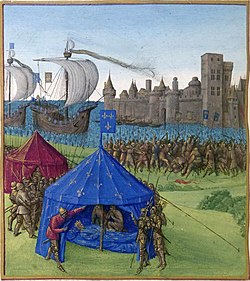
King Louis IX of France led the Eighth Crusade against Tunis in 1270 but died of disease outside the city walls. His brother Charles of Anjou negotiated a treaty with the Hafsids and withdrew the crusading army.
Image source: Eighth Crusade
1300 - 1500
% complete
During the later Hafsid period, Tunis expanded greatly: new souks, mosques, madrasas, and palaces were built within the medina. The city became a major hub of Mediterranean commerce, linking Europe, the Maghreb, and sub-Saharan trade routes.
Image source: Tunis
1535
% complete
Emperor Charles V led a Spanish-imperial fleet that seized Tunis from the corsair Barbarossa Hayreddin Pasha in 1535. Spain installed a puppet Hafsid ruler and fortified La Goulette, dominating the coast for decades.
Image source: Conquest of Tunis (1535)
1560
% complete
The Ottoman fleet under Piyale Pasha destroyed a Christian coalition fleet off Djerba in 1560, shifting naval power in the central Mediterranean to the Ottomans and paving the way for their reconquest of Tunis.
Image source: Battle of Djerba
1574
% complete
Ottoman forces under Uluç Ali Reis expelled the Spaniards from Tunis in 1574, making the city part of the Ottoman Empire. Tunis was governed by deys and pashas sent from Istanbul, beginning nearly three centuries of Ottoman suzerainty.
Image source: Conquest of Tunis (1574)
1613
% complete
Ramadan Bey founded the Muradid dynasty in 1613, establishing hereditary beys who ruled Tunisia in the Sultan's name while exercising growing autonomy. Their reign saw the rise of powerful militias and continued corsair activity.
Image source: Muradid dynasty
1705
% complete
Hussein Ben Ali founded the Husainid dynasty in 1705 after expelling Algerian invaders. The Husainid beys ruled Tunisia for over 250 years, developing state institutions, agriculture, and trade while nominally acknowledging Ottoman authority.
Image source: Husainid dynasty
1777 - 1813
% complete
Hammuda Pasha Bey promoted agriculture, commerce, and diplomacy with European powers. His reign marked a period of relative prosperity for Tunis, whose population and built heritage expanded considerably.
Image source: Hammuda ibn Ali
1827
% complete
In 1827 a French squadron bombarded Tunis and La Goulette to force payment of debts and concessions, illustrating the growing pressure of European powers on the weakened regency and foreshadowing colonial intervention.
Image source: Venetian bombardments of the Beylik of Tunis
1846
% complete
Bey Ahmad I abolished slavery throughout Tunisia in 1846, decades before many other nations. He also pursued modernization, founding military schools and industries modeled on European examples.
Image source: Ahmad I ibn Mustafa
1857 - 1861
% complete
Tunisia adopted the Fundamental Pact in 1857 guaranteeing rights and security to all inhabitants, followed in 1861 by the first written constitution in the Arab world, establishing consultative institutions in the beylicate.
1880 - 1889
% complete
The French built a modern European quarter, the Ville Nouvelle, outside the old medina, complete with boulevards, administrative buildings, churches, and a port at La Goulette, transforming Tunis's urban landscape and demographics.
May 12, 1881
% complete
Following French military intervention from Algeria, the Bey signed the Treaty of Bardo, making Tunisia a French protectorate. French administrators soon controlled finance, defense, and foreign affairs, reducing the bey to a figurehead.
Image source: Treaty of Bardo
1907
% complete
Educated Tunisians formed the Young Tunisians to press for constitutional reforms and greater participation in government, laying intellectual foundations for the nationalist movements that followed.
Image source: Young Tunisians
Mar 2, 1934
% complete
Habib Bourguiba and colleagues split from older nationalists to found the Neo Destour Party in 1934, organizing mass resistance to French rule through strikes, boycotts, and grassroots mobilization.
Nov 1942 - May 1943
% complete
German and Italian troops occupied Tunis in November 1942 after Allied landings in Morocco and Algeria. The Allies drove them out by May 1943, capturing some 250,000 Axis soldiers and opening the way for the invasion of Italy.
Image source: Tunisian campaign
1955
% complete
Facing sustained nationalist pressure, France granted internal autonomy to Tunisia in 1955. Habib Bourguiba returned from exile to a hero's welcome and prepared the country for full independence.
Image source: History of Tunisia
1956 - 1969
% complete
The Personal Status Code of 1956 banned polygamy and gave women legal rights unprecedented in the Arab world, while compulsory free education and secularization reshaped Tunisian society under Bourguiba's leadership.
Image source: Code of Personal Status in Tunisia
Mar 20, 1956
% complete
Tunisia gained full independence from France on March 20, 1956. Habib Bourguiba headed the new government, and the following year the Constituent Assembly proclaimed the Republic, abolishing the monarchy.
Image source: Tunisian independence
Jul 25, 1957
% complete
The National Constituent Assembly voted to abolish the monarchy of Lamine Bey and proclaimed the Republic of Tunisia, with Habib Bourguiba as its first president, ushering in sweeping social reforms.
Image source: President of Tunisia
1979 - 1990
% complete
After Egypt signed the Camp David Accords, Arab League members relocated the organization's headquarters from Cairo to Tunis, making the city the diplomatic capital of the Arab world for over a decade.
Image source: Arab League
Nov 7, 1987
% complete
Prime minister Zine El Abidine Ben Ali had the aging President Bourguiba declared medically unfit and assumed power peacefully on November 7, 1987. He initially liberalized politics but increasingly concentrated authoritarian control.
Sep 2001
% complete
Tunis hosted the Mediterranean Games in September 2001, building major sports infrastructure such as the El Menzah complex, showcasing the capital's modernization and regional standing.
Image source: 2001 Mediterranean Games
Dec 17, 2010 - Jan 14, 2011
% complete
Protests sparked by Mohamed Bouazizi's self-immolation swept across Tunisia, culminating in January 2011 when mass demonstrations forced President Ben Ali to flee to Saudi Arabia, inspiring the wider Arab Spring.
Jan 27, 2014
% complete
After extensive public debate, Tunisia adopted a landmark democratic constitution in January 2014, widely praised as among the most progressive in the region, cementing gains of the revolution.
Image source: Constitution of Tunisia
Oct 9, 2015
% complete
The Nobel Committee awarded the Peace Prize to Tunisia's National Dialogue Quartet for its decisive role in steering the country toward democratic consensus following the revolution.
Image source: Tunisian National Dialogue Quartet
Jul 25, 2021
% complete
On July 25, 2021, President Kais Saied suspended parliament and dismissed the prime minister, moving to concentrate executive power. He later pushed through a new constitution approved by referendum, drawing criticism over democratic backsliding.
Image source: 2021 Tunisian self-coup
Or browse the full history timeline directory, with more than 2,000 topics.
This History of Tunis timeline was generated with the help of AI, using information found on the internet.
We work hard to keep these timelines accurate, but mistakes do get through. If you spot one, email us at [email protected] and we'll fix it for future visitors.
Generate yours with AI or build it from scratch, for free.
Export your timeline, add your own events, edit or remove AI-generated events, and much more
No credit card required.
Cancel anytime.
Cancel anytime.
You can create an unlimited number of timelines with up to 10 events on each one, customize how they look, export them to PDF, PNG, PowerPoint, CSV, and Excel, and share them with a link. Paid plans raise the event limit and add features like spreadsheet imports and collaborators.
Yes. You can cancel your subscription from your account page at any time, and you will not be charged again. Your subscription stays active for the rest of the period you already paid for.
Yes. We will email you a reminder before the annual renewal, and we will also email you a receipt.
Yes. You can email us within 15 days of any payment, and we will issue you a full refund.
Check out our pricing docs or send us an email anytime: [email protected].