-
Use Cases
-
Resources
-
Pricing
The history of astrophysics traces humanity's effort to understand the physical nature of celestial objects, evolving from classical astronomy into a modern science that applies physics and chemistry to stars, galaxies, and the cosmos. Key milestones include Newton's law of gravitation, the discovery of stellar spectra, Einstein's relativity, the Big Bang theory, and the era of space telescopes. More Less
Jan 1, 1600 - Dec 31, 1699
% complete
The roots of astrophysics lie in the seventeenth-century emergence of a unified physics, in which the same natural laws were understood to apply to both the celestial and terrestrial realms. This conceptual breakthrough dissolved the ancient division between the heavens and the Earth and laid the intellectual foundation for the later study of astronomical objects using physical principles.
Image source: Astrophysics
1610
% complete
Galileo Galilei was among the natural philosophers who maintained that the celestial and terrestrial regions were made of similar kinds of material and subject to the same natural laws. His telescopic observations, including mountains on the Moon and moons orbiting Jupiter, provided powerful evidence that the heavens were not fundamentally different from the Earth.
Image source: Galileo Galilei
1644
% complete
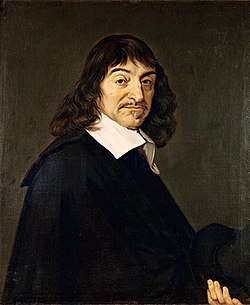
René Descartes contributed to the unification of physics by proposing that celestial phenomena could be explained through the same mechanical principles governing terrestrial motion. His vortex theory of planetary motion treated the heavens as a physical system obeying universal rules, reinforcing the idea that one set of laws applied throughout nature.
Image source: René Descartes
1687
% complete
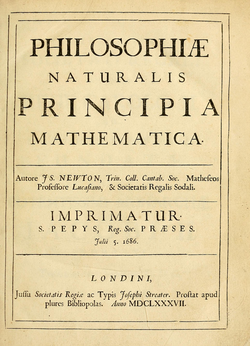
Isaac Newton's Principia Mathematica established the law of universal gravitation, demonstrating that the same force causing an apple to fall also governs the motions of planets and moons. This triumph of unified physics cemented the principle that celestial and terrestrial realms obey identical natural laws, a cornerstone of astrophysics.
Image source: Philosophiæ Naturalis Principia Mathematica
1800 - 1899
% complete
For much of the nineteenth century, astronomical research was focused on the routine work of measuring the positions and computing the motions of astronomical objects. Astrometry dominated observatory work during this period, before the rise of spectroscopy shifted attention toward understanding the physical nature and composition of celestial bodies.
Image source: Astrometry
1932 - 1999
% complete
By the end of the twentieth century, studies of astronomical spectra had expanded beyond visible light to cover radio wavelengths. Radio astronomy opened windows onto cold clouds, pulsars, quasars, and the cosmic microwave background, dramatically broadening the range of observable astrophysical phenomena.
Image source: Radio astronomy
1962 - 1999
% complete
Through the latter half of the twentieth century, astronomical spectroscopy extended to x-ray and gamma wavelengths, revealing violent high-energy processes such as accretion onto black holes, neutron star mergers, supernova remnants, and relativistic jets. These bands exposed the dynamic universe invisible to optical telescopes, completing the coverage of the electromagnetic spectrum.
Image source: X-ray astronomy
Sep 14, 2015
% complete
In the twenty-first century, astronomy further expanded to include observations based on gravitational waves. The first direct detection of gravitational waves from merging black holes inaugurated a new way of observing the universe, allowing scientists to sense cataclysmic cosmic events through spacetime ripples rather than light alone and opening the era of multi-messenger astrophysics.
Image source: Gravitational-wave astronomy
1860
% complete
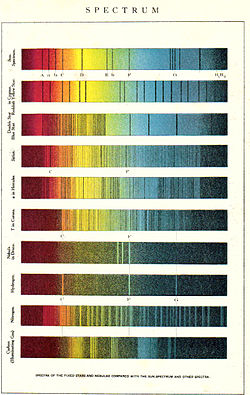
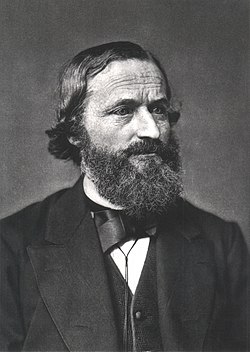
By 1860 the physicist Gustav Kirchhoff and the chemist Robert Bunsen had demonstrated that the dark lines in the solar spectrum corresponded to bright lines in the spectra of known gases, with specific lines corresponding to unique chemical elements. This revelation showed that the chemical composition of the Sun and stars could be determined from Earth, founding the science of astrophysics proper.
Image source: Gustav Kirchhoff
1868
% complete
Norman Lockyer extended the study of solar and stellar spectra when he detected radiant, as well as dark, lines in solar spectra. His observations led him to propose the existence of a new element, helium, in the Sun decades before it was found on Earth, illustrating spectroscopy's power to reveal otherwise inaccessible information about celestial bodies.
Image source: Norman Lockyer
1895
% complete
In 1895, George Ellery Hale and James E. Keeler founded The Astrophysical Journal, providing a dedicated publication venue for the new discipline of astrophysics. The journal gave researchers studying the physical nature of celestial objects a professional outlet, helping consolidate astrophysics as a recognized scientific field.
1925
% complete
Building on her application of Saha's ionization theory, Cecilia Payne concluded in her 1925 dissertation that hydrogen is vastly more abundant than any other element in stellar atmospheres. Though initially met with skepticism, her conclusion proved correct and revolutionized the understanding of cosmic chemical composition.
Image source: Cecilia Payne-Gaposchkin
1870 - 1899
% complete
Theodor von Oppolzer expanded the work on celestial mechanics and geodetic astronomy within the field at the University of Vienna in the late nineteenth century. His efforts strengthened the mathematical treatment of orbital motions, continuing the tradition of precise positional and dynamical astronomy that characterized the era.
Image source: Theodor von Oppolzer
1930 - 1933
% complete
In Sweden in the early 1930s, Svein Rosseland secured funding for the Institute of Theoretical Astrophysics, advancing what he argued had developed into a separate science. His initiative reflected the growing recognition that theoretical astrophysics required dedicated institutional support independent of traditional observational astronomy departments.
Image source: Svein Rosseland
1934
% complete
The Institute of Theoretical Astrophysics funded by Svein Rosseland opened in 1934, becoming one of the first institutions devoted exclusively to theoretical work on the physics of stars and cosmic objects. It trained a generation of theorists and signaled the maturing of astrophysics into an autonomous scientific discipline.
1966
% complete
In 1966, a small group of astronomers led by Fred Hoyle established the Institute of Theoretical Astronomy at the University of Cambridge. It allowed theorists to focus entirely on computational research without teaching responsibilities, creating an environment where ambitious theoretical models of stars, galaxies, and cosmology could be pursued intensively.
Image source: Fred Hoyle
1966 - 1972
% complete
At Fred Hoyle's Cambridge institute, theorists concentrated wholly on computational research, free from teaching duties. During its early years the group produced influential work on nucleosynthesis, stellar evolution, and relativistic astrophysics, exemplifying the growing importance of computation in theoretical astronomy.
Image source: Institute of Astronomy, Cambridge
1985
% complete
In 1985, the University of Virginia, whose grounds had housed the largest refracting telescope in the world and which had long hosted the United States Naval Observatory's operations, opened the Virginia Institute of Theoretical Astronomy. The institute was designed to host research spanning both theoretical astronomy and astrophysics.
Image source: University of Virginia
1985
% complete
The Virginia Institute of Theoretical Astronomy brought together researchers working on celestial mechanics and astrophysical theory under one roof, embodying the convergence of the two traditions. Its founding acknowledged that modern problems, from planetary dynamics to stellar structure, demanded both mathematical rigor and physical insight.
1886
% complete
Edward C. Pickering's vision drove Harvard College Observatory to undertake an ambitious program of photographing and classifying stellar spectra on an unprecedented scale. Employing a team of skilled women 'computers,' his program transformed astronomy into an industrial-scale enterprise of data collection and classification.
Image source: Edward Charles Pickering
1890
% complete
By 1890, a catalog of over 10,000 stars had been prepared that grouped them into thirteen spectral types. Compiled under Edward C. Pickering at Harvard College Observatory, this monumental effort marked the beginning of systematic stellar classification and organized stellar spectra for large-scale scientific analysis.
1911 - 1913
% complete
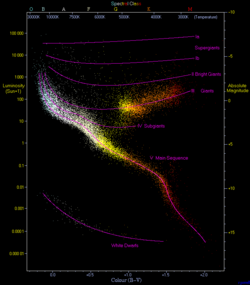
Around the early 1910s, Ejnar Hertzsprung and Henry Norris Russell independently developed the diagram plotting stellar luminosity against temperature or spectral type. Still used as the basis for classifying stars and tracing their evolution, the Hertzsprung–Russell diagram revealed patterns such as main sequence, giants, and dwarfs, reshaping how astronomers understood stellar life cycles.
Image source: Hertzsprung–Russell diagram
1918 - 1924
% complete
Working at Harvard College Observatory, Annie Jump Cannon classified more than a quarter of a million stars with remarkable speed and accuracy, developing the refined version of the Harvard Classification Scheme along the way. Her cataloging work provided the empirical backbone for twentieth-century stellar astrophysics.
Image source: Annie Jump Cannon
1922
% complete
The Harvard Classification Scheme, built on the OBAFGKM sequence of spectral types, was accepted for worldwide use in 1922. Standardized internationally, the scheme became the universal language for describing stellar spectra, enabling astronomers across the globe to compare results and build cumulative knowledge about stars.
Image source: Stellar classification
1924
% complete
Following Pickering's vision, Annie Jump Cannon had by 1924 expanded the Harvard stellar catalog to nine volumes covering over a quarter of a million stars. Her meticulous classification of hundreds of thousands of spectra created the largest and most consistent database of stellar types ever assembled up to that time.
1925
% complete
In her influential 1925 doctoral dissertation at Radcliffe College, Cecilia Helena Payne applied Saha's ionization theory to stellar atmospheres to relate the spectral classes to the temperature of stars. Her work explained why stars of different spectral classes display different absorption lines, showing that temperature, not composition, was the dominant factor.
1900 - 1999
% complete
Despite the interchangeable use of theoretical astronomy and astrophysics during the twentieth century, university courses titled 'theoretical astronomy' exclusively taught celestial mechanics. This curricular tradition preserved the older emphasis on gravitational dynamics even as astrophysics grew into its own distinct discipline.
1900 - 1999
% complete
Throughout the twentieth century, theoretical astronomy and astrophysics were often used interchangeably, reflecting their shared focus on explaining astronomical phenomena through physical theory. Despite this overlap in terminology, the two terms carried different institutional histories and emphases within universities and research organizations.
Image source: Astrophysics
1920
% complete
Around 1920, Arthur Eddington anticipated the discovery and mechanism of nuclear fusion processes in stars in his paper The Internal Constitution of the Stars. He argued that stars shine by converting matter into energy deep within their interiors, a prescient insight that prefigured the modern understanding of stellar energy generation.
Image source: Arthur Eddington
Or browse the full history timeline directory, with more than 2,000 topics.
This History of Astrophysics timeline was generated with the help of AI, using information found on the internet.
We work hard to keep these timelines accurate, but mistakes do get through. If you spot one, email us at [email protected] and we'll fix it for future visitors.
Generate yours with AI or build it from scratch, for free.
Export your timeline, add your own events, edit or remove AI-generated events, and much more
No credit card required.
Cancel anytime.
Cancel anytime.
You can create an unlimited number of timelines with up to 10 events on each one, customize how they look, export them to PDF, PNG, PowerPoint, CSV, and Excel, and share them with a link. Paid plans raise the event limit and add features like spreadsheet imports and collaborators.
Yes. You can cancel your subscription from your account page at any time, and you will not be charged again. Your subscription stays active for the rest of the period you already paid for.
Yes. We will email you a reminder before the annual renewal, and we will also email you a receipt.
Yes. You can email us within 15 days of any payment, and we will issue you a full refund.
Check out our pricing docs or send us an email anytime: [email protected].