-
Use Cases
-
Resources
-
Pricing
The discovery of exoplanets—planets orbiting stars outside our solar system—is one of the most transformative developments in modern astronomy. After decades of false starts and unconfirmed detections, the first definitive discovery came in 1995 with the detection of 51 Pegasi b. Since then, thousands of exoplanets have been found using methods like radial velocity, transit photometry, and direct imaging, revolutionizing our understanding of planetary formation and the potential for life beyond Earth. More Less
1988
% complete
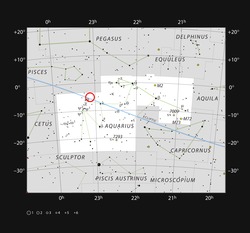
Despite numerous purported discoveries, some with confirmations, it is now believed that the first real detection of an exoplanet was published in 1988 among a list of possible candidates. The detection was not confirmed until 2002.
Image source: Gamma Cephei Ab
1989
% complete
The radial velocity variations of the star Errai were announced in 1989, consistent with a planet in a 2.5-year orbit. The existence of the planet Tadmor was finally confirmed in 2002, though it was found to be a brown dwarf or red dwarf star rather than an exoplanet in 2019.
Image source: Tesseract (band)
1992
% complete
The first confirmed detection of extrasolar planets came in 1992, when a system of terrestrial-mass planets was announced to be present around the millisecond pulsar PSR B1257+12. This marked the first confirmed discovery of planets outside the Solar System.
Image source: PSR B1257+12
Oct 1995
% complete
In 1995, Dimidium became the first exoplanet orbiting a main-sequence star to have its existence confirmed. The giant planet was found in a four-day orbit around the nearby star 51 Pegasi, revolutionizing the field of exoplanetary science.
Image source: 51 Pegasi b
1996
% complete
In 1996, Taphao Thong, a Jupiter-like planet, became the first long-period planet discovered, orbiting at 2.11 AU from its star with an eccentricity of 0.049. A second companion orbits at 3.39 AU with an eccentricity of 0.220 ± 0.028 and a period of 2190 ± 460 days.
Image source: 47 Ursae Majoris
1996
% complete
The planet Saffar was announced in 1996 with a mass of 0.687 Jupiter masses, orbiting at 0.0595 AU. Due to its extreme closeness to its parent star, it is believed to have a molten surface at a temperature of 1000–1500 °C.
Image source: Upsilon Andromedae b
1997
% complete
In 1997, an exoplanet was discovered around Rho Coronae Borealis in a 39.8-day orbit with a minimum mass about the same as Jupiter, adding to the growing catalog of gas giants found by radial velocity surveys.
Image source: Rho Coronae Borealis
1998
% complete
In 1998, Gliese 876 b became the first planet found that orbits around a red dwarf star, Gliese 876. The discovery demonstrated that planets could form around stars much smaller and cooler than the Sun.
Image source: Gliese 876 b
1999
% complete
The planet Samh was announced in 1999 with a mass of 1.97 Jupiter masses, orbiting at 0.830 AU. It was one of several planets discovered that year around Upsilon Andromedae, one of the first multi-planet systems known around a main-sequence star.
Image source: Upsilon Andromedae c
1999
% complete
The planet Majriti was announced in 1999 with a mass of 3.93 Jupiter masses, orbiting at 2.54 AU. In 2007, the inclinations of the system's planets were determined as non-coplanar, revealing a dynamically unusual architecture.
Image source: Upsilon Andromedae d
Aug 2004
% complete
Gliese 436 b was one of the first Neptune-mass planets discovered, detected in August 2004. In May 2007, a transit was found, revealing it as the smallest and least massive transiting planet yet known at 22 times the mass of Earth.
Image source: Gliese 436 b
2005 - 2006
% complete
In late 2005, the parameters of this directly imaged planetary-mass companion were revised to an orbital radius of 41 AU and a mass of 3.3 Jupiters, because the system was found to be closer to Earth than originally believed. In 2006, a dust disk was found around 2M1207, providing evidence for active planet formation.
Image source: 2M1207b
Jan 25, 2006
% complete
OGLE-2005-BLG-390Lb, announced on January 25, was detected using the gravitational microlensing method. As of April 2010, it remained the most distant known exoplanet, demonstrating microlensing as a powerful tool for finding cold, distant worlds.
Image source: OGLE-2005-BLG-390Lb
2008
% complete
In 2008, the mass of a giant planet's core was estimated at 70 Earth masses (80–110 as of later estimates), accounting for at least two-thirds of the planet's total mass, providing key insight into the interior structure of hot Jupiters.
Image source: HAT-P-7b
2008
% complete
In 2008, the albedo of Saffar's cloud layer was measured and its structure modeled as stratospheric. Also in 2008, the system's origin was traced to the Hyades cluster, alongside Epsilon Tauri. The temperature of the gas giant is very high (1250 K), mostly due to gravitational contraction.
Feb 14, 2008
% complete
On February 14, 2008, the discovery of a planetary system was announced that is the most similar one known to the Jupiter-Saturn pair within the Solar System in terms of mass ratio and orbital parameters. Later, in June 2010, the object was confirmed to be a companion planet rather than a background object aligned by chance.
Image source: OGLE-2006-BLG-109Lb
Nov 13, 2008
% complete
On November 13, 2008, the discovery of three planets orbiting HR 8799 was announced. Gemini images allowed the initial discovery of two planets with data obtained on October 17, 2007, and in July through September 2008 the team confirmed the discovery and found a third planet closer to the star using Keck II images. A review of older 2004 Keck II data revealed the outer two planets were visible there too.
Image source: HR 8799
2020
% complete
OGLE-2016-BLG-1928 was found by brief gravitational lensing, likely a low-mass planet detected through an extremely short microlensing event, pushing the boundaries of what microlensing surveys can detect.
Image source: OGLE-2016-BLG-1928
2021
% complete
Scientists announced the discovery of isotopes on TYC 8998-760-1 b, an exoplanet located 300 light-years away in the Musca constellation, marking the first detection of isotopes in an exoplanet atmosphere.
Image source: YSES 1
Aug 9, 2022
% complete
On August 9, 2022, a newborn Jupiter-sized exoplanet in the AS 209 system was discovered via the Atacama Large Millimeter Array telescope in Chile, offering a rare glimpse of planet formation in progress.
Image source: AS 209
2023
% complete
In a study published by the Nature journal, astronomers announced the discovery of IRAS 04125+2902 b, a newborn exoplanet still in the earliest stages of its evolution, providing insight into how planets form.
Image source: IRAS 04125+2902 b
Oct 2009
% complete
October 2009 now holds the record for the most planets discovered in a month, breaking the record set in June 2002 and August 2009, during which 17 planets were discovered each month.
Image source: Exoplanet
Dec 14, 2009
% complete
On December 14, 2009, three planets were discovered around 61 Virginis — one super-Earth and two Neptune-mass planets. Additionally, a super-Earth planet and two unconfirmed planets were discovered around HD 1461.
Image source: 61 Virginis
Dec 16, 2009
% complete
On December 16, 2009, the super-Earth GJ 1214 b was discovered by the transit method. As of January 2010, it was the lightest known extrasolar planet to orbit a main-sequence star, opening a new window on small planet characterization.
Image source: GJ 1214 b
Apr 27, 2011
% complete
On April 27, 2011, the super-Earth 55 Cancri e was found to transit its host star using the MOST satellite, making it one of the first super-Earths known to transit and enabling detailed studies of its atmosphere and composition.
Image source: 55 Cancri Ae
Oct 16, 2012
% complete
On October 16, 2012, the discovery was announced of an Earth-mass planet in orbit around Alpha Centauri B, the closest star system to Earth, generating enormous excitement about potentially habitable worlds next door.
Image source: Alpha Centauri Bb
Jan 6, 2015
% complete
On January 6, 2015, NASA announced the 1000th confirmed exoplanet discovered by the Kepler Space Telescope, a major milestone in humanity's census of planets beyond the Solar System.
Image source: Kepler space telescope
Jul 30, 2015
% complete
On July 30, 2015, NASA confirmed the discovery of the nearest rocky planet outside the Solar System, larger than Earth, located 21 light-years away.
Image source: HD 219134
Sep 2015
% complete
In September 2015, astronomers reported the unusual light fluctuations of KIC 8462852, an F-type main-sequence star in the constellation Cygnus, as detected by the Kepler space telescope while searching for exoplanets. The star became popularly known as Tabby's Star.
Image source: Tabby's Star
Aug 24, 2016
% complete
On August 24, 2016, the Pale Red Dot campaign announced the discovery of Proxima b. The planet was discovered by the HARPS and UVES instruments on telescopes at the European Southern Observatory in Chile, after signs of a planet orbiting Proxima Centauri were first found in 2013.
Image source: Proxima Centauri b
Jan 2020
% complete
In January 2020, scientists announced the discovery of TOI 700 d, the first Earth-sized planet in the habitable zone detected by TESS, continuing the legacy of the Kepler mission in finding potentially habitable worlds.
Image source: TOI-700 d
2020
% complete
GJ 3470 c became the first exoplanet candidate fully discovered by amateur astronomers, showing that dedicated hobbyists can contribute meaningfully to professional exoplanet science.
Sep 2020
% complete
WASP-189b, an ultra-hot Jupiter, was observed by CHEOPS in September 2020, providing detailed measurements of one of the hottest and most extreme known exoplanets.
Mar 21, 2022
% complete
On March 21, 2022, NASA announced that they had discovered their 5000th exoplanet since 1992, three decades after the first confirmed detections around pulsar PSR B1257+12.
Aug 3, 2022
% complete
On August 3, 2022, Ross 508b, a Super-Earth exoplanet, was discovered, adding to the growing population of small rocky worlds found around nearby red dwarf stars.
Apr 3, 2023
% complete
On April 3, 2023, a study published in Nature Astronomy discovered bursts of radiation in radio wavelengths from YZ Ceti, which may be associated with interaction of the innermost planet, YZ Ceti b, possibly indicating magnetic interactions between star and planet.
Image source: YZ Ceti
May 17, 2023
% complete
A study published by Nature on May 17, 2023, indicated the discovery of exoplanet LP 791-18 d, a planet likely tidally heated by the nearby mini-Neptune LP 791-18 c, potentially producing volcanoes on its surface. The statement was announced by NASA on May 31, 2023.
Image source: LP 791-18
Jun 12, 2023
% complete
On June 12, 2023, scientists discovered BEBOP-1c orbiting the binary star system TOI-1338, a circumbinary planet showing that worlds can form and survive around pairs of stars.
Image source: TOI-1338
May 2024
% complete
In May 2024, scientists discovered Gliese 12 b, an Earth-size exoplanet, a temperate world whose characterization may reveal whether small planets around red dwarfs can retain atmospheres.
Image source: Gliese 12
Oct 1, 2024
% complete
On October 1, 2024, Barnard's Star b was discovered just 6 light years from Earth, a planet around one of the Sun's closest stellar neighbors.
Image source: Barnard's Star b
2025
% complete
In 2025, BD+05 4868 Ab was discovered using the Transiting Exoplanet Survey Satellite, a disintegrating planet with a comet-like dusty tail, one of the most unusual worlds ever found.
Image source: BD+05 4868Ab
Apr 23, 2026
% complete
As of April 23, 2026, there are 6,416 confirmed exoplanets in 4,809 planetary systems, with 1,061 systems having more than one planet, reflecting over three decades of accelerating discovery since 1992.
Jan 3, 2013
% complete
On January 3, 2013, the discovery of a 'Jupiter-size' extrasolar planet that could 'potentially be habitable' was announced. PH2 b orbits within its star's habitable zone, where a large moon could sustain liquid water.
Image source: PH2
Jan 7, 2013
% complete
On January 7, 2013, the discovery of an unconfirmed Kepler Object of Interest candidate exoplanet, formerly KOI-172.02, was announced by astronomers affiliated with the Kepler Mission space observatory. It was later confirmed as Kepler-69c.
Image source: Kepler-69c
Apr 18, 2013
% complete
On April 18, 2013, NASA announced the discovery of three new Earth-like exoplanets — Kepler-62e, Kepler-62f, and Kepler-69c (now confirmed) — in the habitable zones of their respective host stars, Kepler-62 and Kepler-69.
Image source: Kepler-62e
Feb 26, 2014
% complete
On February 26, 2014, NASA announced the discovery of 715 newly verified exoplanets around 305 stars by the Kepler Space Telescope, the largest single batch of planet confirmations at that time.
Jul 2014
% complete
In July 2014, NASA announced the most precise measurement so far attained for the size of an exoplanet (Kepler-93b); the discovery of Kepler-421b, which has the longest known year (704 days) of any transiting planet found so far; and very dry atmospheres on three exoplanets (HD 189733b, HD 209458b, WASP-12b) orbiting sun-like stars.
Image source: Kepler-93b
Nov 2014
% complete
In November 2014, the Planet Hunters citizen science group discovered the exoplanet PH3 c, demonstrating the power of public participation in the search for worlds beyond the Solar System.
Image source: Phosphine
Jul 23, 2015
% complete
On July 23, 2015, NASA announced the release of the Seventh Kepler Candidate Catalog, bringing the total number of confirmed exoplanets to 1030 and the number of exoplanet candidates to 4,696.
Feb 22, 2017
% complete
On February 22, 2017, several scientists working at the California Institute of Technology for NASA, using the Spitzer Space Telescope, announced the discovery of seven potentially habitable exoplanets orbiting TRAPPIST-1, a star about 40 light-years away.
Image source: TRAPPIST-1
Or browse the full history timeline directory, with more than 2,000 topics.
This Discovery of Exoplanets timeline was generated with the help of AI, using information found on the internet.
We work hard to keep these timelines accurate, but mistakes do get through. If you spot one, email us at [email protected] and we'll fix it for future visitors.
Generate yours with AI or build it from scratch, for free.
Export your timeline, add your own events, edit or remove AI-generated events, and much more
No credit card required.
Cancel anytime.
Cancel anytime.
You can create an unlimited number of timelines with up to 10 events on each one, customize how they look, export them to PDF, PNG, PowerPoint, CSV, and Excel, and share them with a link. Paid plans raise the event limit and add features like spreadsheet imports and collaborators.
Yes. You can cancel your subscription from your account page at any time, and you will not be charged again. Your subscription stays active for the rest of the period you already paid for.
Yes. We will email you a reminder before the annual renewal, and we will also email you a receipt.
Yes. You can email us within 15 days of any payment, and we will issue you a full refund.
Check out our pricing docs or send us an email anytime: [email protected].