-
Use Cases
-
Resources
-
Pricing
Bahrain, an island nation in the Persian Gulf, has a history spanning over 5,000 years. It was home to the ancient Dilmun civilization, a major trading hub between Mesopotamia and the Indus Valley. Islamized in the 7th century, it later fell under Portuguese and Persian control before becoming a British protectorate in the 19th century. Bahrain gained independence in 1971, discovered vast oil wealth in 1932 (the first Gulf state to do so), and was declared a constitutional monarchy in 2002. More Less
2200 BC
% complete
Thousands of burial mounds were constructed across Bahrain during the Dilmun era, forming one of the largest prehistoric cemeteries in the world. The A'ali burial mound fields remain a striking testament to this ancient culture.
Image source: Dilmun Burial Mounds
323 BC
% complete
After Alexander the Great's conquests, Bahrain became known as Tylos, part of the Hellenistic world. Greek influence spread through trade, and the island served as a commercial waypoint between Mesopotamia, Arabia, and India.
Image source: History of Bahrain
1521
% complete
The Portuguese seized control of Bahrain from Jabrid rule, seeking to dominate Gulf pearl trade routes. They built fortifications, including the Qal'at al-Bahrain fortress additions, and ruled the islands for about 80 years.
Image source: Portuguese–Safavid wars
1602
% complete
Persian forces under the Safavid dynasty drove out the Portuguese garrison, returning Bahrain to Persian suzerainty. The islands remained under nominal Iranian control for over a century, largely administered by local Arab sheikhs.
1783
% complete
Ahmed ibn Muhammad Al Khalifa led the Utub tribes to victory over Persian forces at Nasr al-Bahri near Manama, establishing Al Khalifa rule over Bahrain. This conquest founded the ruling dynasty that continues today.
Image source: Economic impact of the 2026 Iran war
1820
% complete
Bahrain signed the General Maritime Treaty with Britain, curbing piracy and slavery in the Gulf. This began a long relationship with Britain that would eventually make Bahrain a protected state.
1850 - 1930
% complete
Bahrain's natural pearl fisheries made it the premier pearling center in the world. Tens of thousands of divers worked the oyster beds each summer season, and pearl exports formed the backbone of the economy before the discovery of oil.
Image source: Bahrain Pearling Trail
1861
% complete
Under the Perpetual Truce of Peace and Friendship, Bahrain agreed not to dispose of territory except to Britain or enter relations with other powers without British consent, effectively making it a British protectorate.
Image source: Bahrain
1868
% complete
A naval clash between Bahraini forces and Qatari tribes led to a British settlement recognizing Muhammad bin Thani as ruler of Qatar, separating the peninsula's affairs from Bahrain and shaping modern Gulf boundaries.
Image source: History of Qatar
1919
% complete
Charles Belgrave arrived as advisor to the ruler and oversaw sweeping administrative modernization, including the establishment of public education, health services, and the first municipal government in the Gulf.
Image source: Education in Bahrain
1926
% complete
Bahrain established elected municipal councils, giving residents a measure of local representation. These were among the earliest electoral institutions in the Arabian Peninsula.
Image source: Manama
Jun 1, 1932
% complete
Bahrain became the first Arabian Gulf state to discover oil when the Bahrain Petroleum Company struck crude at Jebel Dukhan. The find transformed the economy, funding modernization and ending reliance on pearling.
Dec 1936
% complete
BAPCO commissioned a refinery at Sitra, making Bahrain an early petroleum processing hub. The refinery processed both local crude and, later via pipeline, Saudi Arabian oil from Dhahran starting in 1945.
1939 - 1945
% complete
During World War II, Bahrain hosted British air bases and supported Allied operations in the Middle East. In October 1940, an Italian bomber raided the refinery, one of the few Axis attacks on the Gulf region.
Image source: Middle East Command
Oct 19, 1940
% complete
Four Italian Savoia-Marchetti SM.82 bombers staged a daring long-range raid from Rhodes, dropping bombs on Bahrain's Sitra refinery and Dhahran in Saudi Arabia. Damage was minimal but the raid demonstrated Axis reach into the Gulf.
Image source: Bombing of Bahrain in World War II
1954 - 1956
% complete
Workers and intellectuals organized the National Union Committee, demanding political participation, trade union rights, and an end to British influence. The movement was suppressed in 1956, marking early political activism in Bahrain.
Image source: National Union Committee
Mar 1965 - Apr 1965
% complete
Workers at BAPCO launched strikes and demonstrations against British colonial policies and economic grievances. The uprising was suppressed but intensified calls for independence.
Image source: March Intifada
Nov 11, 1970
% complete
Following a UN-sponsored survey showing Bahrainis preferred independence, Iran formally dropped its long-standing claim to sovereignty over Bahrain, clearing the path for full independence.
Image source: Bahrain–Iran relations
Aug 15, 1971
% complete
Bahrain ended its special treaty relationship with the United Kingdom and became a fully independent sovereign state. Isa bin Salman Al Khalifa assumed the title Emir, and Bahrain soon joined the UN and Arab League.
Dec 1973
% complete
Bahrain adopted its first constitution, creating an elected National Assembly alongside an appointed Consultative Council. It was among the most democratic experiments in the Gulf at the time.
Image source: Constitution of Bahrain
Aug 26, 1975
% complete
After clashes between parliament members and government over security laws and budget issues, Emir Isa dissolved the National Assembly and suspended parts of the constitution, ushering in two decades of rule without elected bodies.
Image source: 1973 Bahraini general election
May 25, 1981
% complete
Bahrain joined Saudi Arabia, Kuwait, UAE, Qatar, and Oman in founding the GCC, promoting economic integration and collective security among the monarchies of the Arabian Peninsula.
Image source: Gulf Cooperation Council
1994 - 1999
% complete
Widespread protests demanded the return of parliamentary democracy, release of political prisoners, and economic justice. The unrest was met with harsh crackdowns but laid groundwork for later reforms.
Image source: 1990s uprising in Bahrain
Mar 6, 1999
% complete
Upon the death of his father Isa, Hamad bin Isa Al Khalifa succeeded as Emir and quickly initiated a program of liberalization, releasing prisoners and allowing exiled opposition figures to return home.
Image source: Hamad bin Isa Al Khalifa
Feb 2001
% complete
Over 98% of voters endorsed the National Action Charter, which promised a constitutional monarchy with restored parliamentary life, setting expectations for democratic renewal.
Image source: National Action Charter of Bahrain
Feb 14, 2002
% complete
Hamad declared himself King as Bahrain was reconstituted as a kingdom. The new constitution created a bicameral National Assembly, but critics noted the appointed council gained powers equal to the elected chamber.
Oct 24, 2002
% complete
Bahrain restored representative government with elections to the House of Representatives. Opposition societies boycotted over perceived constitutional shortcomings, while Islamists won many seats.
Feb 14, 2011
% complete
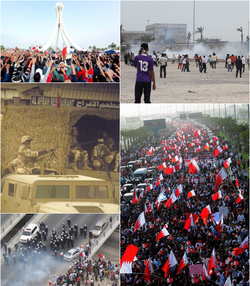
Inspired by the Arab Spring, protesters occupied Pearl Roundabout in Manama demanding constitutional reform and political freedoms. GCC forces intervened, and the government suppressed the movement amid international scrutiny.
Image source: 2011 Bahraini uprising
Nov 23, 2011
% complete
The Bassiouni report documented human rights violations during the 2011 crackdown, including torture and excessive force. Its recommendations prompted some legal reforms, though implementation remained contested.
Image source: Bahrain Independent Commission of Inquiry
Apr 22, 2012
% complete
Bahrain hosted the F1 Grand Prix despite ongoing protests, drawing global attention to the country's political situation. The race highlighted tensions between economic ambitions and civil unrest.
Image source: 2012 Bahrain Grand Prix
Jun 5, 2017 - Jan 2021
% complete
Bahrain joined Saudi Arabia, Egypt, and the UAE in severing ties with Qatar over alleged support for extremism, imposing a blockade that lasted until reconciliation efforts brokered by Kuwait and the US in 2021.
Image source: Qatar diplomatic crisis
Or browse the full history timeline directory, with more than 2,000 topics.
This History of Bahrain timeline was generated with the help of AI, using information found on the internet.
We work hard to keep these timelines accurate, but mistakes do get through. If you spot one, email us at [email protected] and we'll fix it for future visitors.
Generate yours with AI or build it from scratch, for free.
Export your timeline, add your own events, edit or remove AI-generated events, and much more
No credit card required.
Cancel anytime.
Cancel anytime.
You can create an unlimited number of timelines with up to 10 events on each one, customize how they look, export them to PDF, PNG, PowerPoint, CSV, and Excel, and share them with a link. Paid plans raise the event limit and add features like spreadsheet imports and collaborators.
Yes. You can cancel your subscription from your account page at any time, and you will not be charged again. Your subscription stays active for the rest of the period you already paid for.
Yes. We will email you a reminder before the annual renewal, and we will also email you a receipt.
Yes. You can email us within 15 days of any payment, and we will issue you a full refund.
Check out our pricing docs or send us an email anytime: [email protected].