-
Use Cases
-
Resources
-
Pricing
The history of Fiji spans over 3,000 years, beginning with the settlement of Austronesian and later Melanesian peoples. Fiji became a British colony in 1874 and gained independence on October 10, 1970, developing into a multicultural Pacific island nation with a complex political history marked by several coups. More Less
1000 BC
% complete
Over subsequent centuries, later Melanesian migrants mixed with the initial Austronesian settlers, producing the distinctive Fijian people. Villages organized around chiefly hierarchies, and complex inter-island trade networks linked Fiji with Tonga and Samoa.
Image source: History of Fiji
1200 AD
% complete
By the medieval period, fortified hilltop villages and powerful confederacies such as Bau, Rewa, and Verata emerged. Warfare between rival chiefdoms was frequent, and cannibalism was practiced as part of ritual warfare.
Feb 6, 1643
% complete
Dutch explorer Abel Tasman became the first European known to sight Fiji, observing islands in the northern Lau Group during his voyage across the Pacific. He did not land due to hostility from islanders near Vanua Levu.
Image source: Abel Tasman
1774
% complete
Captain James Cook landed on Vatoa in the southern Lau Group during his second Pacific voyage, marking one of the first recorded European contacts with Fijian communities.
Image source: Second voyage of James Cook
1789
% complete
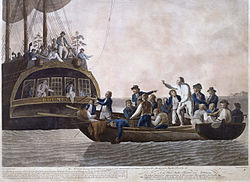
After being cast adrift by mutineers from HMS Bounty, Captain William Bligh navigated a small boat through the Fiji archipelago, charting parts of the group and narrowly avoiding hostile encounters with islanders.
Image source: Mutiny on the Bounty
1800 - 1814
% complete
European traders flocked to Fiji to harvest valuable sandalwood from Vanua Levu. The trade brought firearms, iron tools, and disease, dramatically disrupting traditional society before the sandalwood was exhausted within about two decades.
Image source: Sandalwood
1820 - 1850
% complete
Shipwrecked sailors and deserters settled among Fijian villages as beachcombers, some gaining influence as intermediaries between Europeans and chiefs. Their presence introduced new weapons, goods, and ideas into local power struggles.
Image source: Don Ho
Oct 12, 1835
% complete
Cross and Wesleyan missionaries David Cargill and William Cross, sent with support from Tahitian converts, began Methodist missionary work in Fiji at Lakeba in the Lau Group, initiating the conversion of the islands to Christianity.
Image source: Methodist Church of Fiji and Rotuma
1854
% complete
Ratu Seru Epenisa Cakobau, the influential paramount chief of Bau, embraced Christianity, accelerating widespread conversion across Fiji and transforming social customs by ending practices like cannibalism.
Image source: Seru Epenisa Cakobau
1860 - 1870
% complete
The American Civil War cut world cotton supplies, prompting hundreds of European planters to establish cotton plantations in Fiji. Labor shortages led to the importation of workers from other Pacific islands, often through coercion.
Image source: Fiji
Jun 5, 1871 - Oct 10, 1874
% complete
Facing pressure from rival chiefs, settler interests, and foreign powers, Cakobau established a constitutional monarchy styled as the Kingdom of Fiji, attempting to unify the islands under centralized rule.
Image source: Kingdom of Fiji
Oct 10, 1874
% complete
Unable to manage debt and internal conflict, Cakobau ceded Fiji to Queen Victoria along with other chiefs, beginning nearly a century of British colonial rule under Governor Arthur Gordon's indirect administration of native institutions.
Image source: Colony of Fiji
1875 - 1880
% complete
Sir Arthur Gordon implemented policies protecting Fijian land tenure and village life, ruling through traditional chiefs via the Great Council of Chiefs while restricting Fijian labor in commercial agriculture.
Image source: Charles MacArthur
May 14, 1879 - 1916
% complete
The ship Leonidas brought the first Indian indentured laborers to work on sugar plantations. Over the following decades more than 60,000 Indians were transported to Fiji, profoundly reshaping its demographics and economy.
Image source: Indian indenture system
1882
% complete
The Colonial Sugar Refining Company of Australia established mills and expanded cane cultivation, making sugar Fiji's dominant export and anchoring the plantation economy for the next century.
Image source: Sugar mills in Fiji
1882
% complete
The capital shifted from Levuka to Suva on Viti Levu, which grew into the political and commercial center of the colony with port facilities, government buildings, and a diverse multicultural population.
Image source: Suva
1916 - 1920
% complete
Following sustained protest from Indian activists including Manilal Doctor and criticism in India, Britain ended indentured emigration to Fiji; remaining contracts expired in 1920, freeing Indo-Fijians to pursue farming and business.
Sep 3, 1939 - Sep 2, 1945
% complete
Thousands of Fijians enlisted in the Fiji Infantry Regiment, serving with distinction in the Solomon Islands campaign against Japanese forces, an experience that boosted national consciousness and pride.
Image source: Fiji Infantry Regiment
1964 - 1966
% complete
As decolonization advanced, ethnic-based parties formed: the Alliance Party led by Ratu Kamisese Mara drew mainly indigenous Fijian support, while Indo-Fijian leaders organized the Federation Party, shaping communal politics.
Image source: Alliance Party (Fiji)
1965 - 1970
% complete
London conferences between British officials and Fiji's leaders negotiated a constitution balancing indigenous Fijian land rights and chiefly authority with representation for Indo-Fijians, paving the way for independence.
Oct 10, 1970
% complete
Exactly 96 years after cession, Fiji became an independent Dominion within the Commonwealth with Ratu Sir Kamisese Mara as prime minister, celebrated amid optimism about multiracial nationhood.
Apr 11, 1987
% complete
The Fiji Labour Party–National Federation Party coalition under Dr Timoci Bavadra won the April 1987 election, forming a government dominated by Indo-Fijian ministers and provoking ethnic tensions that led to Rabuka's coups weeks later.
Oct 6, 1987
% complete
Following Sitiveni Rabuka's May coup against the Bavadra-led coalition government and a September second coup, Fiji declared itself a republic, leaving the Commonwealth and entrenching indigenous political dominance.
1990
% complete
The 1990 constitution guaranteed ethnic Fijians a majority of parliamentary seats and reserved the presidency for them, institutionalizing political inequality and drawing international criticism.
Jul 25, 1997
% complete
A review commission chaired by Sir Paul Reeves produced a more equitable constitution adopted in 1997, allowing Fiji to rejoin the Commonwealth and hold elections won by Mahendra Chaudhry's Labour-led coalition in 1999.
May 19, 2000 - Jul 13, 2000
% complete
Civilian coup leader George Speight stormed Parliament and held Prime Minister Mahendra Chaudhry and MPs hostage for 56 days, claiming to act for indigenous rights; the army eventually brokered his surrender amid unrest.
Image source: 2000 Fijian coup d'état
Dec 5, 2006
% complete
Commodore Frank Bainimarama ousted Prime Minister Laisenia Qarase, accusing him of favoring indigenous interests and corruption. His military regime ruled without elections for eight years, pursuing reforms it called 'cleaning up' governance.
Image source: 2006 Fijian coup d'état
Sep 6, 2013 - Sep 17, 2014
% complete
Bainimarama's regime introduced a constitution abolishing ethnic voting in favor of common citizenship, then held democratic elections in September 2014, which Bainimarama's FijiFirst party won, returning him to office as elected prime minister.
Dec 24, 2022
% complete
In tightly contested December elections, Sitiveni Rabuka returned to politics leading a People's Alliance–led coalition with Sodelpa and NFP that defeated Bainimarama's FijiFirst, forming a new government and marking Fiji's first peaceful transfer of power since 2006.
Or browse the full history timeline directory, with more than 2,000 topics.
This History of Fiji timeline was generated with the help of AI, using information found on the internet.
We work hard to keep these timelines accurate, but mistakes do get through. If you spot one, email us at [email protected] and we'll fix it for future visitors.
Generate yours with AI or build it from scratch, for free.
Export your timeline, add your own events, edit or remove AI-generated events, and much more
No credit card required.
Cancel anytime.
Cancel anytime.
You can create an unlimited number of timelines with up to 10 events on each one, customize how they look, export them to PDF, PNG, PowerPoint, CSV, and Excel, and share them with a link. Paid plans raise the event limit and add features like spreadsheet imports and collaborators.
Yes. You can cancel your subscription from your account page at any time, and you will not be charged again. Your subscription stays active for the rest of the period you already paid for.
Yes. We will email you a reminder before the annual renewal, and we will also email you a receipt.
Yes. You can email us within 15 days of any payment, and we will issue you a full refund.
Check out our pricing docs or send us an email anytime: [email protected].