-
Use Cases
-
Resources
-
Pricing
The history of Uzbekistan spans thousands of years, encompassing ancient Silk Road cities like Samarkand, Bukhara, and Khiva, the empires of Alexander the Great, the Arab conquest, the Mongol invasion, and the glorious Timurid Empire. Later shaped by Russian imperial expansion and Soviet governance, Uzbekistan emerged as an independent nation in 1991 following the dissolution of the USSR. More Less
540 BC
% complete
The Achaemenid Persian Empire under Cyrus the Great conquered the region of Sogdia, incorporating the fertile lands between the Amu Darya and Syr Darya rivers, including Samarkand and Bukhara, into the Persian imperial system.
Image source: Sogdia
329 BC
% complete
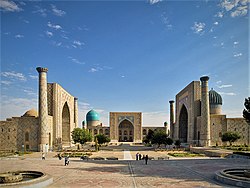
Alexander the Great seized the Sogdian capital of Maracanda, modern-day Samarkand, after fierce resistance from the local leader Spitamenes, bringing Hellenistic culture to Central Asia.
Image source: Samarkand
30 AD - 375 AD
% complete
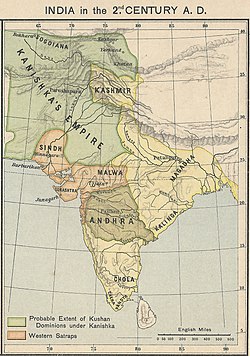
The Kushan Empire, originating from Bactria, extended its control over parts of present-day Uzbekistan, fostering trade along the Silk Road and spreading Buddhism into the region.
Image source: Kushan Empire
450 AD - 565 AD
% complete
The nomadic Hephthalite confederation conquered much of Transoxiana, ruling over the oasis cities until their defeat by a combined Turkic and Sasanian force.
Image source: Hephthalites
560 AD
% complete
After defeating the Hephthalites with Persian aid, the Göktürk Khaganate took control of Transoxiana, integrating it into a vast Turkic empire spanning the Eurasian steppe.
Image source: First Turkic Khaganate
671 AD - 751 AD
% complete
Umayyad Arab forces launched campaigns into Transoxiana, gradually subduing Bukhara and Samarkand. The conquest culminated in the decisive Battle of Talas in 751 against Tang China.
Image source: Muslim conquest of Transoxiana
Jul 751 AD
% complete
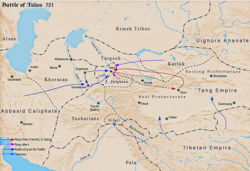
Abbasid forces allied with Turkic troops defeated the Chinese Tang army near the Talas River, securing Muslim dominance in Central Asia and ending Chinese influence in Transoxiana.
Image source: Battle of Talas
819 AD - 999 AD
% complete
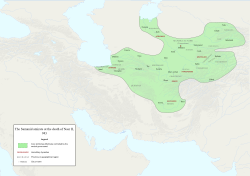
The Persian-speaking Samanids made Bukhara their capital and presided over a golden age of Islamic culture, scholarship, and trade. The dynasty fell to the Karakhanids in 999.
Image source: Samanid Empire
820 AD
% complete
Working at the House of Wisdom, the scholar al-Khwarizmi, born in Khwarezm, wrote 'Al-Jabr,' which gave its name to algebra and profoundly influenced mathematics worldwide.
Image source: Al-Khwarizmi
980 AD
% complete
The polymath Avicenna was born near Bukhara; his 'Canon of Medicine' became one of the most influential medical texts in both the Islamic world and medieval Europe.
Image source: Avicenna
999 AD
% complete
The Karakhanid Khanate, the first Muslim Turkic dynasty, seized Transoxiana from the Samanids, ushering in a period of Turkic rule and cultural synthesis.
Image source: Kara-Khanid Khanate
1040 AD
% complete
The Seljuks decisively defeated the Ghaznavids, extending their dominion toward Transoxiana and reshaping the political map of the eastern Islamic world.
Image source: Battle of Dandanaqan
1200 AD
% complete
The Khwarazmian Shahs built a vast empire centered on Khwarezm that briefly dominated Central Asia and Iran before provoking catastrophic conflict with the Mongols.
Image source: Khwarazmian Empire
1219 AD - 1221 AD
% complete
Genghis Khan's armies destroyed Otrar, Bukhara, Samarkand, and Urgench in retaliation for the execution of Mongol envoys, devastating the region's cities and irrigation systems.
Image source: Mongol invasion of the Khwarazmian Empire
1370 AD - 1405 AD
% complete
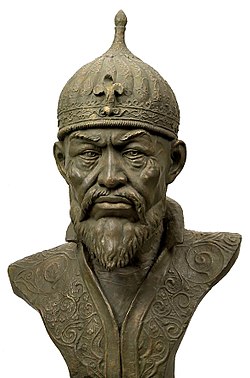
Timur rose to power from his capital at Samarkand and forged an enormous empire through brutal campaigns across Persia, Mesopotamia, India, and Anatolia, making Samarkand a jewel of Islamic architecture.
Image source: Timur
1424 AD - 1429 AD
% complete
Timur's grandson Ulugh Beg constructed a great observatory in Samarkand, producing star catalogs of unprecedented accuracy and making the city a leading center of astronomy.
Image source: Ulugh Beg Observatory
1501 AD
% complete
Muhammad Shaybani's Uzbek dynasty captured Samarkand and Herat, founding the Khanate of Bukhara and marking the ascendancy of Uzbek political power in Transoxiana.
Image source: Khanate of Bukhara
1504 AD
% complete
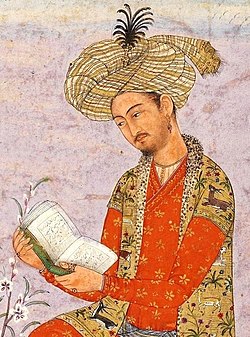
Driven from his native Fergana by Uzbek expansion, Babur moved south and eventually founded the Mughal Empire in India, linking Uzbekistan's history to South Asia's greatest dynasty.
Image source: Babur
1511 AD - 1709 AD
% complete
Alongside the Khanate of Bukhara, the Khanates of Khiva (founded early 1500s) and Kokand (1709) divided the territory of present-day Uzbekistan into three rival states.
Image source: Khanate of Khiva
Jun 1865
% complete
Imperial Russian forces stormed and captured Tashkent, marking a decisive step in Russia's conquest of Turkestan and beginning direct colonial administration of the region.
Image source: Siege of Tashkent (1865)
1868
% complete
Russian troops took Samarkand in May 1868, forcing the Emirate of Bukhara to become a vassal protectorate, effectively ending independent Uzbek statehood under the khans.
Image source: Russian conquest of Central Asia
1875 - 1876
% complete
An anti-Russian revolt in the Khanate of Kokand was crushed, and the khanate was abolished and annexed outright into the Russian Governor-Generalship of Turkestan.
Image source: Khanate of Kokand
1899
% complete
The completion of the railway line connecting Central Asia to Russia accelerated cotton monoculture, Russian settlement, and economic integration of Uzbekistan into the empire.
Image source: Trans-Caspian railway
1905
% complete
Reformist Muslim intellectuals known as Jadids advocated new-method schools, press freedom, and cultural revival in Turkestan, laying groundwork for later national consciousness.
Image source: Jadid
1916 - 1926
% complete
Beginning with the 1916 revolt against conscription and continuing through the 1920s, Muslim guerrillas fought Soviet forces across Turkestan in a prolonged anti-colonial insurgency.
Image source: Basmachi movement
Apr 30, 1918
% complete
Following the Bolshevik revolution, Soviet authorities created the Turkestan ASSR with its center at Tashkent, replacing colonial governance with communist rule amid civil war and Basmachi resistance.
Image source: Turkestan Autonomous Soviet Socialist Republic
Oct 27, 1924
% complete
Soviet national delimitation of Central Asia created the Uzbek SSR, drawing borders that largely correspond to today's Uzbekistan and uniting the Uzbek people within a single republic.
Image source: Uzbek Soviet Socialist Republic
1937 - 1938
% complete
Stalin's purges devastated the Uzbek intelligentsia, destroying most surviving Jadids and party elites, while forced collectivization caused famine and upheaval across Central Asia.
Image source: Great Purge
1941 - 1945
% complete
During World War II, hundreds of factories and hundreds of thousands of evacuees were relocated from the European USSR to Uzbekistan, transforming Tashkent into a major industrial hub.
Image source: Tashkent
Apr 26, 1966
% complete
A powerful 5.1 magnitude earthquake leveled much of central Tashkent, leaving hundreds of thousands homeless; massive Soviet reconstruction rebuilt the city as a showcase of socialist planning.
Image source: 1966 Tashkent earthquake
Mar 24, 1990
% complete
Karimov assumed leadership of the Uzbek SSR and skillfully navigated the collapse of communism, positioning himself to lead the republic into independence.
Image source: Islam Karimov
Aug 31, 1991
% complete
In the wake of the failed Moscow coup, Uzbekistan proclaimed independence on August 31, 1991, which was ratified by referendum in December; September 1 is now Independence Day.
Dec 8, 1992
% complete
The newly independent republic adopted its first constitution, establishing the framework of a presidential republic and declaring Uzbekistan a secular democratic state.
Image source: Constitution of Uzbekistan
Nov 13, 1993
% complete
Uzbekistan introduced the som coupon as a transitional currency, later replaced in 1994 by the permanent som, establishing monetary sovereignty after the ruble zone collapsed.
Image source: Uzbekistani sum
May 13, 2005
% complete
Government forces opened fire on protesters in Andijan following a prison break and uprising, killing hundreds according to observers; the crackdown drew international condemnation and strained ties with the West.
Image source: Andijan massacre
Sep 2, 2016
% complete
President Islam Karimov, who had ruled since 1989, died in office, ending a quarter-century era of authoritarian stability and opening the door to reform.
Dec 14, 2016
% complete
Mirziyoyev succeeded Karimov and initiated sweeping reforms: liberalizing the economy, reopening borders, improving regional relations, releasing political prisoners, and courting foreign investment.
Image source: Shavkat Mirziyoyev
May 6, 2018
% complete
Uzbekistan hosted the signing ceremony of the additional protocol strengthening the Central Asian Nuclear-Weapon-Free Zone treaty, underscoring its new diplomatic activism in the region.
Image source: Southeast Asian Nuclear-Weapon-Free Zone Treaty
Or browse the full history timeline directory, with more than 2,000 topics.
This History of Uzbekistan timeline was generated with the help of AI, using information found on the internet.
We work hard to keep these timelines accurate, but mistakes do get through. If you spot one, email us at [email protected] and we'll fix it for future visitors.
Generate yours with AI or build it from scratch, for free.
Export your timeline, add your own events, edit or remove AI-generated events, and much more
No credit card required.
Cancel anytime.
Cancel anytime.
You can create an unlimited number of timelines with up to 10 events on each one, customize how they look, export them to PDF, PNG, PowerPoint, CSV, and Excel, and share them with a link. Paid plans raise the event limit and add features like spreadsheet imports and collaborators.
Yes. You can cancel your subscription from your account page at any time, and you will not be charged again. Your subscription stays active for the rest of the period you already paid for.
Yes. We will email you a reminder before the annual renewal, and we will also email you a receipt.
Yes. You can email us within 15 days of any payment, and we will issue you a full refund.
Check out our pricing docs or send us an email anytime: [email protected].