-
Use Cases
-
Resources
-
Pricing
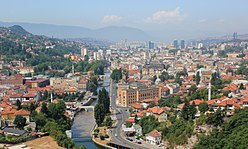
The history of Bosnia and Herzegovina spans from the medieval Kingdom of Bosnia through centuries of Ottoman and Austro-Hungarian rule, incorporation into Yugoslavia, and its declaration of independence in 1992, followed by the devastating Bosnian War and the establishment of a modern multiethnic state. More Less
400 BC - 299 BC
% complete
Celtic migrations in the 4th and 3rd century BCE displaced many Illyrian tribes from their former lands in the Balkans. Some Celtic and Illyrian tribes mixed, shaping the early ethnic landscape of the region that is today Bosnia and Herzegovina.
Image source: Illyrians
300 - 399
% complete
By the 4th century the territory of present-day Bosnia and Herzegovina had become part of the Western Roman Empire, bringing Roman administration, infrastructure, and Latin culture to the region.
Image source: Western Roman Empire
400 - 499
% complete
Germanic tribes invaded soon after the weakening of Roman control, disrupting life in the region and contributing to the broader upheaval of the Migration Period in Europe.
Image source: Migration Period
500 - 599
% complete
In the 6th century, Emperor Justinian re-conquered the area and large parts of the former Western Empire for the Eastern Roman Empire with its capital in Constantinople. Around this time the Latin-speaking Eastern Romans were evolving into what would later be called the Byzantine Empire, speaking Greek.
Image source: Justinian I
500 - 699
% complete
The Slavs, a migratory people from southeastern Europe, allied with the Eurasian Avars in the 6th century and together they invaded the Eastern Roman Empire in the 6th and 7th centuries, settling in what is now Bosnia and Herzegovina and surrounding lands and bringing Slavic languages to the region.
Image source: Slavs
800 - 899
% complete
Upon the looter invasions by the Avars and Slavs from the 6th to 9th centuries, both probably gave way to feudalism only with the might of the Franks penetrating into the region in the late 9th century. Bosnia probably originated as one such pre-feudal entity, and Frankish and Byzantine sources begin mentioning early Slavic polities from this time.
Image source: Franks
900 - 999
% complete
The earliest widely acknowledged reference to Bosnia dates from the 10th century De Administrando Imperio written by Byzantine emperor Constantine Porphyrogenitus. During this period Bosnia was part of the Serbian state of Časlav; after his death in battle around 960, much of Bosnia was briefly incorporated into the Croatian state of Krešimir II.
Image source: De Administrando Imperio
997 - 1018
% complete
In 997, Samuel of Bulgaria marched through Bosnia and asserted his over-lordship over parts of it, but he was defeated by the Byzantine Empire in 1018, which annexed Bulgaria and asserted its own suzerainty in Bosnia.
Image source: Samuel of Bulgaria
1101
% complete
Later in the century some parts of the territory of today's Bosnia were briefly incorporated into Croatia and others into Duklja, from which Bosnia appears to have seceded in about 1101, upon which Bosnia's bans tried to rule for themselves.
Image source: Duklja
1137 - 1167
% complete
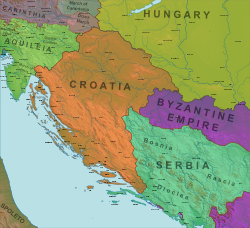
It was primarily under Hungarian political influence from 1137 to 1167, and primarily under Byzantine influence from 1167 to 1180. Neither neighbor had held the Bosnians long enough to acquire their loyalty or impose any serious claim to Bosnia.
Image source: Kingdom of Hungary
1180 - 1204
% complete
Ban Kulin (r. 1180–1204) emerged as the Ban of Bosnia, initially under Byzantine political influence. His reign marked a period of peace and prosperity for the young Banate of Bosnia.
Image source: Ban Kulin
1200 - 1299
% complete
Following the rise of the rivalling Kotromanić family and Croatian Šubić family in the mid 13th century, the Šubić family took control of the Banate of Bosnia in the late 13th century.
Image source: Šubić family
1203
% complete
In response to Hungarian attempts to use church politics as a way to reclaim sovereignty over Bosnia, Kulin held a council of local church leaders to renounce the heresy in 1203, defusing the religious pretext for foreign intervention.
Image source: Banate of Bosnia
1254
% complete
Hungarian ambitions remained unchanged long after Kulin's death in 1204, waning only after an unsuccessful invasion in 1254, which also fostered the schism of the Bosnian Church.
Image source: Bosnian Church
1300 - 1399
% complete
Bosnia regained its independence from the Croatian Šubić family in the early 14th century when Stjepan II Kotromanić became ban, establishing the Kotromanić dynasty as a resilient monarchy.
Image source: Stephen II, Ban of Bosnia
1353
% complete
By the time of Stjepan II's death in 1353, he had annexed territories to the north and west, as well as Zahumlje and parts of Dalmatia. He was succeeded by his nephew Tvrtko.
1367
% complete
Tvrtko, following a prolonged struggle with nobility and inter-family strife, gained full control of the country in 1367 and began consolidating power.
Image source: Tvrtko I of Bosnia
1377
% complete
Under Tvrtko, Bosnia grew in both size and power, and in 1377 Tvrtko I was crowned King of Bosnia, establishing the independent Kingdom of Bosnia at its medieval zenith.
Image source: Kingdom of Bosnia
1391
% complete
Following Tvrtko's death in 1391, Bosnia fell into a long period of decline marked by political fragmentation and weakening royal authority.
1400 - 1463
% complete
The Ottoman Empire had already started its conquest of Europe and posed a major threat to the Balkans throughout the first half of the 15th century, pressing ever closer to Bosnia's borders.
Image source: Ottoman wars in Europe
1463
% complete
After decades of political and social instability, Bosnia officially fell to the Ottomans in 1463, beginning more than 400 years of Ottoman rule, while resistance remained active and fierce for a few more centuries. Southern regions known as 'Herzegovina' followed in 1482.
Image source: Ottoman conquest of Bosnia and Herzegovina
1475 - 1499
% complete
During Ottoman rule, a native Slavic-speaking Muslim community emerged and became the largest ethno-religious group through gradual conversions to Islam, while a significant number of Sephardi Jews arrived following their expulsion from Spain in the late 15th century. The Orthodox community also spread throughout the country.
Image source: Sephardic Jews
1699
% complete
By the late 17th century the Ottoman Empire's military misfortunes caught up with the country, and the conclusion of the Great Turkish War with the Treaty of Karlowitz in 1699 once again made Bosnia the empire's westernmost province.
Image source: Treaty of Karlowitz
1831
% complete
Frustrations combined with resentment over political concessions to nascent Christian states culminated in a famous but ultimately unsuccessful revolt by Husein Gradaščević in 1831. Related rebellions would be extinguished by 1850.
Image source: Husein Gradaščević
1866
% complete
A renewed effort at Ottoman reforms occurred in the 1860s under governor Topal Şerif Osman, who founded a provincial printing press in 1866 that published in both Ottoman Turkish and Bosnian.
Image source: Bosnia and Herzegovina
1875 - 1878
% complete
Agrarian unrest sparked the Herzegovinian rebellion in 1875, a widespread peasant uprising. The conflict rapidly spread, involving several Balkan states and Great Powers.
1878
% complete
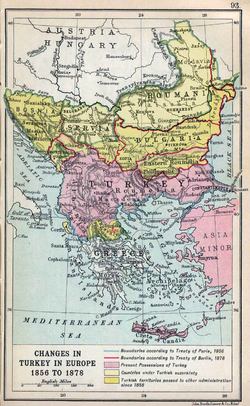
The conflict forced the Ottomans to cede administration of the country to the Habsburg monarchy through the Treaty of Berlin in 1878, ending four centuries of Ottoman rule and beginning Austro-Hungarian governance.
Image source: Treaty of Berlin (1878)
1908
% complete
The Habsburg decision to formally annex Bosnia-Herzegovina in 1908 added urgency among Croat and Serb nationalists whose nationhood concepts had spread into the country's Catholic and Orthodox communities in the mid 19th century.
Image source: Bosnian Crisis
Jun 28, 1914
% complete
Political tensions culminated on 28 June 1914 when Young Bosnia revolutionary Gavrilo Princip assassinated the heir to the Habsburg throne, Archduke Franz Ferdinand, in Sarajevo — the spark that ignited World War I.
Image source: Assassination of Archduke Franz Ferdinand
1918
% complete
The establishment of the Kingdom of Serbs, Croats, and Slovenes in 1918 brought the redrawing of administrative regions into the new kingdom. Political life was marked by social unrest over the Agrarian Reform of 1918–19 and shifting party coalitions.
Image source: Kingdom of Yugoslavia
1929
% complete
The establishment of the Kingdom of Yugoslavia in 1929 brought the redrawing of administrative regions into banates that purposely avoided all historical and ethnic lines, removing any trace of a Bosnian entity. The 1939 Cvetković-Maček agreement creating the Croatian banate encouraged an effective partition of Bosnia between Croatia and Serbia.
1941
% complete
Starting in 1941, Yugoslav communists under Josip Broz Tito organized their own multi-ethnic resistance group, the Partisans, who fought against Axis, Ustaše, and Chetnik forces throughout the war.
Image source: Yugoslav Partisans
Apr 6, 1941
% complete
Following attempts at appeasement, the joining of the Tripartite Pact, and a coup d'état, Yugoslavia was finally invaded by Germany on 6 April 1941, plunging Bosnia into war.
Image source: Invasion of Yugoslavia
Oct 12, 1941
% complete
On 12 October 1941, 108 notable Muslim citizens of Sarajevo signed the Resolution of Sarajevo Muslims, condemning the persecution of Serbs organized by Ustaše forces and requesting security for all citizens regardless of identity.
Nov 25, 1943
% complete
On 25 November 1943 the Anti-Fascist Council of National Liberation of Yugoslavia held a founding conference in Jajce where Bosnia and Herzegovina was reestablished as a republic within the Yugoslavian federation within its Ottoman-era borders.
Image source: Anti-Fascist Council for the National Liberation of Yugoslavia
Apr 6, 1945
% complete
On 6 April 1945 Sarajevo was captured by the Partisans, contributing to the end of Axis occupation and the conclusion of World War II in Yugoslavia.
Image source: Sarajevo
1946
% complete
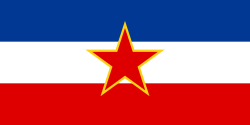
Following Axis defeat, Bosnia and Herzegovina achieved its current borders by becoming a federal unit within the Federal People's Republic of Yugoslavia, with the constitution of 1946 officially making it one of six constituent republics. The state was renamed the Socialist Federal Republic of Yugoslavia in 1963.
Image source: Socialist Federal Republic of Yugoslavia
1980
% complete
While working within the communist system, politicians such as Džemal Bijedić, Branko Mikulić and Hamdija Pozderac reinforced and protected the sovereignty of Bosnia and Herzegovina. Their efforts proved key during the turbulent period following Tito's death in 1980 and are considered early steps towards Bosnian independence.
Image source: Hamdija Pozderac
Nov 18, 1990 - Nov 25, 1990
% complete
The first multi-party parliamentary elections held on 18 and 25 November 1990 led to a national assembly dominated by three ethnically based parties, which had formed a loose coalition to oust the communists from power.
Oct 15, 1991
% complete
A declaration of sovereignty on 15 October 1991 was followed by a referendum for independence from Yugoslavia on 29 February and 1 March 1992.
Image source: Breakup of Yugoslavia
1992 - 1993
% complete
Armed and equipped from JNA stockpiles and supported by volunteers, Republika Srpska's offensives in 1992 placed much of the country under its control. By 1993, when conflict erupted between Sarajevo and the Croat statelet of Herzeg-Bosnia, about 70% of the country was controlled by Serb forces.
Image source: Republika Srpska
Mar 3, 1992
% complete
Bosnia and Herzegovina became an independent state on 3 March 1992, following the independence referendum held on 29 February and 1 March 1992.
Image source: Socialist Republic of Bosnia and Herzegovina
Mar 7, 1992
% complete
Significant Serbian offensives began in March 1992 in Eastern and Northern Bosnia. Serb paramilitary forces attacked Bosniak villages around Čapljina on 7 March 1992 and around Bosanski Brod and Goražde on 15 March, opening armed conflict supported by weapons from JNA stockpiles.
Image source: Bosnian War
Apr 5, 1992
% complete
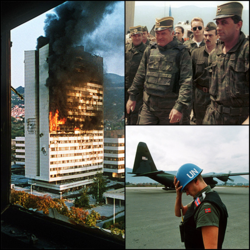
The killing of a Bosniak civilian woman on 5 April 1992 by a sniper, while she demonstrated in Sarajevo against the raising of barricades by Bosnian Serbs, is widely regarded as marking the start of warfare between the three major communities.
Image source: Siege of Sarajevo
Mar 1994
% complete
In March 1994, the signing of the Washington accords between Bosniak and ethnic-Croat leaders led to the creation of a joint Bosniak-Croat Federation of Bosnia and Herzegovina, ending fighting between the two sides.
Image source: Washington Agreement
Jul 1995
% complete
International outrage at Serb war crimes and atrocities, most notably the Srebrenica massacre of as many as 8,000 Bosniak males in July 1995, helped turn the tide of war. In total the three-year war caused around 100,000 deaths and 2 million refugees.
Image source: Srebrenica massacre
Dec 14, 1995
% complete
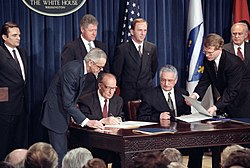
Since its 1992 independence and the 1995 Constitutional framework of the Dayton Agreement, Bosnia and Herzegovina has followed a path of state-building while remaining under final international supervision through the High Representative for Bosnia and Herzegovina.
Image source: Dayton Agreement
Apr 2010
% complete
The accession of Bosnia and Herzegovina to NATO is in the negotiation phase, and a Membership Action Plan was signed in April 2010.
Image source: Bosnia and Herzegovina–NATO relations
Feb 4, 2014
% complete
On 4 February 2014, protests against the government of the Federation of Bosnia and Herzegovina began in the northern town of Tuzla, marking the largest outbreak of public anger over high unemployment and two decades of political inertia since the end of the Bosnian War.
Image source: 2014 unrest in Bosnia and Herzegovina
Jun 2015
% complete
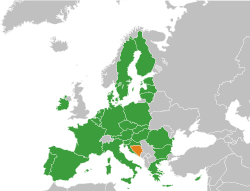
As a potential candidate country for EU accession, Bosnia and Herzegovina saw the EU-BiH Stabilization and Association Agreement, signed in 2008, enter into force in June 2015.
Image source: Stabilisation and Association Process
Feb 15, 2016
% complete
Bosnia and Herzegovina submitted its formal application for EU membership on 15 February 2016. The EU Council conditioned its consideration on further progress on the Reform Agenda, adaptation of the SAA for Croatia's accession, and a functioning Coordination Mechanism — conditions fulfilled by Summer 2016.
Image source: Accession of Bosnia and Herzegovina to the European Union
Or browse the full history timeline directory, with more than 2,000 topics.
This History of Bosnia and Herzegovina timeline was generated with the help of AI, using information found on the internet.
We work hard to keep these timelines accurate, but mistakes do get through. If you spot one, email us at [email protected] and we'll fix it for future visitors.
Generate yours with AI or build it from scratch, for free.
Export your timeline, add your own events, edit or remove AI-generated events, and much more
No credit card required.
Cancel anytime.
Cancel anytime.
You can create an unlimited number of timelines with up to 10 events on each one, customize how they look, export them to PDF, PNG, PowerPoint, CSV, and Excel, and share them with a link. Paid plans raise the event limit and add features like spreadsheet imports and collaborators.
Yes. You can cancel your subscription from your account page at any time, and you will not be charged again. Your subscription stays active for the rest of the period you already paid for.
Yes. We will email you a reminder before the annual renewal, and we will also email you a receipt.
Yes. You can email us within 15 days of any payment, and we will issue you a full refund.
Check out our pricing docs or send us an email anytime: [email protected].