-
Use Cases
-
Resources
-
Pricing
Moldova's history spans ancient Dacian tribes, the medieval Principality of Moldavia founded by Dragoș and later ruled by Stephen the Great, centuries of Ottoman suzerainty, annexation by the Russian Empire in 1812, unification with Romania in 1918, Soviet rule as the Moldavian SSR after World War II, and finally independence following the collapse of the USSR in 1991. More Less
1359
% complete
Bogdan I led a group of Vlachs across the Carpathians from Maramureș and established the Principality of Moldavia, an independent medieval state that would become the historical core of the region known today as Moldova.
Image source: Moldavia
1436
% complete
Chișinău, today the capital of Moldova, was first mentioned in documents dating to 1436 as a small village. It would later grow under Russian rule into the region's principal city and administrative center.
Image source: Chișinău
Apr 12, 1457 - Jul 2, 1504
% complete
Stephen the Great ruled Moldavia for nearly half a century, successfully defending it against the Ottoman Empire, Hungary, and Poland in numerous battles. He is regarded as the most important ruler in Moldavian history and was later canonized by the Romanian Orthodox Church.
Image source: Stephen the Great
Jan 10, 1475
% complete
Stephen the Great achieved one of his greatest victories at Vaslui, decisively defeating an invading Ottoman army far larger than his own forces. The victory temporarily halted Ottoman expansion into Moldavia and earned Stephen renown across Europe.
Image source: Battle of Vaslui
1538
% complete
After Sultan Suleiman the Magnificent's campaign against Petru Rareș, Moldavia was forced to accept Ottoman suzerainty, paying tribute while retaining nominal autonomy. This status persisted for over three centuries.
Jul 21, 1774
% complete
The treaty ending the Russo-Turkish War of 1768–1774 gave Russia the right to intervene on behalf of Orthodox Christians in Ottoman lands, including Moldavia, paving the way for growing Russian influence in the Danubian principalities.
Image source: Battle of Kinburn (1787)
May 28, 1812
% complete
Following the Russo-Turkish War of 1806–1812, the eastern half of the Principality of Moldavia, known as Bessarabia, was ceded to the Russian Empire. This event separated the region from western Moldavia for most of the next two centuries.
Image source: Treaty of Bucharest (1812)
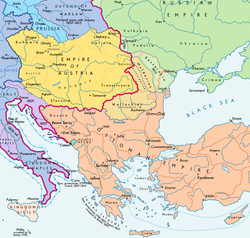
1829
% complete
Russia implemented administrative reforms in Bessarabia modeled on the Organic Regulations, gradually integrating the province into the imperial system and diminishing local autonomy.
1856
% complete
In the aftermath of the Crimean War, Russia fully abolished Bessarabia's special autonomous status, incorporating it more tightly into the empire and intensifying policies of Russification.
Image source: Bessarabia Governorate
Mar 30, 1856 - 1878
% complete
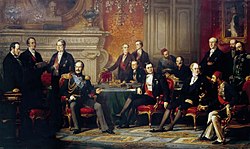
The Treaty of Paris ending the Crimean War transferred southern Bessarabia back to the Principality of Moldavia, which soon united with Wallachia to form Romania. Russia regained this territory in 1878 through the Treaty of Berlin.
Image source: Treaty of Paris (1856)
1871
% complete
The arrival of the railway connecting Chișinău with Odessa and other imperial cities spurred economic growth, trade, and urbanization, transforming the city into a commercial hub of southwestern Russia.
Image source: Rail transport by country
1905 - 1907
% complete
The revolutionary upheaval in the Russian Empire reached Bessarabia, prompting demands for political freedoms, use of the Romanian language in schools and churches, and greater self-governance amid widespread strikes and peasant unrest.
Image source: Russian Revolution of 1905
Dec 6, 1917
% complete
Amid the chaos following the Russian Revolution, the Sfatul Țării council proclaimed the Moldavian Democratic Republic, declaring autonomy within Russia and later full independence before seeking union with Romania.
Image source: Moldavian Democratic Republic
Apr 9, 1918
% complete
The Sfatul Țării voted unanimously to unite Bessarabia with the Kingdom of Romania. The union was recognized by major Western powers in 1920 but never acknowledged by Soviet Russia, remaining a point of contention.
Image source: Sfatul Țării
Oct 28, 1920
% complete
The Treaty of Paris formally recognized the union of Bessarabia with Romania by Britain, France, Italy, and Japan. The Soviet Union refused to accept it, considering Bessarabia occupied territory.
Image source: Treaty of Paris (1920)
Oct 12, 1924 - Aug 2, 1940
% complete
The USSR created the Moldavian ASSR within Ukraine, on territory east of the Dniester River, partly as a claim on Bessarabia. It promoted a 'Moldovan' identity distinct from Romanian and served as a precursor to the future Moldavian SSR.
Image source: Moldavian Autonomous Soviet Socialist Republic
1940
% complete
Soviet policy mandated writing the Moldovan language in a Cyrillic-based script rather than Latin letters, aiming to differentiate Moldovans from Romanians. The Latin script would only be restored in 1989.
Image source: Moldovan Cyrillic alphabet
Jun 28, 1940 - Jul 3, 1940
% complete
Under the Molotov–Ribbentrop Pact, the USSR demanded and received Bessarabia from Romania, occupying it along with northern Bukovina. Most of Bessarabia was joined with part of the Moldavian ASSR to form the Moldavian SSR.
Image source: Soviet occupation of Bessarabia and Northern Bukovina
Aug 2, 1940 - Aug 27, 1991
% complete
The Moldavian SSR was established as a union republic of the USSR with its capital at Chișinău. It existed until the dissolution of the Soviet Union, undergoing war devastation, deportations, industrialization, and forced collectivization.
Image source: Moldavian Soviet Socialist Republic
Jul 22, 1941 - 1944
% complete
Romanian and German forces invaded the Soviet Union and retook Bessarabia during Operation München. During the subsequent Axis occupation, Jews were persecuted and deported en masse, with tens of thousands killed or expelled to Transnistria.
Image source: Operation München
Aug 20, 1944 - Aug 29, 1944
% complete
The Red Army's decisive Jassy–Kishinev operation destroyed German-Romanian forces and brought the Moldavian SSR firmly back under Soviet control for the remainder of the Cold War era.
Image source: Second Jassy–Kishinev offensive
Jun 13, 1949 - 1951
% complete
Stalinist authorities deported tens of thousands of Moldovans—peasants labeled 'kulaks,' religious figures, and 'bourgeois nationalists'—to Siberia and Central Asia as part of collectivization and political repression campaigns.
Image source: Kulak
Sep 10, 1988
% complete
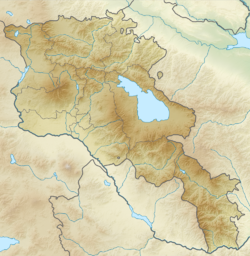
A powerful earthquake centered in Armenia shook much of Eastern Europe, including the Moldavian SSR, causing damage to buildings in Chișinău and highlighting aging infrastructure in the late Soviet period.
Image source: 1988 Armenian earthquake
Aug 31, 1989
% complete
The Popular Front movement pressured the Moldavian SSR to adopt legislation restoring the Latin alphabet and recognizing the identity of Moldovan with Romanian. August 31 is now celebrated as National Language Day.
Image source: 2025 Moldovan parliamentary election
Jun 23, 1990
% complete
The Moldavian parliament declared the republic sovereign, asserting supremacy of its laws over Soviet legislation—a crucial step toward full independence as the USSR weakened.
Sep 2, 1990
% complete
Russian-speaking separatists in the Dniester region proclaimed the Pridnestrovian Moldavian Republic, fearing reunification with Romania. The move triggered a conflict that remains unresolved to this day.
Image source: Transnistria
Nov 19, 1990 - Dec 23, 1994
% complete
The Gagauz minority in southern Moldova declared the Republic of Gagauzia in response to nationalist trends. After negotiations, Gagauzia peacefully reintegrated in 1994 as an autonomous territorial unit.
Image source: Gagauzia
Aug 27, 1991
% complete
Following the failed August coup in Moscow, Moldova's parliament declared independence from the Soviet Union. The date became the country's national holiday, Independence Day.
Mar 2, 1992 - Jul 21, 1992
% complete
Armed conflict broke out between Moldovan forces and Transnistrian separatists supported by Russian troops. The ceasefire signed in Moscow froze the conflict, leaving Russian peacekeepers in the breakaway region and Transnistria de facto independent.
Image source: Transnistrian War
Jul 8, 1994
% complete
Moldova formally acceded to the CIS, balancing between East and West while pursuing economic integration with its post-Soviet neighbors, particularly its main trading partner Russia.
Image source: Commonwealth of Independent States
Jul 29, 1994
% complete
Moldova adopted its new constitution establishing it as a parliamentary republic with a semi-autonomous status for Gagauzia. It defined the official language as 'Moldovan' while affirming neutrality.
Image source: Constitution of Moldova
Feb 25, 2001
% complete
The Communist Party led by Vladimir Voronin won a landslide victory, making Moldova the first former Soviet country where communists legally returned to power; Voronin served as president until 2009.
Image source: Party of Communists of the Republic of Moldova
Apr 7, 2009 - Apr 8, 2009
% complete
Allegations of fraud in parliamentary elections sparked violent riots in Chișinău, including the storming of parliament and the presidency. The unrest, dubbed the 'Twitter Revolution,' precipitated political crisis and early elections.
Image source: April 2009 Moldovan parliamentary election protests
Jul 29, 2009 - 2013
% complete
Pro-European parties formed governing coalitions after elections, shifting foreign policy toward the European Union and launching negotiations on visa liberalization, free trade, and eventual EU candidacy.
Image source: First Filat Cabinet
Mar 16, 2012 - Dec 23, 2016
% complete
Parliament elected Nicolae Timofti as president, ending a prolonged political deadlock and constitutional crisis that had left Moldova without a head of state for more than two years.
Image source: Nicolae Timofti
Jun 27, 2014
% complete
Moldova signed an Association Agreement including a Deep and Comprehensive Free Trade Area with the European Union, marking the country's firmest commitment yet to European integration despite Russian pressure.
Image source: Moldova–European Union relations
Jan 2015
% complete
Investigations revealed that roughly $1 billion—one eighth of Moldova's GDP—had been siphoned out of three major banks. The scandal triggered mass anti-corruption protests and a deep political crisis.
Image source: 2014 Moldovan bank fraud scandal
Feb 24, 2016
% complete
Former World Bank economist Maia Sandu founded PAS, an explicitly pro-European, anti-corruption party that would become the dominant political force in Moldova within five years.
Image source: Party of Action and Solidarity
Nov 13, 2016
% complete
Moldova reinstated direct presidential elections, and pro-Russian candidate Igor Dodon won the runoff, signaling continued polarization between pro-European and pro-Moscow camps.
Image source: Igor Dodon
Nov 15, 2020
% complete
Maia Sandu defeated incumbent Igor Dodon, becoming Moldova's first female president on a strongly pro-EU and anti-corruption platform, reshaping the country's political trajectory.
Image source: Maia Sandu
Or browse the full history timeline directory, with more than 2,000 topics.
This History of Moldova timeline was generated with the help of AI, using information found on the internet.
We work hard to keep these timelines accurate, but mistakes do get through. If you spot one, email us at [email protected] and we'll fix it for future visitors.
Generate yours with AI or build it from scratch, for free.
Export your timeline, add your own events, edit or remove AI-generated events, and much more
No credit card required.
Cancel anytime.
Cancel anytime.
You can create an unlimited number of timelines with up to 10 events on each one, customize how they look, export them to PDF, PNG, PowerPoint, CSV, and Excel, and share them with a link. Paid plans raise the event limit and add features like spreadsheet imports and collaborators.
Yes. You can cancel your subscription from your account page at any time, and you will not be charged again. Your subscription stays active for the rest of the period you already paid for.
Yes. We will email you a reminder before the annual renewal, and we will also email you a receipt.
Yes. You can email us within 15 days of any payment, and we will issue you a full refund.
Check out our pricing docs or send us an email anytime: [email protected].