-
Use Cases
-
Resources
-
Pricing
The history of Belarus spans from early Slavic settlements and the Principality of Polotsk in the 9th century, through centuries within the Grand Duchy of Lithuania and the Polish-Lithuanian Commonwealth, incorporation into the Russian Empire after the partitions of Poland, the Soviet period as the Byelorussian SSR including heavy devastation during World War II, and finally independence following the dissolution of the Soviet Union in 1991. More Less
500 - 800
% complete
Between the 6th and 8th centuries, the migrations and expansion of Slavic peoples across Eastern Europe began, settling the territories of present-day Belarus.
Image source: Slavs
800
% complete
The common cultural bond of Eastern Orthodox Christianity and written Church Slavonic, developed by 8th-century missionaries Saints Cyril and Methodius, fostered the emergence of a new geopolitical entity, Kievan Rus'.
Image source: Kievan Rus'
900 - 1200
% complete
Between the 9th and 12th centuries, the Principality of Polotsk in northern Belarus emerged as the dominant center of power in the territory of Belarus, while the Principality of Turov to the south was a lesser power.
Image source: Principality of Polotsk
1044 - 1066
% complete
The Cathedral of Holy Wisdom in Polotsk was built between 1044 and 1066. Though completely rebuilt over the years, it remains a symbol of independent-mindedness, rivaling churches of the same name in Novgorod and Kiev and referring to Hagia Sophia in Constantinople.
Image source: Vseslav of Polotsk
1120 - 1182
% complete
Cultural achievements of the Polotsk period include the work of nun Euphrosyne of Polotsk (1120–1173), who built monasteries, transcribed books and sponsored art including Lazar Bohsha's famous Cross of Euphrosyne, and the Church Slavonic sermons of Bishop Kirill of Turov (1130–1182).
Image source: Euphrosyne of Polotsk
1240
% complete
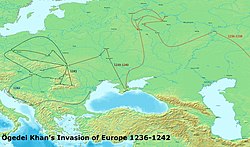
In the 13th century, the fragile unity of Kievan Rus' disintegrated due to nomadic incursions from Asia, climaxing with the Mongol sacking of Kiev in 1240, which left a geopolitical vacuum in the region.
Image source: Mongol invasion of Kievan Rus'
1200 - 1500
% complete
From the 13th to 15th century, the principalities were either conquered or willingly joined the Grand Duchy of Lithuania. Following the Mongol invasions, these lands were absorbed by the Grand Duchy of Lithuania.
Image source: Grand Duchy of Lithuania
1240 - 1263
% complete
Due to military conquest and dynastic marriages, the western principalities of Rus' in modern Belarus were acquired by the expanding Grand Duchy of Lithuania, beginning with the rule of Lithuanian King Mindaugas (1240–1263).
1413
% complete
Since the Union of Horodlo of 1413, the local nobility was assimilated into the traditional clan system by means of the formal procedure of adoption by the szlachta, the Polish gentry.
Image source: Union of Horodło
1432 - 1436
% complete
Several Lithuanian monarchs — the last being Švitrigaila in 1432–36 — relied on the Eastern Orthodox Ruthenian majority, while most monarchs and magnates increasingly came to reflect the opinions of the Roman Catholics.
Image source: Švitrigaila
1480
% complete
Construction of Orthodox churches in some parts of present-day Belarus had been initially prohibited, as was the case in Vitebsk in 1480.
Image source: Vitebsk
1511
% complete
In 1511, King and Grand Duke Sigismund I the Old granted the Orthodox clergy an autonomy previously enjoyed only by Catholic clergy. The privilege was enhanced in 1531, when the metropolitan became responsible only to the sobor of eight Orthodox bishops, the Grand Duke and the Patriarch of Constantinople.
Image source: Sigismund I the Old
1569
% complete
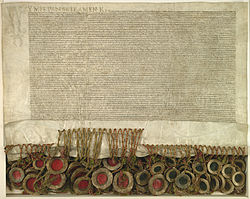
The Union of Lublin in 1569 merged the Grand Duchy of Lithuania with Poland into the Polish–Lithuanian Commonwealth, which became an influential player in European politics and the largest multinational state in Europe.
Image source: Union of Lublin
1569 - 1700
% complete
From 1569, the Polish–Lithuanian Commonwealth suffered a series of Tatar raids aimed at looting, pillaging and capturing slaves into jasyr. The borderland area to the south-east remained in a state of semi-permanent warfare until the 18th century.
Image source: Crimean–Nogai slave raids in Eastern Europe
1573
% complete
The Warsaw Compact of 1573 codified the preexisting freedom of worship in the Polish–Lithuanian Commonwealth.
Image source: Warsaw Confederation
1595
% complete
Possibly to avoid religious conflicts, in 1595 the Orthodox hierarchs of Kiev signed the Union of Brest, breaking their links with the Patriarch of Constantinople and placing themselves under the Pope.
Image source: Union of Brest
1595
% complete
In 1595, Cossack insurgents under Severyn Nalyvaiko took the towns of Slutsk and Mogilev and executed Polish magistrates there. Further clashes took place in Mogilev (1606–10), Vitebsk (1623), and Polotsk (1623, 1633).
Image source: Severyn Nalyvaiko
1772 - 1795
% complete
Following the Partitions of Poland in the 18th century, Belarusian territories became part of the Russian Empire. Eventually, by 1795, Poland was partitioned by its neighbors.
Image source: Partitions of Poland
1830 - 1863
% complete
The independence-seeking 1830 and 1863 uprisings of the gentry were subdued by government forces of the Russian Empire.
Image source: January Uprising
1850 - 1900
% complete
In the second half of the 19th century, the Belarusian economy experienced significant growth due to the spread of the Industrial Revolution to Eastern Europe, particularly after the emancipation of the serfs in 1861 and the construction of railways, with Minsk, Vitebsk, Grodno, Pinsk and Gomel becoming significant industrial centres. Despite Russification policies under Nicholas I and Alexander III, the 19th century marked the rise of the modern Belarusian nation.
Image source: Belarus
1862 - 1863
% complete
In 1862–1863 Kalinowski published the first newspaper in the modern Belarusian language, Mużyckaja prauda (Peasants' Truth), written in Latin script.
Image source: Mužyckaja prauda
Feb 21, 1918
% complete
On 21 February 1918, Minsk was captured by German troops during World War I. German administration allowed schools teaching the previously banned Belarusian language, until they were banned again in 1919 by the Polish military administration.
Image source: History of Belarus
Mar 25, 1918
% complete
At the end of World War I, when Belarus was still occupied by Germany according to the Treaty of Brest-Litovsk, the short-lived Belarusian People's Republic was pronounced on 25 March 1918 as part of the German Mitteleuropa plan.
Image source: Belarusian Democratic Republic
Dec 3, 1918 - Dec 10, 1918
% complete
In December 1918, Mitteleuropa was obsolete as the German Empire withdrew from Ober-Ost territory. On 3 December 1918 the Germans withdrew from Minsk, and on 10 December 1918 Soviet troops occupied the city.
Image source: Byelorussian Soviet Socialist Republic
Jan 2, 1919 - Feb 17, 1919
% complete
On 2 January 1919, the Soviet Socialist Republic of Byelorussia was declared. It was disbanded on 17 February 1919.
Image source: Socialist Soviet Republic of Lithuania and Belorussia
Apr 17, 1919 - Aug 8, 1919
% complete
When Vilnius was captured by Polish forces on 17 April 1919, the capital of the Soviet puppet state Litbel was moved to Minsk. On 17 July 1919 Lenin dissolved Litbel because of the pressure of Polish forces advancing from the West, and Polish troops captured Minsk on 8 August 1919.
Apr 25, 1920 - Jul 31, 1920
% complete
Poland's Józef Piłsudski, who envisioned an Intermarium federation, carried out a Kiev offensive into Ukraine in 1920. A Red Army counter-offensive drove into Poland almost to Warsaw; Minsk was re-captured by the Red Army on 11 July 1920 and a new Byelorussian SSR was declared on 31 July 1920.
Image source: Kiev offensive (1920)
Oct 12, 1920 - Mar 15, 1923
% complete
The republic was created in 1920 following the staged rebellion of soldiers of the 1st Lithuanian–Belarusian Division of the Polish Army under Lucjan Żeligowski. After a disputed election on 8 January 1922, the territory was annexed to Poland, which Żeligowski later condemned in his 1943 memoir.
Image source: Republic of Central Lithuania
Mar 15, 1923
% complete
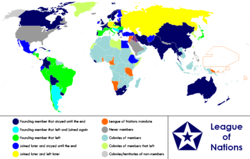
The People's Republic of Belarus prepared a national uprising over two years, ceasing preparations only when the League of Nations recognized the Soviet Union's western borders on 15 March 1923.
Image source: League of Nations
1924
% complete
In 1924 Poland created the Border Protection Corps along its eastern borderlands.
Image source: Border Protection Corps
1930
% complete
Belarusian representation in the Polish parliament was reduced as a result of the 1930 elections. By spring 1939 there was neither a single Belarusian official organization in Poland nor a single exclusively Belarusian school, with only 44 schools teaching Belarusian remaining.
Image source: Belarusians in Poland
Sep 17, 1939
% complete
When the Soviet Union invaded Poland on September 17, 1939, following the terms of the Molotov–Ribbentrop Pact's secret protocol, Western Byelorussia, which was part of Poland, was included in the BSSR. By October 1940, over 75% of schools used the Belarusian language.
Image source: Soviet invasion of Poland
Jun 22, 1941 - Aug 31, 1941
% complete
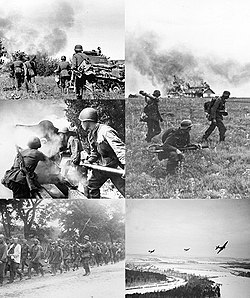
After twenty months of Soviet rule, Nazi Germany and its Axis allies invaded the Soviet Union on 22 June 1941. Minsk was captured on 28 June 1941, and following bloody encirclement battles all of present-day Belarus was occupied by the Germans by the end of August 1941.
Image source: Operation Barbarossa
1942
% complete
One of the first uprisings of a Jewish ghetto against the Nazis occurred in 1942 in Belarus, in the small town of Lakhva.
Image source: Łachwa Ghetto
Jul 30, 1943
% complete
In the largest partisan sabotage action of the entire Second World War, the so-called Asipovichy diversion of 30 July 1943 destroyed four German trains carrying supplies and Tiger tanks.
Image source: German occupation of Byelorussia during World War II
Jun 22, 1944 - Aug 31, 1944
% complete
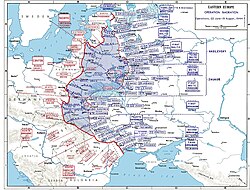
On 22 June 1944 the huge Soviet offensive Operation Bagration was launched. Minsk was re-captured on 3 July 1944, and all of Belarus was regained by the end of August 1944. In 1944 thirty Belarusians known as Čorny Kot (Black Cat), led by Michał Vituška, were airdropped by the Luftwaffe behind Red Army lines.
Image source: Operation Bagration
1933
% complete
Belarusian orthography was Russified in 1933 and use of the Belarusian language was discouraged in the Byelorussian SSR as exhibiting anti-Soviet attitude.
1945
% complete
After the end of the war in 1945, Belarus became one of the founding members of the United Nations Organisation. Industrial production in 1945 amounted to less than 20% of pre-war size, and most evacuated factories were not returned to Belarus after 1945.
Apr 26, 1986
% complete
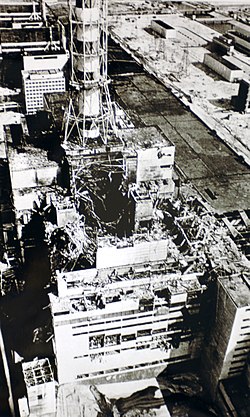
On 26 April 1986, the Chernobyl disaster occurred at the Chernobyl Nuclear Power Plant in Ukraine, situated close to the border with Belarus, causing severe radioactive contamination of large areas of Belarus.
Image source: Chernobyl disaster
Jul 27, 1990
% complete
On 27 July 1990, Belarus declared its national sovereignty, a key step toward independence from the Soviet Union.
Image source: Dissolution of the Soviet Union
Aug 25, 1991
% complete
On 25 August 1991, after the failure of the August Coup in Moscow, Belarus declared full independence from the USSR by granting the declaration of state sovereignty constitutional status it did not have before.
Image source: Independence Day (Belarus)
Dec 8, 1991
% complete
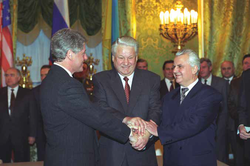
On 8 December 1991, Shushkevich met with Boris Yeltsin of Russia and Leonid Kravchuk of Ukraine in Belavezhskaya Pushcha to formally declare the dissolution of the Soviet Union and the formation of the Commonwealth of Independent States.
Image source: Belovezha Accords
Jun 23, 1994 - Jul 10, 1994
% complete
A new Belarusian constitution enacted in early 1994 paved the way for the first democratic presidential election held on 23 June and 10 July, won by Alexander Lukashenko.
Image source: 1994 Belarusian presidential election
Dec 5, 1994
% complete
Having assumed the rights and responsibilities of the Soviet Union on the territory of Byelarus, in December 1994 Lukashenko signed the Budapest Memorandum along with Russia, the United Kingdom and the United States acting as guarantors, thereby denuclearizing the nation.
Image source: Budapest Memorandum
Nov 24, 1996
% complete
The 1996 referendum resulted in amendments to the constitution that removed key powers from the parliament.
1999
% complete
In 1999 opposition leaders Yury Zacharanka and Viktar Hanchar disappeared and were presumably killed.
Sep 9, 2001 - Dec 19, 2010
% complete
In 2001 Lukashenko was re-elected in elections described as undemocratic by Western observers. He was re-elected again in 2006 and 2010 in presidential elections criticized as flawed or falsified by most EU countries and organizations such as the OSCE.
Image source: Alexander Lukashenko
Aug 9, 2020
% complete
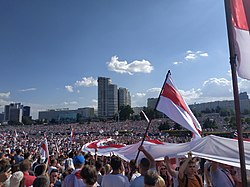
Lukashenko's disputed victory in the country's 2020 presidential election led to widespread allegations of vote rigging, which strongly amplified anti-government protests — the largest during his rule.
Image source: 2020–2021 Belarusian protests
May 23, 2021
% complete
On 23 May 2021, Ryanair Flight 4978 was diverted by the Belarusian government to Minsk National Airport, where opposition activist Roman Protasevich and his girlfriend Sofia Sapega were arrested by authorities.
Image source: Ryanair Flight 4978
Jun 2021 - Jun 2022
% complete
In summer 2021, Belarusian authorities organized a border crisis consisting of an influx of tens of thousands of immigrants, primarily from Iraqi Kurdistan, to Lithuania, Latvia, and Poland via those countries' borders with Belarus.
Image source: Belarus–European Union border crisis
Feb 24, 2022
% complete
Belarus allowed its territory to be used by the Russian army in the 2022 Russian invasion of Ukraine to stage and launch forces from the north into Ukraine.
Image source: Russian invasion of Ukraine
Or browse the full history timeline directory, with more than 2,000 topics.
This History of Belarus timeline was generated with the help of AI, using information found on the internet.
We work hard to keep these timelines accurate, but mistakes do get through. If you spot one, email us at [email protected] and we'll fix it for future visitors.
Generate yours with AI or build it from scratch, for free.
Export your timeline, add your own events, edit or remove AI-generated events, and much more
No credit card required.
Cancel anytime.
Cancel anytime.
You can create an unlimited number of timelines with up to 10 events on each one, customize how they look, export them to PDF, PNG, PowerPoint, CSV, and Excel, and share them with a link. Paid plans raise the event limit and add features like spreadsheet imports and collaborators.
Yes. You can cancel your subscription from your account page at any time, and you will not be charged again. Your subscription stays active for the rest of the period you already paid for.
Yes. We will email you a reminder before the annual renewal, and we will also email you a receipt.
Yes. You can email us within 15 days of any payment, and we will issue you a full refund.
Check out our pricing docs or send us an email anytime: [email protected].