-
Use Cases
-
Resources
-
Pricing
Botswana's history spans from ancient San hunter-gatherer communities through Tswana kingdom formation, British colonial rule as Bechuanaland, and its peaceful independence in 1966, after which it became one of Africa's most stable democracies and fastest-growing economies, driven largely by diamond mining. More Less
1075 - 1220
% complete
The Kingdom of Mapungubwe, centered near the Limpopo River on Botswana's eastern edge, became a wealthy trading state linked to gold and ivory commerce with the Indian Ocean coast, influencing early state formation in the region.
Image source: Kingdom of Mapungubwe
1200
% complete
Bantu-speaking agricultural and pastoral communities, ancestors of today's Tswana people, gradually migrated southward and settled along river valleys in present-day Botswana, establishing chiefdoms based on cattle wealth and crop cultivation.
Image source: Tswana people
1795
% complete
Chief Khama I founded the Bangwato (Ngwato) kingdom at Shoshong, one of several powerful Tswana states that emerged in the 18th century alongside the Bakwena, Bangwaketse, and Bakgatla, each organized around a central kgotla council.
1815 - 1840
% complete
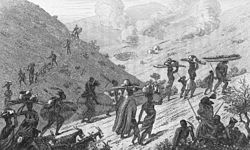
Waves of conflict and displacement radiating from Zululand, including raids by the Ndebele under Mzilikazi, devastated many Tswana communities, forcing consolidation of chiefdoms and reshaping settlement patterns across the region.
Image source: Mfecane
1824
% complete
Robert Moffat's mission station at nearby Kuruman became a hub for Christianity, literacy, and translation work, profoundly influencing Tswana society; later missions spread into Bechuanaland itself, converting influential chiefs.
Image source: Kuruman
1849
% complete
Missionary-explorer David Livingstone traveled through Tswana territory with William Oswell and reached Lake Ngami, opening the interior to European geographic knowledge and intensifying missionary and commercial interest in Bechuanaland.
Image source: Lake Ngami
1872
% complete
Khama III, a Christian convert, ascended to leadership of the Bangwato and became one of Africa's most renowned rulers, modernizing his kingdom, banning alcohol and gun trade abuses, and skillfully navigating relations with Boers and Britons.
Image source: Khama III
1867 - 1884
% complete
After diamonds were discovered near the Vaal River, Transvaal Boers and German colonial ambitions threatened Tswana lands. Tswana chiefs appealed to Britain for protection against annexation by the South African Republic.
1867
% complete
Gold discoveries at Tati, one of southern Africa's earliest mining rushes, led to the founding of Francistown in 1897, making it the protectorate's principal town and industrial center for decades before independence.
Image source: Francistown
1884 - 1885
% complete
Sir Charles Warren led a British military expedition that expelled Boer freebooters from Stellaland and Goshen, leading Britain to proclaim a protectorate over Bechuanaland in 1885 and secure the road north toward Central Africa.
Image source: Bechuanaland Expedition
Jan 31, 1885
% complete
Britain declared the area north of the Molopo River the Bechuanaland Protectorate, placing it under imperial protection while leaving Tswana chiefs largely in charge of internal affairs—a light-touch administration that shaped Botswana's future institutions.
Image source: Bechuanaland Protectorate
1889 - 1895
% complete
Rhodes chartered company sought control over Bechuanaland as a corridor to Mashonaland. Tswana kings, especially Bathoen I, Sechele I's successors, and Khama III, resisted ceding their territory to company rule.
Image source: British South Africa Company
1895
% complete
Chiefs Khama III, Sebele I, and Bathoen I traveled to London to successfully oppose incorporation of their lands into Rhodesia or the Cape Colony, a landmark diplomatic mission celebrated in Botswana as a founding act of national resistance.
Image source: Three Dikgosi Monument
1896 - 1897
% complete
The rinderpest epizootic wiped out an estimated 90 percent of cattle in Bechuanaland, destroying the foundation of Tswana wealth and social life, prompting labor migration to South African mines and lasting economic hardship.
Image source: Rinderpest
1897
% complete
The Cape-to-Rhodesia railway was completed through the protectorate, passing through Palapye and later Francistown, integrating the territory into regional trade networks and stimulating growth of towns along the line.
Image source: Rail transport in Botswana
1923
% complete
Tshekedi Khama ruled the Bangwato as regent for his nephew Seretse, becoming a formidable and sometimes controversial leader who resisted British administrative encroachment and defended chiefly authority.
Image source: Tshekedi Khama II
1948 - 1956
% complete
Seretse Khama's interracial marriage to Englishwoman Ruth Williams provoked opposition from Tshekedi, some Bangwato elders, and apartheid South Africa. The British government exiled Seretse until 1956, when he returned as kgosi and later turned to politics.
Image source: Seretse Khama
1960
% complete
Britain introduced a legislative council and constitutional reforms, beginning the transition toward self-government as nationalist parties formed and demanded greater representation for Batswana.
1960
% complete
One of the territory's first political parties advocated rapid independence and anti-colonial nationalism, contributing to the growing pressure on Britain to accelerate constitutional change.
Image source: Botswana People's Party
1961
% complete
Seretse Khama co-founded the Bechuanaland Democratic Party (later Botswana Democratic Party), which championed gradual constitutional reform, multi-party democracy, and liberal economic policy—becoming the dominant party after independence.
Image source: Botswana Democratic Party
Sep 30, 1966
% complete
The Bechuanaland Protectorate became the independent Republic of Botswana with Seretse Khama as its first president. Despite being one of the poorest countries in the world at the time, it adopted stable democratic governance.
Image source: Botswana
Sep 30, 1966
% complete
The new republic established a Westminster-style parliamentary system with regular elections, a bill of rights, and a non-executive vice presidency, laying foundations for decades of political stability and peaceful transfers of power.
Image source: Constitution of Botswana
1967
% complete
The discovery of the Orapa kimberlite pipe, one of the world's largest diamond mines, transformed Botswana's economy. Diamond revenues would fund infrastructure, education, and healthcare for decades to come.
Image source: Orapa diamond mine
1969
% complete
Botswana and De Beers formed the Debswana joint venture, giving the state half ownership of its diamond industry—an arrangement that allowed Botswana to capture unprecedented mineral wealth and avoid the resource curse.
Jul 13, 1980
% complete
Following Seretse Khama's death, Vice President Ketumile Quett Masire assumed the presidency, continuing prudent economic management and presiding over rapid growth driven by diamonds and sound fiscal policy.
Image source: Quett Masire
1985
% complete
By the 1990s Botswana had one of the world's highest HIV prevalence rates. The government responded with pioneering programs including widespread antiretroviral treatment, becoming a model for AIDS response in Africa.
Apr 1, 1998 - Apr 1, 2008
% complete
Festus Mogae served two terms as president, overseeing diversification efforts, the fight against HIV/AIDS, and continued democratic consolidation; he later received the Mo Ibrahim Prize for Achievement in African Leadership.
Image source: Festus Mogae
Apr 1, 2008 - Mar 31, 2018
% complete
Ian Khama, son of Botswana's first president, took office and emphasized conservation, security, and social programs, though his tenure also saw rising criticism over press freedom and political centralization.
Image source: Ian Khama
Apr 1, 2018
% complete
Mokgweetsi Masisi succeeded Ian Khama after winning the BDP succession, marking another peaceful transfer of power; he pursued economic diversification and education reform while navigating tensions with his predecessor.
Image source: Mokgweetsi Masisi
Or browse the full history timeline directory, with more than 2,000 topics.
This History of Botswana timeline was generated with the help of AI, using information found on the internet.
We work hard to keep these timelines accurate, but mistakes do get through. If you spot one, email us at [email protected] and we'll fix it for future visitors.
Generate yours with AI or build it from scratch, for free.

Export your timeline, add your own events, edit or remove AI-generated events, and much more
No credit card required.
Cancel anytime.
Cancel anytime.
You can create an unlimited number of timelines with up to 10 events on each one, customize how they look, export them to PDF, PNG, PowerPoint, CSV, and Excel, and share them with a link. Paid plans raise the event limit and add features like spreadsheet imports and collaborators.
Yes. You can cancel your subscription from your account page at any time, and you will not be charged again. Your subscription stays active for the rest of the period you already paid for.
Yes. We will email you a reminder before the annual renewal, and we will also email you a receipt.
Yes. You can email us within 15 days of any payment, and we will issue you a full refund.
Check out our pricing docs or send us an email anytime: [email protected].