-
Use Cases
-
Resources
-
Pricing
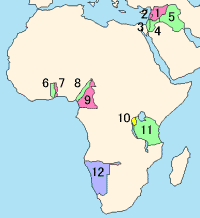
Cameroon's history spans ancient Bantu migrations and powerful pre-colonial kingdoms such as the Bamoun and Bornu empires, through German colonization in 1884, French and British rule after World War I, independence in 1960–1961, the reunification of French and British Cameroons, and its development as a modern bilingual nation facing political and social challenges. More Less
1000 BCE - 1000 CE
% complete
Linguistic analysis, supported by archaeological and genetic research, has shown that the Bantu expansion most likely originated in the Bamenda highlands on the Nigeria-Cameroon border around 1000 BCE. Bantu language and culture came to dominate most of central and southern Africa over the following two millennia.
Image source: Bantu expansion
1000 BCE
% complete
Recent research in southern Cameroon indicates that the Iron Age may have started there as early as 1000 BCE and was certainly well established by 100 BCE at the latest, making the region an early center of ironworking in Sub-Saharan Africa.
Image source: Iron Age
400 BC
% complete
The Sao culture possibly arose as early as the fourth century BC but certainly, by the end of the first millennium BC, their presence was well established around Lake Chad and near the Chari River, including territory in northern Cameroon.
Image source: Sao civilisation
700
% complete
The Kanem Empire began in Chad in the eighth century and gradually extended its influence northward into Libya and southward into Nigeria and Cameroon, bringing new political and religious currents to the region.
Image source: Kanem–Bornu Empire
800 - 1500
% complete
The fortified city-states of the Sao reached their apex sometime between the ninth and fifteenth centuries AD, before being displaced or assimilated by the sixteenth century.
1000
% complete
The Kanem Empire was Muslim from at least the eleventh century and reached its first peak in the thirteenth century, controlling most of what is now Chad and smaller regions in surrounding countries, including parts of northern Cameroon.
Image source: Kanem–Bornu Empire
1804 - 1808
% complete
From 1804 to 1808 the Fulani War saw the Bornu pushed north out of Cameroon and the Sokoto Caliphate took control of the region, as well as most of northern Nigeria and large swathes of Niger and Mali.
Image source: Fula jihads
1807
% complete
In 1807, the British abolished slavery in the Empire and began military efforts to suppress the slave trade, particularly along the West African coast where Cameroon's ports had been active in the Atlantic trade.
Image source: Slave Trade Act 1807
1850 Jan 1
% complete
Christian missionaries established a presence in Cameroon in the late nineteenth century, founding schools and churches that would have a lasting cultural and educational impact on the country.
Image source: Religion in Cameroon
Jul 5, 1884
% complete
On July 5, 1884, German explorer and administrator Gustav Nachtigal began signing agreements with Duala leaders establishing a German protectorate. From 1884, Cameroon was the German colony of Kamerun, with borders drawn through negotiations between Germany, Britain, and France.
Image source: Kamerun
1891 - 1907
% complete
Germany faced resistance across its new colony; the largest conflicts were the Bafut Wars and the Adamawa Wars, which ended by 1907 with German victories and consolidated colonial control.
Image source: Bafut Wars
1911
% complete
In 1911 at the Treaty of Fez after the Agadir Crisis, France ceded a nearly 300,000 km² portion of French Equatorial Africa to Kamerun, which became Neukamerun (New Cameroon), while Germany ceded a smaller area in present-day Chad to France.
Image source: Neukamerun
1914 - Feb 1916
% complete
Shortly after the outbreak of World War I in 1914, the British invaded Cameroon from Nigeria and the French from French Equatorial Africa in the Kamerun campaign. The last German fort in the country surrendered in February 1916.
Image source: Kamerun campaign
Jun 28, 1919
% complete
After the Allied victory, the former German colony was partitioned between the United Kingdom and France, formalized on June 28, 1919 with Class B League of Nations mandates.
Image source: League of Nations mandate
1922
% complete
A British parliamentary publication, Report on the British Sphere of the Cameroons (May 1922), noted that returnees to their villages increasingly took up cocoa and other cultivation on their own account, increasing the general prosperity of the country.
Image source: British Cameroons
1925
% complete
In 1925, the mortality rate on a French-administered site reached 61.7%, reflecting harsh conditions endured by laborers under colonial rule in French Cameroon.
Image source: French Cameroon
Jun 1940
% complete
In the 1930s, most of the white population of British Cameroons still consisted of Germans, most of whom were interned in British camps starting in June 1940 during World War II.
Aug 1940
% complete
French Cameroon joined Free France in August 1940, aligning itself early with Charles de Gaulle's forces against Vichy France during World War II.
1945 - Jan 1, 1960
% complete
In 1945, the country was placed under the supervision of the United Nations, successor to the League of Nations, which left Cameroon under French control as a UN Trust Territory.
Image source: United Nations trust territories
Jun 12, 1946
% complete
When the League of Nations ceased to exist, the United Nations approved Trusteeship Agreements for British Cameroons on June 12, 1946, reclassifying it as a UN trust territory administered through the Trusteeship Council but remaining under British control.
1948
% complete
In 1948, the Union des Populations du Cameroun (UPC), a nationalist movement demanding independence and reunification, was founded, and Ruben Um Nyobe took over as its leader.
Image source: Union of the Peoples of Cameroon
May 1955
% complete
In May 1955, arrests of independence activists were followed by riots in several cities across the country, escalating tensions between nationalists and the French colonial administration.
1956 - 1970
% complete
The UPC rebellion that began in the mid-1950s continued for years after independence. Government forces captured the last important rebel leader in 1970, ultimately defeating the movement.
Dec 18, 1956
% complete
An insurrection broke out among the Bassa people on December 18–19, 1956, beginning the UPC rebellion that would continue for years after independence.
Apr 16, 1957
% complete
Legislative elections were held on December 23, 1956, and the resulting Assembly passed a decree on April 16, 1957 which made French Cameroon a self-governing state within the French Union.
Jun 12, 1958
% complete
On June 12, 1958, the Legislative Assembly of French Cameroon asked the French government to accord independence to the State of Cameroon at the end of their trusteeship, setting independence in motion.
Oct 19, 1958 - Nov 12, 1958
% complete
On October 19, 1958, France recognized the right of its UN trust territory to choose independence, and on November 12 asked the United Nations to grant French Cameroon independence and end the Trusteeship.
Dec 5, 1958 - Mar 13, 1959
% complete
On October 24, 1958 the Assembly proclaimed Cameroonians' desire for full independence on January 1, 1960. On December 5, 1958 the UN General Assembly took note, and on March 13, 1959 it resolved that the Trusteeship Agreement would end when French Cameroon became independent on that date.
Jan 1, 1960
% complete
French Cameroun became independent as Cameroun or Cameroon in January 1960, with part of British Cameroons later voting to join the former French territory. Nigeria's own scheduled independence that year raised the question of what to do with the British territory.
Image source: Cameroon
Feb 21, 1960
% complete
On February 21, 1960, the new nation held a constitutional referendum approving a constitution that established the framework of the newly independent state.
Image source: 1960 Cameroonian constitutional referendum
May 5, 1960
% complete
On May 5, 1960, Ahmadou Ahidjo became president of the young republic, launching a tenure that would last more than two decades.
Image source: Ahmadou Ahidjo
Feb 11, 1961
% complete
After discussions begun in 1959, a plebiscite was held on February 11, 1961. Results announced on February 12 showed Southern Cameroons had voted for unification with the Republic of Cameroon—often called 'reunification' since both regions had been part of German Kamerun.
Jul 16, 1961 - Jul 21, 1961
% complete
To negotiate the terms of the union between Southern Cameroons and French Cameroon, the Foumban Conference was held July 16–21, 1961. On August 14, 1961 the federal constitution was adopted, with Ahidjo as president of the Federal Republic of Cameroon.
Image source: Anglophone problem
1966
% complete
In 1966, opposition parties were banned and Cameroon became a one-party state under Ahidjo's leadership, a system that would persist until 1990.
Image source: Politics of Cameroon
Mar 28, 1970
% complete
On March 28, 1970, Ahidjo was re-elected as president with 100% of the vote and a 99.4% turnout, reflecting the tightly controlled single-party political system.
1972
% complete
In 1972, a referendum approved a new constitution replacing the federation between East and West with a unitary state called the United Republic of Cameroon, further expanding the power of the president.
Image source: Cameroon
Jun 30, 1975
% complete
On June 30, 1975, Paul Biya, a long-serving bureaucrat and administrator in the Ahidjo government, was appointed Prime Minister, positioning him as Ahidjo's eventual successor.
Image source: Paul Biya
1977
% complete
Cameroon became an oil-producing country in 1977, adding petroleum revenues to its economy and becoming an important economic actor in Central Africa.
Image source: Economy of Cameroon
1981
% complete
Disputes over the oil-rich Bakassi Peninsula simmered for decades: a demarcation effort revealed that a 1913 agreement placed Bakassi in German Cameroon, and an agreement between the countries in 1975 was derailed by a coup in Nigeria. In 1981, clashes between Nigerian and Cameroonian forces resulted in several deaths and nearly led to war.
Image source: Bakassi conflict
Nov 4, 1982
% complete
On November 4, 1982, Ahidjo resigned as president and Biya became his legal successor, beginning one of the longest presidencies in African history.
1983
% complete
Despite previous good relations, in 1983 a rift became apparent between Biya and Ahidjo, fueled by struggles over the ruling party and accusations of a plot against the new president.
Jan 1984
% complete
In January 1984, Biya was elected president of the country, running unopposed in a single-party election that confirmed his hold on power.
Apr 6, 1984
% complete
On April 6, 1984, supporters of Ahidjo attempted a coup d'état, led by the Republican Guard, an elite force recruited mainly from the north. The coup failed and was followed by purges and reprisals.
Aug 15, 1984
% complete
On August 15, 1984, Lake Monoun exploded in a limnic eruption that released enormous amounts of carbon dioxide, suffocating 37 people to death—an event that foreshadowed an even greater disaster two years later.
Image source: Lake Monoun
Aug 21, 1986
% complete
On August 21, 1986, another limnic eruption at Lake Nyos killed as many as 1,800 people and 3,500 livestock when a massive cloud of carbon dioxide descended on nearby villages—one of the deadliest natural gas disasters ever recorded.
Image source: Lake Nyos
Jun 1990 - Jul 1990
% complete
At the 1990 FIFA World Cup in Italy, the Indomitable Lions became the first African team to reach the quarter-final—a feat unmatched since. The team has only made it out of the group stage once, in 1990, making it a landmark moment for African football.
Image source: Cameroon national football team
Dec 1990
% complete
By 1990, pressure from Western governments mounted as the Cold War ended, making them less tolerant of authoritarian allies. In December 1990, opposition parties were legalized for the first time since 1966.
1992
% complete
The first multiparty elections were held in 1992 and were hotly contested, with Biya retaining power amid opposition claims of fraud. Only one party—the CPDM—has ever governed Cameroon.
Image source: 1992 Cameroonian presidential election
1993
% complete
In 1993, the situation worsened with both countries sending large military contingents to the region and numerous reports of skirmishes and attacks against civilians over the contested peninsula.
Mar 29, 1994
% complete
On March 29, 1994, Cameroon referred the Bakassi dispute to the International Court of Justice, seeking a legal resolution to the long-running territorial conflict with Nigeria.
1996
% complete
Pressure from Anglophone groups in former British Cameroons resulted in constitutional changes in 1996, which purported to decentralize power but fell short of Anglophone demands to reestablish the federal structure; many changes were never fully implemented and power remains highly centralized in the President.
Oct 2002
% complete
In October 2002, the International Court of Justice ruled in favor of Cameroon, awarding sovereignty over Bakassi based largely on colonial-era treaties.
2006 - 2008
% complete
Pressure from the UN and international community forced Nigeria to acquiesce, and the 2006 Greentree Agreement laid out a plan for transferring administration of Bakassi over two years. Low-level violence continued until it was subsumed in the Anglophone Crisis in 2017.
Feb 2008
% complete
In February 2008, Cameroon experienced widespread violent unrest as a strike by transport workers opposing high fuel prices and poor working conditions coincided with President Biya's announcement that he wanted the constitution amended to remove term limits.
2011
% complete
Biya had been scheduled to leave power at the end of his term in 2011. Ultimately, constitutional term limits were revoked and Biya was reelected in 2011 in an election criticized by the opposition and international observers as plagued by irregularities and low turnout.
Image source: 2011 Cameroonian presidential election
2014
% complete
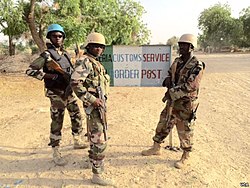
In 2014, the Boko Haram insurgency spread into Cameroon from Nigeria, bringing bombings, raids, and terror attacks to the far north of the country.
Image source: Boko Haram insurgency
May 2014
% complete
In May 2014, in the wake of the Chibok schoolgirl kidnapping, Presidents Paul Biya of Cameroon and Idriss Déby of Chad announced they were waging war on Boko Haram and deployed troops to the Northern Nigerian border.
Nov 2016
% complete
In November 2016, major protests broke out in the Anglophone regions of Cameroon, driven by grievances over marginalization, language discrimination, and perceived Francophone domination of courts, schools, and government.
Image source: Anglophone Crisis
Sep 2017
% complete
In September 2017, the protests and the government's response escalated into armed conflict, with separatists declaring the independence of Ambazonia and starting a guerilla war against the Cameroonian Army in the west of the country.
Sep 2018
% complete
Cameroon announced in September 2018 that Boko Haram had been repelled, but the conflict persists nonetheless in the northern border areas, with continued insurgent activity.
Jan 2024
% complete
In January 2024, Cameroon launched the world's first routine malaria vaccine program, using the WHO-approved RTS,S vaccine developed by British drugmaker GSK—a milestone in global public health.
Image source: Malaria vaccine
Or browse the full history timeline directory, with more than 2,000 topics.
This History of Cameroon timeline was generated with the help of AI, using information found on the internet.
We work hard to keep these timelines accurate, but mistakes do get through. If you spot one, email us at [email protected] and we'll fix it for future visitors.
Generate yours with AI or build it from scratch, for free.
Export your timeline, add your own events, edit or remove AI-generated events, and much more
No credit card required.
Cancel anytime.
Cancel anytime.
You can create an unlimited number of timelines with up to 10 events on each one, customize how they look, export them to PDF, PNG, PowerPoint, CSV, and Excel, and share them with a link. Paid plans raise the event limit and add features like spreadsheet imports and collaborators.
Yes. You can cancel your subscription from your account page at any time, and you will not be charged again. Your subscription stays active for the rest of the period you already paid for.
Yes. We will email you a reminder before the annual renewal, and we will also email you a receipt.
Yes. You can email us within 15 days of any payment, and we will issue you a full refund.
Check out our pricing docs or send us an email anytime: [email protected].