-
Use Cases
-
Resources
-
Pricing
The history of Ivory Coast, officially known as Côte d'Ivoire, spans ancient precolonial empires such as Ghana and Mali that influenced the region, the arrival of French colonizers in the 19th century, independence in 1960 led by Félix Houphouët-Boigny, decades of relative stability and economic growth as a major cocoa producer, and turbulent periods including the 2002–2007 civil war and the 2011 post-election crisis. More Less
1100
% complete
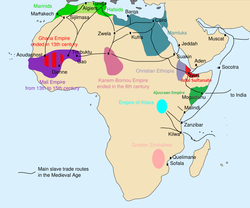
By the 11th century, the rulers of the Ghana Empire had embraced Islam, and it had spread south into the northern areas of contemporary Ivory Coast.
Image source: Ghana Empire
1300
% complete
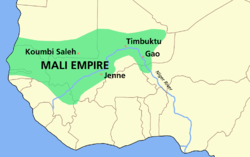
After the decline of the Ghana Empire, the Mali Empire grew into a powerful Muslim state, reaching its peak in the early 14th century, with territory in Ivory Coast limited to the northwest corner around Odienné.
Image source: Mali Empire
1400
% complete
Because of its location between Europe and the imagined treasures of the Far East, Africa became a destination for the European explorers of the 15th century.
Image source: History of Ivory Coast
1483
% complete
The earliest recorded French voyage to West Africa took place in 1483, marking the beginning of sustained European contact with the region.
1490
% complete
By the end of the 15th century, trade with the Europeans had resulted in a strong European influence in Africa, permeating north from the West African coast.
1500
% complete
Peoples who arrived before the 16th century include the Ehotilé (Aboisso), Kotrowou (Fresco), Zéhiri (Grand Lahou), Ega, and Diès (Divo).
1550
% complete
At first, trade included gold, ivory, and pepper, but the establishment of American colonies in the 16th century spurred demand for slaves.
Image source: Atlantic slave trade
1600
% complete
A profitable trade in ivory existed in the 17th century and gave the area its name.
Image source: Ivory Coast
1687
% complete
The French established a mission in 1687 at Assinie, near the Gold Coast (now Ghana) border, and it became the first European outpost in that area.
Image source: Assinie-Mafia
1690
% complete
The kingdom of Gyaman was established around 1690 by Gyamanhene Tan Date.
1700
% complete
The resulting decline in elephant population ended the ivory trade by the beginning of the 18th century.
Image source: Ivory trade
1700
% complete
In the 18th century, Ivory Coast was invaded by two related Akan groups—the Agni, who occupied the southeast, and the Baoulés, who settled in the central section. Other Akan groups fleeing the Ashanti Empire established a Baoulé kingdom at Sakasso and two Agni kingdoms, Indénié and Sanwi.
Image source: Baoulé people
Nov 1737
% complete
They conquered north to Bobo-Dioulasso in 1737 and south to Boule. Seku's brother Famaga Watara launched a major military operation westwards in November 1739, taking Sofara on the Bani River.
Image source: Kong Empire
1740
% complete
Nevertheless, they fell under Asante domination in 1740.
1745
% complete
Seku died around 1745, and the central authority of his successors faltered.
1750
% complete
In the middle of the 18th century conflict broke out between Kong and the Ashanti Empire.
1969
% complete
The descendants of the rulers of the Agni kingdoms tried to retain their separate identity long after independence; as late as 1969, the Sanwi of Krinjabo attempted to break away from Ivory Coast and form an independent kingdom.
Image source: Kingdom of Sanwi
1843 - 1844
% complete
In 1843–1844, the French admiral Bouët-Willaumez signed treaties with the kings of the Grand Bassam and Assini regions, placing these territories under a French protectorate.
Image source: Édouard Bouët-Willaumez
1871
% complete
The defeat of France in the Franco-Prussian War (1871) caused the French government to abandon its colonial ambitions and withdraw its military garrisons from its West African trading posts, leaving them in the care of resident merchants.
Image source: Franco-Prussian War
1878
% complete
The trading post at Grand-Bassam was left to Arthur Verdier, a shipper from Marseille who was named a resident minister when the Ivory Coast was established in 1878.
Image source: Arthur Verdier
1878 - 1898
% complete
Samori Touré offered the greatest resistance; he had established an empire over large parts of present-day Guinea, Mali, Burkina Faso, and Ivory Coast starting in 1878. The French campaigns against him intensified in the mid-1890s until they captured Touré in 1898.
Image source: Samori Ture
1885
% complete
In 1885, France and Germany brought the European powers with interests in Africa together at the Berlin Conference. The agreement stipulated that only European annexations or spheres of influence involving effective occupation would be recognized; another agreement in 1890 extended this rule to the interior of Africa, resulting in a rush for territory by France, Britain, Portugal, and Belgium.
Image source: Berlin Conference
1886
% complete
To support its claims of effective occupation, France again assumed direct control of its West African coastal trading posts and embarked on an accelerated program of exploration in the interior in 1886.
Image source: French West Africa
1887
% complete
In 1887, Lieutenant Louis Gustave Binger began a two-year journey across Ivory Coast's interior. Also that year, Verdier's agent, Marcel Treich-Laplène, negotiated five additional agreements extending French influence from the headwaters of the Niger River Basin through Ivory Coast.
Image source: Louis-Gustave Binger
1889
% complete
By the end of the 1880s, France had established effective control over the coastal regions of Ivory Coast and Britain recognized French sovereignty in the area in 1889. France named Treich-Laplène the titular governor of the territory in 1889.
Mar 10, 1893
% complete
Côte d'Ivoire officially became a French colony on 10 March 1893; agreements with Liberia in 1892 and with Britain in 1893 determined the eastern and western boundaries, but the northern boundary was not fixed until 1947.
1900
% complete
In 1900, France imposed a head tax for a public works program in the colony, provoking several revolts.
1904 - 1958
% complete
From 1904 to 1958, Ivory Coast was a constituent unit of the Federation of French West Africa.
1905
% complete
In 1905, the French officially abolished slavery in most of French West Africa.
Image source: Slavery in Africa
1908
% complete
In 1908, Gabriel Angoulvant was appointed governor of Ivory Coast.
Image source: Gabriel Louis Angoulvant
1932
% complete
Labor was so important to the economic life of Ivory Coast that in 1932 the AOF annexed a large part of Upper Volta to Ivory Coast and administered it as a single colony. Assimilation was practiced so that a small number of Westernised Ivorians could apply for French citizenship after 1930.
Image source: French Upper Volta
1943
% complete
In World War II, the Vichy regime remained in control until 1943, when members of General Charles De Gaulle's provisional government assumed control of all French West Africa.
Image source: Free France
1944
% complete
Houphouët-Boigny first came to political prominence in 1944 as the founder of the African Agricultural Union, an organization that won improved conditions for African farmers and formed a nucleus for the PDCI. The Brazzaville conference in 1944 led to far-reaching governmental reforms.
Image source: Félix Houphouët-Boigny
1946
% complete
The first Constituent Assembly of the Fourth Republic in 1946 and France's gratitude for African loyalty during World War II led to far-reaching governmental reforms. The French Empire was converted into the French Union, which was superseded by the French Community in 1958.
1956
% complete
A turning point in relations with France was reached with the 1956 Overseas Reform Act or Loi-cadre Defferre, which transferred several powers from Paris to elected territorial governments in French West Africa and removed remaining voting inequalities.
Image source: Dodd–Frank Act
Dec 1958
% complete
In December 1958, Ivory Coast became an autonomous republic within the French Community as a result of a referendum on 7 August that brought community status to all members of the old Federation of French West Africa (except Guinea).
Image source: French Community
Apr 1959
% complete
After his thirteen years in the French National Assembly (1946–1959), including almost three years as a minister in the French Government, he became Ivory Coast's first prime minister in April 1959.
May 1959
% complete
In May 1959, Houphouët-Boigny reinforced his position as a dominant figure in West Africa by leading Ivory Coast, Niger, Upper Volta, and Dahomey into the Council of the Entente, a regional organization promoting economic development.
Image source: Conseil de l'Entente
1960
% complete
Following his time as prime minister, Houphouët-Boigny was elected Ivory Coast's first president in 1960, leading the country until his death in 1993 as leader of the Democratic Party of Ivory Coast (PDCI).
Aug 7, 1960
% complete
On 11 July 1960, France agreed to Ivory Coast becoming fully independent. Ivory Coast became independent on 7 August 1960, and permitted its community members to lapse.
Oct 1990
% complete
The first multiparty presidential elections were held in October 1990 and Houphouët-Boigny won convincingly.
Image source: 1990 Ivorian presidential election
Dec 7, 1993
% complete
Félix Houphouët-Boigny, president of the republic and leader of the PDCI, died on 7 December 1993, ending an era in Ivorian politics.
Dec 24, 1999
% complete
Konan Bédié was overthrown on 24 December 1999 during the 1999 Ivorian coup d'état by General Robert Guéï, a former army commander dismissed by Bédié.
Image source: 1999 Ivorian coup d'état
2000
% complete
An economic downturn followed and the junta promised to return the country to democratic rule in 2000.
Image source: Robert Guéï
Oct 26, 2000
% complete
However, street protests forced Robert Guéï to step down, and Laurent Gbagbo became president on 26 October 2000.
Image source: Laurent Gbagbo
2002
% complete
Sep 19, 2002
% complete
On 19 September 2002, a rebellion in the north and west of Ivory Coast flared up and the country was divided into three parts.
2003
% complete
A reconciliation process under international auspices started in 2003.
2004
% complete
Most of the fighting ended by late 2004, with the country split between a rebel-held north under Guillaume Soro and a government-held south under Laurent Gbagbo.
Oct 15, 2004
% complete
Disarmament was supposed to take place on 15 October 2004, but was a failure.
Nov 6, 2004
% complete
Tensions between Ivory Coast and France increased on 6 November 2004, after Ivorian air strikes killed 9 French peacekeepers and an aid worker.
Mar 2007
% complete
In March 2007 the two sides signed an agreement to hold fresh elections. However, the elections were delayed until 2010, five years after Gbagbo's term of office expired.
2010
% complete
After northern candidate Alassane Ouattara was declared the victor by the Independent Electoral Commission, Gbagbo ally and President of the Constitutional Council declared the results invalid and claimed Gbagbo was the winner.
Image source: 2010 Ivorian presidential election
2010
% complete
Alassane Ouattara has ruled Ivory Coast since 2010, when he unseated his predecessor Laurent Gbagbo.
Image source: Alassane Ouattara
Apr 11, 2011
% complete
Ouattara's forces arrested Gbagbo at his residence on 11 April 2011, ending the post-election crisis.
Image source: Second Ivorian Civil War
2015
% complete
Ouattara was re-elected in the 2015 presidential election.
Nov 2020
% complete
In November 2020, Ouattara won a third term in the presidential election, and Ivory Coast's Constitutional Council formally ratified his re-election to a third term that month.
Or browse the full history timeline directory, with more than 2,000 topics.
This History of Ivory Coast timeline was generated with the help of AI, using information found on the internet.
We work hard to keep these timelines accurate, but mistakes do get through. If you spot one, email us at [email protected] and we'll fix it for future visitors.
Generate yours with AI or build it from scratch, for free.
Export your timeline, add your own events, edit or remove AI-generated events, and much more
No credit card required.
Cancel anytime.
Cancel anytime.
You can create an unlimited number of timelines with up to 10 events on each one, customize how they look, export them to PDF, PNG, PowerPoint, CSV, and Excel, and share them with a link. Paid plans raise the event limit and add features like spreadsheet imports and collaborators.
Yes. You can cancel your subscription from your account page at any time, and you will not be charged again. Your subscription stays active for the rest of the period you already paid for.
Yes. We will email you a reminder before the annual renewal, and we will also email you a receipt.
Yes. You can email us within 15 days of any payment, and we will issue you a full refund.
Check out our pricing docs or send us an email anytime: [email protected].