-
Use Cases
-
Resources
-
Pricing
The history of Albania spans from ancient Illyrian tribes and Roman conquest to Byzantine and Ottoman rule. Albania declared independence in 1912, experienced monarchy under King Zog, was occupied in World War II, and became a strict communist state under Enver Hoxha until 1991, followed by a transition to democracy and eventual integration into NATO and the EU accession process. More Less
168 BC
% complete
Rome defeated the last Illyrian king Gentius and absorbed the region into its empire as the province of Illyricum. Roman rule brought roads, cities like Scodra (Shkodër), and Latin influence that shaped the later development of Albanian language and culture.
Image source: Illyricum (Roman province)
395
% complete
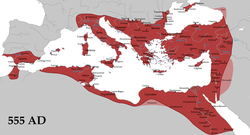
After Emperor Theodosius I died in 395, the Roman Empire split permanently. Albania came under Byzantine control, though its territory was repeatedly contested by Goths, Slavs, Bulgars, and Normans over the following centuries.
Image source: Byzantine Empire
1285
% complete
The earliest known document referencing the Albanian language appeared in Ragusa (Dubrovnik), when a crime witness was described as unable to testify except 'in Albanian'. This provides some of the earliest evidence of the distinct Albanian ethno-linguistic identity.
Image source: Albanian language
Nov 28, 1443
% complete
Gjergj Kastrioti Skanderbeg, an Albanian noble raised as an Ottoman hostage who had converted to Islam, defected during the Battle of Niš, raised the Kastrioti banner at Krujë, and renounced Islam to lead a 25-year resistance against Ottoman expansion in Europe.
Image source: Skanderbeg's rebellion
Mar 2, 1444
% complete
Albanian princes gathered at Lezhë under Skanderbeg's leadership to form a military alliance known as the League of Lezhë. This union is regarded by many historians as the first unified Albanian state and enabled coordinated resistance against Ottoman armies for decades.
Image source: League of Lezhë
May 14, 1450 - Nov 26, 1450
% complete
Sultan Murad II led a massive Ottoman army to besiege the fortress of Krujë. Despite overwhelming odds, Skanderbeg's defenders held out for months, forcing the Ottomans to withdraw. The victory made Skanderbeg famous across Christian Europe.
Image source: Siege of Krujë (1450)
Jan 17, 1468
% complete
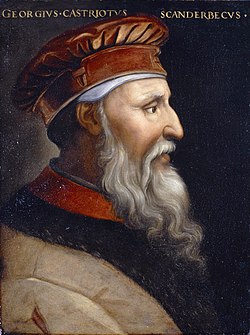
Skanderbeg died of malaria in Lezhë after more than two decades of resisting the Ottomans. His death removed the central figure of Albanian resistance, and organized opposition collapsed within a decade, paving the way for full Ottoman conquest.
Image source: Skanderbeg
Apr 25, 1479
% complete
Ottoman forces captured Venice's stronghold of Shkodër, the last major fortress resisting them in Albanian lands. With its fall, nearly all of present-day Albania came under Ottoman rule, beginning more than four centuries of Turkish administration.
Image source: Mehmed II
1550
% complete
Over the course of the 16th and 17th centuries, a majority of Albanians gradually converted to Islam, driven by tax incentives, social advancement, and legal pressures under Ottoman rule. Catholic and Orthodox minorities persisted, giving Albania its distinctive religious diversity.
Image source: Islam in Albania
1760
% complete
As Ottoman central authority weakened in the 18th century, regional Albanian dynasties like the Bushati family of Shkodra and Ali Pasha of Janina carved out semi-independent pashaliks, ruling large territories with considerable autonomy until they were suppressed by Istanbul.
Image source: Pashalik of Scutari
Jun 10, 1878
% complete
Albanian leaders formed the League of Prizren in response to the Treaty of San Stefano and the Congress of Berlin, which threatened to partition Albanian-inhabited lands among neighboring states. The league became a catalyst for Albanian national awakening and cultural unification.
Image source: League of Prizren
Nov 14, 1908 - Nov 22, 1908
% complete
Intellectuals meeting in Manastir (Bitola) agreed on a standardized Latin-based alphabet for the Albanian language, replacing competing scripts. This was a milestone of the Rilindja national awakening, enabling unified education and publishing.
Image source: Congress of Manastir
Nov 28, 1912
% complete
Delegates gathered at Vlorë and proclaimed Albania an independent state amid the First Balkan War, as neighboring powers threatened to divide Albanian territories. Ismail Qemali hoisted the national flag, ending nearly five centuries of Ottoman rule.
Image source: Albanian Declaration of Independence
Jul 29, 1913
% complete
The ambassadors of the six Great Powers formally recognized Albania as an independent principality but stripped it of roughly half the territories claimed by Albanian nationalists, leaving large Albanian populations in Kosovo and elsewhere outside the new state.
Image source: Treaty of London (1913)
Mar 7, 1914
% complete
The Great Powers installed German Prince Wilhelm of Wied as sovereign of the new Principality of Albania. His reign lasted only six months; internal revolts, foreign occupation, and World War I forced him to depart, leaving the country without effective government.
Image source: Wilhelm, Prince of Albania
Dec 2, 1924
% complete
Ahmed Zogu returned to Albania with Yugoslav backing, overthrowing Fan Noli's reformist government. As prime minister and later president, he centralized authority, suppressed political opposition, and dominated Albanian politics throughout the late 1920s.
Image source: Zog I of Albania
Sep 1, 1928
% complete
President Ahmed Zogu transformed Albania into a constitutional monarchy, crowning himself King Zog I. He pursued limited modernization—codifying laws based on European models—but relied increasingly on Italian financial and military support.
Image source: Albanian Kingdom (1928–1939)
Apr 7, 1939
% complete
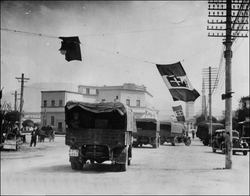
Mussolini's Italy launched a swift invasion, occupying the country within days. King Zog fled into exile, and Italy's King Victor Emmanuel III was proclaimed King of Albania, making the country a puppet state and a base for Italy's later invasion of Greece.
Image source: Italian invasion of Albania
Nov 8, 1941
% complete
Yugoslav communists helped found the Communist Party of Albania in Tirana, uniting small Marxist groups. Enver Hoxha soon emerged as its dominant leader, and the party became the core of the anti-fascist National Liberation Movement during World War II.
Image source: Party of Labour of Albania
Sep 1943
% complete
Following Italy's surrender to the Allies, Nazi Germany occupied Albania, attempting to court Albanian nationalists while fighting growing partisan forces. The occupation intensified the civil war between communist partisans and nationalist Balli Kombëtar.
Image source: German occupation of Albania
Nov 29, 1944
% complete
Enver Hoxha's partisans drove out remaining German forces and entered Tirana, liberating Albania largely through their own efforts. The communist-dominated government consolidated control, and November 29 became celebrated as Liberation Day.
Image source: Liberation Day (Albania)
Jan 11, 1946
% complete
A constituent assembly abolished the monarchy and declared the People's Republic of Albania, with Enver Hoxha as head of government. One-party communist rule, nationalization of industry, collectivization of agriculture, and harsh repression of opponents followed.
Image source: People's Socialist Republic of Albania
1948
% complete
When Josip Broz Tito broke with Stalin, Hoxha sided firmly with Moscow and purged pro-Yugoslav figures like Koçi Xoxe. Albania escaped absorption into Yugoslavia and pivoted toward close alignment with the Soviet Union.
Image source: Tito–Stalin split
1961
% complete
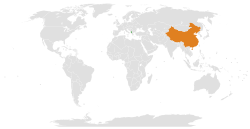
Hoxha condemned Nikita Khrushchev's reforms and Soviet rapprochement with Yugoslavia, severing ties with Moscow. Albania aligned instead with Maoist China, becoming China's principal European ally and recipient of aid for the next two decades.
1967
% complete
Hoxha's regime banned religion entirely, closing or converting hundreds of mosques and churches, imprisoning clergy, and constitutionally declaring Albania the world's first atheist state. Religious practice went underground until communism's fall.
Image source: Religion in Albania
1978
% complete
After Mao's death, Deng Xiaoping's China cut off economic and military aid to Tirana, ending their alliance. Albania was left almost completely isolated internationally, intensifying its autarkic policies and economic stagnation.
Image source: Albania–China relations
Apr 11, 1985
% complete
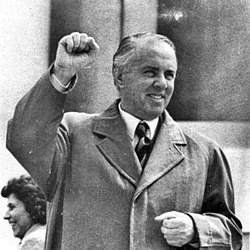
Enver Hoxha died after ruling Albania for over 40 years, one of the longest tenures of any 20th-century leader. Ramiz Alia succeeded him, gradually allowing cautious liberalization as the broader Eastern Bloc began to transform.
Image source: Enver Hoxha
Jul 1990
% complete
Thousands of Albanians climbed embassy walls in Tirana demanding asylum, forcing the regime to relax travel restrictions. The exodus marked the collapse of Hoxhaist isolationism and presaged the end of communist rule.
Image source: Albania–Montenegro relations
Mar 31, 1991
% complete
Albania held its first pluralistic elections since before World War II. The communist Party of Labour initially won, but mass protests and strikes forced a coalition government and the drafting of a new constitution ending the socialist era.
Image source: 1991 Albanian parliamentary election
Mar 22, 1992
% complete
The Democratic Party led by Sali Berisha won elections, ending communist rule definitively. Berisha became president, launching market reforms, privatization, and integration with Western institutions, though corruption and instability persisted.
Image source: 1992 Albanian parliamentary election
Jan 1997
% complete
The failure of fraudulent pyramid investment schemes wiped out much of the population's savings, igniting riots, army mutinies, and near civil war. An international intervention force eventually restored order, and socialists returned to power.
Image source: 1997 Albanian civil unrest
Mar 24, 1999 - Jun 10, 1999
% complete
During NATO's air campaign against Yugoslavia, hundreds of thousands of ethnic Albanian refugees from Kosovo crossed into Albania. Albania served as a NATO staging ground, strengthening its ties with the West and its aspiration to join alliances.
Image source: Kosovo War
Apr 1, 2009
% complete
Alongside Croatia, Albania acceded to NATO, realizing a long-held strategic goal of anchoring itself in Western security structures. Membership cemented Albania's post-communist geopolitical reorientation toward the Euro-Atlantic world.
Image source: Albania–NATO relations
Nov 26, 2019
% complete
A magnitude 6.4 earthquake near Durrës and Thumanë killed dozens, injured thousands, and destroyed or damaged tens of thousands of buildings. It was Albania's deadliest seismic disaster in decades, prompting major reconstruction and international assistance.
Image source: 2019 Albania earthquake
Or browse the full history timeline directory, with more than 2,000 topics.
This History of Albania timeline was generated with the help of AI, using information found on the internet.
We work hard to keep these timelines accurate, but mistakes do get through. If you spot one, email us at [email protected] and we'll fix it for future visitors.
Generate yours with AI or build it from scratch, for free.
Export your timeline, add your own events, edit or remove AI-generated events, and much more
No credit card required.
Cancel anytime.
Cancel anytime.
You can create an unlimited number of timelines with up to 10 events on each one, customize how they look, export them to PDF, PNG, PowerPoint, CSV, and Excel, and share them with a link. Paid plans raise the event limit and add features like spreadsheet imports and collaborators.
Yes. You can cancel your subscription from your account page at any time, and you will not be charged again. Your subscription stays active for the rest of the period you already paid for.
Yes. We will email you a reminder before the annual renewal, and we will also email you a receipt.
Yes. You can email us within 15 days of any payment, and we will issue you a full refund.
Check out our pricing docs or send us an email anytime: [email protected].