-
Use Cases
-
Resources
-
Pricing
The history of Montenegro spans from ancient Illyrian and Roman settlements, through the medieval state of Duklja and Zeta, to centuries of resistance against the Ottoman Empire under prince-bishops, unification with Serbia after World War I as part of Yugoslavia, and finally full independence restored in 2006. More Less
600 AD
% complete
In the early 7th century, Slavic tribes migrated into the Balkans and settled the territory of present-day Montenegro, gradually assimilating or displacing the earlier Romanized population and establishing new tribal principalities.
Image source: Slavs in Lower Pannonia
1040 AD
% complete
Duklja emerged as an independent South Slavic principality in the 11th century under rulers such as Stefan Vojislav, who defeated Byzantine forces and established local rule over much of present-day Montenegro.
Image source: Duklja
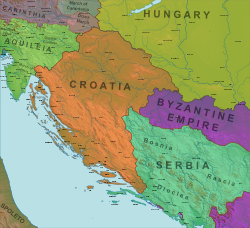
1077 AD
% complete
Mihailo Vojislavljević received a royal crown from Pope Gregory VII around 1077, making Duklja one of the first Slavic kingdoms recognized by Rome and marking the height of its medieval prestige.
Image source: Mihailo I of Duklja
1186 AD
% complete
Stefan Nemanja of Raška annexed Zeta (the successor state to Duklja), incorporating it into the expanding medieval Serbian state, where it remained a significant province for centuries.
Image source: Nemanjić dynasty
1360 AD
% complete
The Balšić dynasty rose to power in Zeta after the collapse of the Serbian Empire, expanding their control from Lake Skadar along the Adriatic coast and consolidating a semi-independent lordship.
Image source: Balšić noble family
1435 AD
% complete
The Crnojević family displaced the Balšići and ruled Zeta until the late 15th century; Stefan Crnojević's rule marked the beginning of the political entity most directly ancestral to Montenegro.
Image source: Crnojević noble family
Jan 4, 1494
% complete
Đurađ Crnojević established a printing press at Obod near Cetinje, producing Oktoih, the first book printed in Cyrillic script among the South Slavs, a landmark of regional cultural history.
Image source: Cetinje Octoechos
1496 AD
% complete
Đurađ Crnojević fled into exile and Ottoman forces absorbed Zeta into the Sanjak of Scutari, ending independent medieval statehood and beginning centuries of Ottoman domination.
Image source: Sanjak of Scutari
Oct 7, 1571
% complete
Montenegrin fighters participated in the Christian Holy League's decisive naval victory over the Ottoman fleet at Lepanto, an engagement celebrated in Montenegrin epic poetry and memory.
Image source: Battle of Lepanto
1697 AD
% complete
Danilo Šćepčević was elected prince-bishop (vladika), founding the Petrović-Njegoš dynasty and uniting Montenegrin clans under a theocratic leadership based at Cetinje that would endure for over two centuries.
Image source: Cetinje Monastery
1712 AD
% complete
Under vladika Danilo, outnumbered Montenegrin clans defeated a much larger Ottoman army at Carev Laz, cementing a reputation for resistance and preserving de facto autonomy in the mountains.
Image source: Christmas Uprising
1766 AD - 1773 AD
% complete
An impostor known as Šćepan Mali ('Stephen the Little') claimed to be the Russian Tsar Peter III and briefly unified the Montenegrin clans under his rule before being murdered by his servant.
Image source: Šćepan Mali
1768 AD - 1774 AD
% complete
Montenegro aligned with Russia during the Russo-Turkish conflict surrounding the Bar Confederation, deepening ties with St. Petersburg that shaped Montenegrin foreign policy for generations.
Image source: Bar Confederation
1782 AD
% complete
Petar I assumed the office of prince-bishop, strengthening central authority, codifying justice, leading successful wars against the Ottomans, and forging close alliances with Russia and Austria.
Image source: Petar I Petrović-Njegoš
1796 AD
% complete
Montenegrin and Brda forces under Petar I crushed an invading Ottoman army at Martinići, followed by victory at Krusi, securing Montenegro's independence from effective Ottoman control.
1830 AD
% complete
Petar II became prince-bishop, modernizing administration by creating a governing senate, and wrote 'The Mountain Wreath', the foundational epic poem of Montenegrin literature and identity.
Image source: Petar II Petrović-Njegoš
1852 AD
% complete
Danilo Petrović-Njegoš transformed Montenegro from a theocratic bishopric into a hereditary secular principality, becoming its first prince and separating religious and temporal authority.
Image source: Danilo I, Prince of Montenegro
May 1, 1858
% complete
Prince Danilo led Montenegrin forces to a famous victory over the Ottomans at Grahovac, prompting the Great Powers to formally delineate Montenegro's borders with the Ottoman Empire for the first time.
Image source: Battle of Grahovac
Jul 13, 1878
% complete
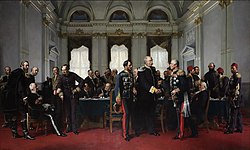
The Congress of Berlin granted Montenegro international recognition as an independent state and substantially enlarged its territory, including access to the Adriatic coast at Bar and Ulcinj.
Image source: Congress of Berlin
Aug 28, 1910
% complete
On the 50th anniversary of his reign, Prince Nikola I elevated Montenegro to a kingdom and took the title King, capping decades of modernization including railways, schools, and Cetinje's diplomatic corps.
Image source: Kingdom of Montenegro
Oct 8, 1912
% complete
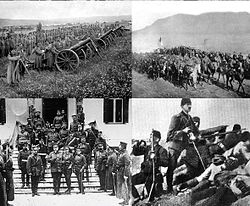
Montenegro fired the first shots of the First Balkan War against the Ottoman Empire, capturing Skadar after a prolonged siege and nearly doubling its territory alongside Serbia, Greece, and Bulgaria.
Image source: First Balkan War
Aug 6, 1914
% complete
As a Russian ally, Montenegro entered World War I against Austria-Hungary, bombarding Kotor and fighting in the Balkans until being overwhelmed by the Central Powers' invasion in early 1916.
Nov 24, 1918 - Nov 29, 1918
% complete
A controversial assembly voted to depose King Nikola and unite Montenegro with Serbia, paving the way for incorporation into the Kingdom of Serbs, Croats and Slovenes, later Yugoslavia — a decision still debated today.
Image source: Podgorica Assembly
Jan 7, 1919
% complete
Supporters of the exiled king, known as 'Greens', launched an armed uprising on Orthodox Christmas against unionist 'Whites', beginning years of guerrilla resistance to the new Yugoslav state.
Apr 17, 1941
% complete
Following the Axis invasion of Yugoslavia, Italy occupied Montenegro and installed a puppet governorate, provoking immediate armed resistance among the population.
Image source: Italian governorate of Montenegro
Jul 13, 1941
% complete
Communist-led Partisans launched a massive popular uprising on July 13, briefly liberating much of the country — one of the largest anti-Axis uprisings in occupied Europe that year.
Image source: July Uprising
Nov 29, 1945
% complete
With the Communist victory, Montenegro became one of six constituent republics of the Socialist Federal Republic of Yugoslavia, gaining defined borders and institutions for the first time as a modern federal entity.
Image source: Socialist Republic of Montenegro
Apr 15, 1979
% complete
A powerful magnitude 6.9 earthquake struck Montenegro's Adriatic coast, killing over 100 people and heavily damaging Kotor, Budva, and Herceg Novi, prompting a major reconstruction effort across Yugoslavia.
Image source: 1979 Montenegro earthquake
Mar 1, 1992
% complete
As Yugoslavia disintegrated, Montenegrins voted overwhelmingly to stay in a rump federation with Serbia, forming the Federal Republic of Yugoslavia amid the wars tearing apart the former country.
Image source: 1992 Montenegrin sovereignty referendum
Feb 4, 2003
% complete
Under EU mediation, the loose union of Serbia and Montenegro replaced the Federal Republic of Yugoslavia, with provisions allowing either republic to referendum-vote for independence after three years.
Image source: Serbia and Montenegro
May 21, 2006
% complete
55.5% of voters backed independence, narrowly surpassing the EU-set threshold; Montenegro declared independence on June 3, 2006, ending its 88-year union with Serbia and restoring full sovereignty.
Image source: 2006 Montenegrin independence referendum
Jun 28, 2006
% complete
Less than a month after declaring independence, Montenegro became the 192nd member of the United Nations, achieving swift international recognition as a sovereign state.
Image source: Accession of Montenegro to the European Union
Jun 26, 2012
% complete
Montenegro began formal EU membership talks, becoming a frontrunner among Western Balkan candidates as it progressively aligned its laws with EU standards toward eventual accession.
Jun 5, 2017
% complete
Despite Russian opposition and domestic protests, Montenegro became NATO's 29th member, marking a major geopolitical realignment toward the West and fulfilling a key foreign policy goal.
Image source: Montenegro–NATO relations
Or browse the full history timeline directory, with more than 2,000 topics.
This History of Montenegro timeline was generated with the help of AI, using information found on the internet.
We work hard to keep these timelines accurate, but mistakes do get through. If you spot one, email us at [email protected] and we'll fix it for future visitors.
Generate yours with AI or build it from scratch, for free.
Export your timeline, add your own events, edit or remove AI-generated events, and much more
No credit card required.
Cancel anytime.
Cancel anytime.
You can create an unlimited number of timelines with up to 10 events on each one, customize how they look, export them to PDF, PNG, PowerPoint, CSV, and Excel, and share them with a link. Paid plans raise the event limit and add features like spreadsheet imports and collaborators.
Yes. You can cancel your subscription from your account page at any time, and you will not be charged again. Your subscription stays active for the rest of the period you already paid for.
Yes. We will email you a reminder before the annual renewal, and we will also email you a receipt.
Yes. You can email us within 15 days of any payment, and we will issue you a full refund.
Check out our pricing docs or send us an email anytime: [email protected].