-
Use Cases
-
Resources
-
Pricing
Estonia's history spans thousands of years, from early Finno-Ugric settlers through Danish and German medieval rule, Swedish governance, Russian imperial control, and a turbulent 20th century marked by independence in 1918, Soviet occupation during World War II, and the restoration of independence in 1991 following the Singing Revolution. More Less
800
% complete
The Oeselians, seafaring Estonians from Saaremaa island, became known for their naval raids across the Baltic Sea during the Viking Age. They raided Swedish coasts and engaged in piracy, establishing themselves as formidable maritime powers in the region.
Image source: Oeselians
1208 - 1227
% complete
German crusading orders, chiefly the Livonian Brothers of the Sword, conquered the Estonian mainland through two decades of campaigns. By 1227, with the fall of Saaremaa, all Estonian lands had been Christianized and brought under foreign rule by Denmark and German crusaders.
Image source: Livonian Crusade
Jun 15, 1219
% complete
Danish King Valdemar II defeated Estonian forces near Reval (Tallinn) in a pivotal battle of the Northern Crusades. According to legend, the Dannebrog, Denmark's flag, fell from the sky during the battle. The victory established Danish rule over northern Estonia for over a century.
Image source: Battle of Lyndanisse
1285
% complete
Reval (Tallinn) joined the Hanseatic League, becoming a major Baltic trading hub connecting Novgorod with Western Europe. The league's merchant networks brought prosperity to Estonian coastal towns and shaped their medieval urban culture and architecture.
Image source: Hanseatic League
Apr 23, 1343 - 1345
% complete
Estonian peasants launched a massive uprising against Danish and German rule, burning manors and besieging castles. The revolt was ultimately crushed by the Teutonic Order, which subsequently purchased Estonia from Denmark, cementing centuries of German-speaking elite dominance.
Image source: Saint George's Night Uprising
1558 - 1583
% complete
Tsar Ivan IV of Russia invaded Livonia, triggering a prolonged conflict involving Russia, Sweden, Denmark, and Poland-Lithuania. The war devastated the region, and Estonia was partitioned: northern Estonia came under Swedish rule while southern Estonia fell to Poland-Lithuania.
Image source: Livonian War
1600
% complete
Warfare between Poland-Lithuania and Sweden over the Baltics ended with Sweden gaining control of southern Estonia by 1625, uniting all of Estonia under the Swedish crown. The 'good Swedish time' that followed brought reforms including education and reduced oppression of peasants.
Image source: Polish–Swedish War (1600–1611)
1695 - 1697
% complete
Years of crop failure and harsh frosts produced catastrophic famine in Estonia and Livonia, killing an estimated fifth to a quarter of the population. It remains one of the deadliest demographic catastrophes in Estonian history.
1700 - 1721
% complete
Russia under Peter the Great defeated Sweden in the Great Northern War. The Treaty of Nystad ceded Estonia to the Russian Empire, beginning more than two centuries of Tsarist rule while local German nobility retained significant autonomy.
Image source: Great Northern War
1816 - 1819
% complete
The Russian Empire abolished serfdom in Estonia (1816) and Livonia (1819), decades earlier than in Russia proper. Though peasants initially lacked land rights, the reform began a gradual transformation toward free farmers and eventually land ownership.
Image source: History of serfdom
1850 - 1914
% complete
A cultural movement flourished as educated Estonians promoted their language, folklore, and identity. Friedrich Reinhold Kreutzwald compiled the epic Kalevipoeg, the first song festival was held in Tartu in 1869, and newspapers spread national consciousness, laying foundations for statehood.
Image source: Estonian national awakening
Jun 1869
% complete
The first nationwide song festival gathered choirs from across Estonia in Tartu, becoming a defining event of the national awakening and a cherished tradition continuing to this day. Singing later became a powerful symbol of Estonian resistance and unity.
Image source: Estonian Song Festival
Oct 1905
% complete
Estonian workers and peasants rose against both Tsarist authorities and Baltic German landlords, demanding political freedoms and national rights. The uprising was violently suppressed, but it accelerated political mobilization and land reform debates.
Image source: Russian Revolution of 1905
Feb 24, 1918
% complete
Amid the collapse of the Russian Empire and German occupation, the Estonian Salvation Committee proclaimed independence in Tallinn. Though soon suppressed by Germany, the declaration survived and February 24 became Estonia's national day.
Image source: Estonian Declaration of Independence
Nov 28, 1918 - Jan 2, 1920
% complete
Newly independent Estonia fought Soviet Russian forces and Baltic German militias. With Allied assistance, including British naval support and Finnish volunteers, Estonia repelled the Bolshevik advance and signed the Treaty of Tartu, securing international recognition of its independence.
Image source: Estonian War of Independence
Feb 2, 1920
% complete
Soviet Russia formally recognized Estonia's independence 'for all time' in the Treaty of Tartu, renouncing all rights to its territory forever. This diplomatic milestone secured Estonia's place among sovereign nations.
Image source: Treaty of Tartu (Estonia–Russia)
Jun 15, 1920
% complete
Estonia adopted its first constitution, creating one of Europe's most democratic systems with broad suffrage, including early women's political participation. Radical land reform redistributed estates from Baltic German nobility to Estonian farmers.
Image source: Constitution of Estonia
Mar 12, 1934 - 1938
% complete
After a failed coup attempt by the right-wing Vaps Movement, Konstantin Päts declared a state of emergency and ruled by decree, suspending parliament. A new constitution in 1938 created a presidential system, ending democratic governance just before the war.
Image source: Konstantin Päts
Aug 23, 1939
% complete
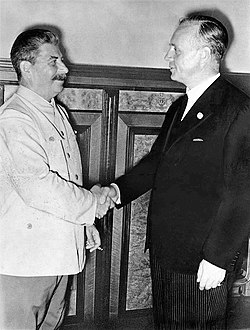
Nazi Germany and the Soviet Union signed a non-aggression pact whose secret protocols divided Eastern Europe into spheres of influence, placing Estonia within the Soviet sphere. The pact sealed Estonia's fate despite its neutrality declarations.
Image source: Molotov–Ribbentrop Pact
Jun 17, 1940 - Aug 6, 1940
% complete
Soviet forces occupied Estonia following ultimatums demanding base access and regime change. Staged elections installed communist governments, and Estonia was annexed as the Estonian SSR, with Western nations largely refusing to recognize the annexation.
Image source: Occupation of the Baltic states
Jun 14, 1941
% complete
Soviet authorities deported around 10,000 Estonians—political leaders, military officers, businessmen, and their families—to labor camps in Siberia. Many died en route or in exile, decapitating Estonian society on the eve of war.
Image source: June deportation
Jul 28, 1941 - Sep 22, 1944
% complete
Wehrmacht troops captured Estonia after fierce fighting, and some Estonians initially welcomed Germans as liberators from Stalinism. However, the Nazi occupation proved brutal, murdering Estonia's Jewish community and thousands of others, while conscripting Estonians into forced service.
1944 - 1956
% complete
Thousands of Estonian men took refuge in forests, waging armed guerrilla resistance against Soviet reoccupation for years after World War II. Their struggle, supported secretly by rural communities, symbolized enduring resistance until suppression in the mid-1950s.
Image source: Guerrilla war in the Baltic states
Feb 2, 1944 - Sep 19, 1944
% complete
German and Estonian forces halted the Soviet offensive at Narva for months, delaying the Soviet reoccupation of Estonia. The prolonged battle caused massive destruction and casualties before German forces withdrew in September 1944.
Image source: Battle of Narva (1944)
Mar 25, 1949
% complete
Soviet forces deported over 20,000 Estonians, mostly women, children, and the elderly, to Siberia as part of collectivization efforts. Combined with mass immigration of Soviet workers, this dramatically altered Estonia's demographic composition.
Image source: Operation Priboi
Apr 1988 - Aug 20, 1991
% complete
Mass singing events, rallies, and political activism challenged Soviet rule without violence. As the August coup collapsed in Moscow, Estonia declared full independence on August 20, 1991, and was quickly recognized internationally, restoring its pre-war statehood continuity.
Image source: Singing Revolution
Aug 23, 1989
% complete
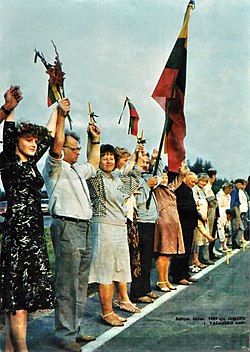
Around two million people formed an unbroken 600-kilometer human chain linking Tallinn, Riga, and Vilnius on the 50th anniversary of the Molotov-Ribbentrop Pact. The peaceful demonstration drew worldwide attention to the illegal Soviet annexation of the Baltics.
Image source: Baltic Way
Jun 20, 1992
% complete
Estonia reintroduced its own currency and pursued radical market reforms, including flat taxation and privatization. These bold moves transformed Estonia into one of post-communist Europe's fastest-growing economies, dubbed the 'Baltic Tiger'.
Image source: Estonian kroon
Mar 29, 2004 - May 1, 2004
% complete
Estonia achieved its key strategic goals by joining NATO on March 29 and the European Union on May 1, 2004. Membership anchored the small nation firmly in Western security structures and integrated it into European markets and institutions.
Image source: North Macedonia–NATO relations
Jan 1, 2011
% complete
After weathering the global financial crisis with austerity, Estonia became the first former Soviet state to adopt the euro, replacing the kroon. The move deepened European integration and boosted investor confidence in the digital-forward economy.
Image source: Estonian euro coins
Or browse the full history timeline directory, with more than 2,000 topics.
This History of Estonia timeline was generated with the help of AI, using information found on the internet.
We work hard to keep these timelines accurate, but mistakes do get through. If you spot one, email us at [email protected] and we'll fix it for future visitors.
Generate yours with AI or build it from scratch, for free.
Export your timeline, add your own events, edit or remove AI-generated events, and much more
No credit card required.
Cancel anytime.
Cancel anytime.
You can create an unlimited number of timelines with up to 10 events on each one, customize how they look, export them to PDF, PNG, PowerPoint, CSV, and Excel, and share them with a link. Paid plans raise the event limit and add features like spreadsheet imports and collaborators.
Yes. You can cancel your subscription from your account page at any time, and you will not be charged again. Your subscription stays active for the rest of the period you already paid for.
Yes. We will email you a reminder before the annual renewal, and we will also email you a receipt.
Yes. You can email us within 15 days of any payment, and we will issue you a full refund.
Check out our pricing docs or send us an email anytime: [email protected].