-
Use Cases
-
Resources
-
Pricing
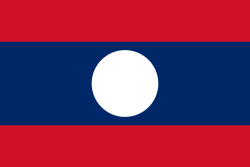
The history of Laos spans over a thousand years, beginning with early Tai migrations and the founding of the Lan Xang Kingdom in 1353. The country endured Burmese and Siamese domination before becoming a French protectorate in 1893. Laos gained independence in 1953 but was soon drawn into the Indochina Wars, experiencing a devastating secret bombing campaign during the Vietnam War. In 1975, the communist Pathet Lao took power, establishing the Lao People's Democratic Republic, which has since gradually introduced economic reforms while remaining a one-party socialist state. More Less
1200 BCE - 1101 BCE
% complete
Chamberlain (2016) proposes that the Tai-Kadai (Kra-Dai) language family was formed as early as the 12th century BCE in the middle Yangtze basin, coinciding roughly with the establishment of the Chu state and the beginning of the Zhou dynasty.
Image source: Kra–Dai languages
800 BC - 199
% complete
From the 8th century BCE to as late as the 2nd century CE, an inland trading society emerged on the Xieng Khouang Plateau, around the megalithic site called the Plain of Jars.
Image source: Plain of Jars
800 BC - 799 BC
% complete
Following the southward migrations of Kra and Hlai (Rei/Li) peoples around the 8th century BCE, the Be-Tai people started to break away to the east coast in Zhejiang, forming the state of Yue by the 6th century BCE.
Image source: Tai peoples
1 CE - 99 CE
% complete
The first indigenous kingdom to emerge in Indochina was referred to in Chinese histories as the Kingdom of Funan, encompassing an area of what later is Cambodia, and the coasts of southern Vietnam and southern Thailand since the 1st century CE.
Image source: Funan
500 - 599
% complete
Funan expanded and incorporated the Champasak region by the sixth century CE, when it was replaced by its successor polity Chenla.
Image source: Chenla
500 - 599
% complete
By the 6th century in the Chao Phraya River Valley, Mon peoples had coalesced to create the Dvaravati kingdoms.
Image source: Dvaravati
700 - 799
% complete
By the 8th century CE, Chenla had divided into 'Land Chenla' located in Laos, and 'Water Chenla' founded by Mahendravarman near Sambor Prei Kuk in Cambodia.
700 - 799
% complete
In the area that later is northern and central Laos and northeast Thailand, the Mon people established their own kingdoms during the 8th century CE, outside the reach of the contracting Chenla kingdoms.
Image source: Mon people
700 - 799
% complete
By the 8th century the Mon had pushed north to create city states, known as 'muang,' in Fa Daet, Sri Gotapura near modern Tha Khek, Muang Sua (Luang Prabang), and Chantaburi (Vientiane).
Image source: Luang Prabang
700 - 799
% complete
In the 8th century CE, Sri Gotapura (Sikhottabong) controlled trade throughout the middle Mekong region.
Image source: Sikhottabong district
700 - 999
% complete
Based on layers of Chinese loanwords in proto-Southwestern Tai and other historical evidence, Pittayaporn (2014) proposes that the southwestward migration of Tai-speaking tribes from Guangxi and northern Vietnam to mainland Southeast Asia took place between the 8th and 10th centuries. As a result of these three centuries of migration, the Tai began to settle southwestward.
1259
% complete
The Tai kingdom of Lanna was founded in 1259 in the north of what later is Thailand.
Image source: Lan Na
1271
% complete
The Sukhothai Kingdom, founded in 1279, expanded northward and captured the city of Muang Sua, renaming it Xieng Dong Xieng Thong or 'City of Flame Trees beside the River Dong.'
Image source: Sukhothai Kingdom
1298 - 1354
% complete
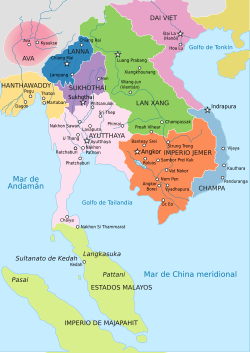
Following the death of the Sukhothai king Ram Khamhaeng, and internal disputes within Lanna, Vieng Chan Vieng Kham (Vientiane) and Xieng Dong Xieng Thong (Luang Prabang) were independent city-states until the founding of the kingdom of Lan Xang in 1354.
Image source: Lan Xang
1300 - 1399
% complete
In later centuries the Lao themselves would preserve the legend in written form, becoming a depiction of life in Southeast Asia prior to Theravada Buddhism and Tai cultural influence.
Image source: Lan Xang
1354
% complete
The kingdom of Lan Xang was founded in 1354, unifying Vientiane and Luang Prabang into a single Lao kingdom that would exist for centuries. In truncated form it traces back to this thirteenth-century-era legacy, existing as a unified kingdom from 1357 to 1707.
1637 - 1694
% complete
Lan Xang recovered and reached the apex of its political and economic power during the seventeenth century under King Sourigna Vongsa, who became the longest reigning of Lan Xang's monarchs (1637–1694) after defeating four rival claimants to the throne.
Image source: Sourigna Vongsa
1707 - 1779
% complete
Upon the death of Sourigna Vongsa a succession dispute and exploitation by Ayutthaya and Dai Viet led to the kingdom of Lan Xang being ultimately divided in 1707 into the three rival kingdoms of Luang Prabang, Vientiane, and Champasak, which lasted from 1707 to 1779.
1779 - 1893
% complete
The Lao kingdoms fell to Siamese suzerainty from 1779 to 1893. The sack of Vientiane in 1779 brought the region firmly under Bangkok's control.
Image source: History of Laos
1780
% complete
Siribunnyasan, the last independent king of Vientiane, died by 1780, and his sons Nanthasen, Inthavong, and Anouvong had been taken to Bangkok as prisoners during the sack of Vientiane in 1779.
Image source: Vientiane
1781
% complete
The sons of Siribunnyasan became successive kings of Vientiane under Siamese suzerainty, beginning with Nanthasen in 1781.
Image source: Kingdom of Vientiane
1791
% complete
1792
% complete
By 1792 Nanthasen had convinced Rama I that Anuruttha was secretly dealing with the Burmese, and Siam allowed Nanthasen to lead an army and besiege and capture Luang Prabang.
1795
% complete
Anuruttha was sent to Bangkok as a prisoner, and through diplomatic exchanges facilitated by China, he was released in 1795.
1795 - 1804
% complete
Inthavong (1795–1804) became the next king of Vientiane, dispatching armies to aid Siam against Burmese invasions in 1797 and 1802, and to capture the Sipsong Chau Tai with his brother Anouvong as general.
1828
% complete
By 1828, Anouvong had been captured, tortured and sent to Bangkok with his family to die in a cage after his rebellion against Siamese rule failed.
Image source: Anouvong
1880
% complete
The population transfers and slave raids ameliorated toward the end of the nineteenth century when European observers and anti-slavery groups made their presence increasingly difficult for the Bangkok elite. In 1880, slave raiding and trading became illegal, while debt slavery persisted until 1905 by decree of King Chulalongkorn.
Image source: Slavery in Thailand
1800 - 1999
% complete
The borders of Laos were established by the French colonial government in the 19th and 20th centuries, defining the modern territorial shape of the country.
Image source: French protectorate of Laos
1893
% complete
After falling to Siamese suzerainty from 1779, Laos was reunified under the French Protectorate of Laos in 1893.
1920
% complete
By 1920, the majority of French Laos was at peace and colonial order had been established.
1928
% complete
In 1928, the first school for the training of Lao civil servants was established, allowing upward mobility of Lao to fill positions occupied by Vietnamese.
1943
% complete
By 1943, the Vietnamese population stood at nearly 40,000, forming the majority in some cities of Laos and having the right to elect their own leaders. As late as 1945, the French drew up a plan to move Vietnamese populations to three areas.
Feb 1945
% complete
In February 1945, a detachment from the Japanese Imperial Army moved into Xieng Khouang during World War II.
Apr 1945
% complete
Under Japanese pressure, King Sisavangvong declared independence in April 1945.
Image source: Sisavang Vong
Aug 15, 1945
% complete
The Japanese surrender on 15 August 1945 emboldened pro-French factions and Prince Phetsarath was dismissed by King Sisavangvong.
Image source: Surrender of Japan
Oct 12, 1945
% complete
On 12 October 1945 the Lao Issara government was declared under the civil administration of Prince Phetsarath.
Image source: Lao Issara
Apr 1946
% complete
In the next six months the French rallied against the Lao Issara and were able to reassert control over Indochina in April 1946.
Aug 1946 - 1949
% complete
With the Lao Issara in exile, in August 1946 France instituted a constitutional monarchy in Laos headed by King Sisavangvong, and Thailand agreed to return territories seized during the Franco-Thai War. The exiled Lao Issara maintained opposition until 1949, when the group split and the communist Pathet Lao was formed.
1949
% complete
The Franco-Lao General Convention of 1949 provided most members of the Lao Issara with a negotiated amnesty and sought appeasement by establishing the Kingdom of Laos as a quasi-independent constitutional monarchy within the French Union.
Image source: Lao Issara
1950
% complete
In 1950, additional powers were granted to the Royal Lao Government including training and assistance for a national army.
Image source: Royal Lao Government in Exile
Oct 22, 1953
% complete
On 22 October 1953, the Franco–Lao Treaty of Amity and Association transferred remaining French powers to the independent Royal Lao Government.
1954
% complete
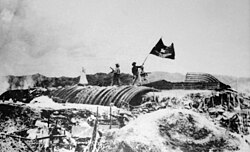
By 1954 the defeat at Dien Bien Phu brought eight years of fighting with the Vietminh, during the First Indochinese War, to an end and France abandoned all claims to the colonies of Indochina.
Image source: Battle of Dien Bien Phu
1954 - 1975
% complete
Growing North Vietnamese military presence in the country increasingly drew Laos into the Second Indochina War (1954–1975).
Image source: Laotian Civil War
1961 - 1962
% complete
A second Geneva conference, held in 1961–62, provided for the independence and neutrality of Laos, but the war resumed afterward.
1975 - 1991
% complete
Laos depended on Soviet aid channeled through Vietnam up until the Soviet collapse in 1991.
Apr 1975
% complete
After the fall of South Vietnam to communist forces in April 1975, the Pathet Lao with the backing of North Vietnam were able to take total power.
Dec 2, 1975
% complete
On 2 December 1975, the king was forced to abdicate his throne and the Lao People's Democratic Republic was established.
1992
% complete
The Plain of Jars was nominated as a UNESCO World Heritage Site in 1992, recognizing its megalithic significance.
1998
% complete
Since 1998, the Plain of Jars site has been cleared of unexploded ordnance left over from wartime bombing, enabling safe access and study of the ancient site.
Or browse the full history timeline directory, with more than 2,000 topics.
This History of Laos timeline was generated with the help of AI, using information found on the internet.
We work hard to keep these timelines accurate, but mistakes do get through. If you spot one, email us at [email protected] and we'll fix it for future visitors.
Generate yours with AI or build it from scratch, for free.
Export your timeline, add your own events, edit or remove AI-generated events, and much more
No credit card required.
Cancel anytime.
Cancel anytime.
You can create an unlimited number of timelines with up to 10 events on each one, customize how they look, export them to PDF, PNG, PowerPoint, CSV, and Excel, and share them with a link. Paid plans raise the event limit and add features like spreadsheet imports and collaborators.
Yes. You can cancel your subscription from your account page at any time, and you will not be charged again. Your subscription stays active for the rest of the period you already paid for.
Yes. We will email you a reminder before the annual renewal, and we will also email you a receipt.
Yes. You can email us within 15 days of any payment, and we will issue you a full refund.
Check out our pricing docs or send us an email anytime: [email protected].