-
Use Cases
-
Resources
-
Pricing
200 BCE
% complete
Notable contact was made with local peoples when envoys of the Han dynasty journeyed to this area in the 2nd century BC, opening early links between China and the regions of modern Tajikistan.
Image source: History of Tajikistan
750 - 1258
% complete
The ascension of the Abbasids to rule the Caliphate (750–1258) opened a new era in the history of Central Asia, bringing the region under Islamic rule and cultural influence.
819 - 1005
% complete
The Samanid dynasty ruled (819–1005) in Khorasan, including eastern Iran and Transoxiana, and was founded by Saman Khuda. The era is regarded as a golden age of Persian culture in the region.
Image source: Samanid Empire
1000 - 1005
% complete
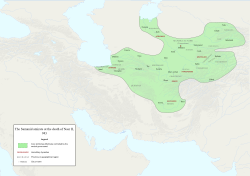
The Samanid Isma'il Muntasir (died 1005) tried to restore the dynasty between 1000 and 1005, until he was assassinated by an Arab bedouin chieftain.
Image source: Isma'il Muntasir
Apr 8, 1336
% complete
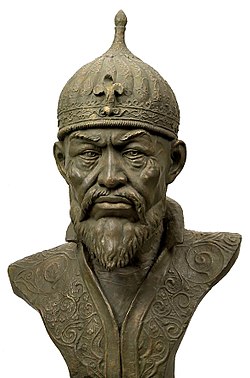
Timur, founder of the Timurid Empire, was born on 8 April 1336 in Kesh, near Samarkand. His empire would come to dominate much of Central Asia.
Image source: Timur
1506 - 1526
% complete
Although the last Timurid ruler of Herat, Badi az Zaman, fell to the armies of the Uzbek Muhammad Shaibani Khan in 1506, the Timurid ruler of Ferghana, Zahir-ud-Din Babur, survived and re-established the Timurid dynasty in India in 1526 as the Mughals.
1709
% complete
In 1709, the eastern part of the Khanate of Bukhara seceded and formed the Khanate of Kokand, a new political power in the Fergana Valley that would later rule parts of modern Tajikistan.
1740
% complete
In 1740, the Janid khanate was conquered by Nader Shah, the Afsharid ruler of Iran, extending Iranian control over Bukhara.
Image source: Bukhara
1747
% complete
After the death of Nader Shah in 1747, Muhammad Rahim Biy Azaliq, chief of the Manghit tribe of Uzbeks, overcame his rivals from other tribes and consolidated his rule over the Khanate of Bukhara.
Image source: Emirate of Bukhara
1785
% complete
In 1785, Shah Murad formalised the family's dynastic rule as the Manghit dynasty, and the khanate became the Emirate of Bukhara.
Image source: Manghud
1864 - 1885
% complete
Russian imperialism drove the Russian Empire's conquest of Central Asia during the late 19th century, a period often associated with the Great Game. Between 1864 and 1885, Russia gradually assumed control over the entirety of Russian Turkestan.
Image source: Russian conquest of Central Asia
1867
% complete
Following the capture of Tashkent in 1865, the Turkestan Governor-Generalship was established in 1867, with Konstantin Petrovich Von Kaufman appointed as its first Governor-General.
Image source: Russian Turkestan
1868
% complete
Fierce resistance to Russian expansion was met only at Jizzakh and Ura-Tyube, as well as during the siege of the Russian garrison in Samarkand in 1868 by forces from Shahr-e Sabz and local inhabitants.
Jun 18, 1868
% complete
On 18 June 1868, Emir Mozaffar al-Din signed a peace treaty with Konstantin Von Kaufman, the Governor-General of Russian Turkestan. The emir retained his throne as a Russian vassal.
1870
% complete
With Russian assistance, Emir Mozaffar al-Din consolidated control over Shahr-e Sabz and the mountainous regions of the upper Zeravshan Valley in 1870, and later the principalities of the western Pamirs (1895).
Image source: Zarafshon (river)
1890
% complete
During the late 19th century the Jadidists established themselves as an Islamic social movement throughout the region, promoting reform and modernisation in Muslim societies of Central Asia.
Image source: Jadid
1910 - 1913
% complete
Russian troops were required to restore order during uprisings against the Khanate of Kokand between 1910 and 1913.
Image source: Khanate of Kokand
Jul 1, 1916
% complete
Violence occurred in July 1916 when demonstrators attacked Russian soldiers in Khujand over the threat of forced conscription during World War I. These anti-conscription riots laid roots for the Basmachi movement.
Image source: Central Asian revolt of 1916
1917 - 1923
% complete
The Basmachi revolt broke out in the wake of the Russian Revolution of 1917 as an uprising against Russian Imperial and Soviet rule by guerrillas throughout Central Asia. By 1923 the Red Army's extensive campaigns dealt the Basmachis many defeats, and it was quelled in the early 1920s.
Image source: Basmachi movement
Feb 1, 1918
% complete
In the months following the October 1917 Revolution the Bolsheviks seized power in many parts of the Russian Empire and the Russian Civil War began. The Bolsheviks launched an assault on Kokand in February 1918 and carried out a general massacre of up to 25,000 people.
Aug 31, 1920
% complete
At the end of August 1920, the last emir, Sayyid Alim Khan, was overthrown by Soviet troops, ending centuries of dynastic rule in Bukhara.
Oct 6, 1920
% complete
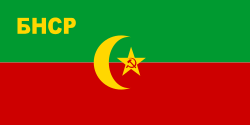
On 6 October 1920, the emirate was abolished and the Bukharan People's Soviet Republic was proclaimed, replacing the Emirate of Bukhara with a Soviet state.
Image source: Bukharan People's Soviet Republic
1924 - 1929
% complete
In 1924, Tajikistan became an Autonomous Soviet Socialist Republic within Uzbekistan, known as the Tajik ASSR. When national borders were redrawn in 1928 during the administrative delimitation, the ancient Tajik cities of Bukhara and Samarkand were placed outside Tajikistan.
1926 - 1959
% complete
Between 1926 and 1959 the proportion of Russians among Tajikistan's population grew from less than 1% to 13%, reflecting migration into the republic during the Soviet era.
1927 - 1934
% complete
Between 1927 and 1934 collectivization of agriculture and a rapid expansion of cotton production took place, especially in the southern region. Two rounds of Soviet purges directed by Moscow (1927–1934 and 1937–1938) resulted in the expulsion of nearly 10,000 people from all levels of the Communist Party of Tajikistan.
Image source: Tajik Soviet Socialist Republic
1929 - 1991
% complete
In 1929, Tajikistan was made one of the constituent republics of the Soviet Union—the Tajik Soviet Socialist Republic—and retained this status until gaining independence in 1991 following the dissolution of the Soviet Union.
1939 - 1945
% complete
Tajiks began to be conscripted into the Soviet Army in 1939, and during World War II around 260,000 Tajik citizens fought against Germany, Finland and Japan.
Image source: Tajikistan
1946 - 1956
% complete
Bobojon Ghafurov, Tajikistan's First Secretary of the Communist Party from 1946 to 1956, was the only Tajikistani politician of significance outside the country during the Soviet Era.
Image source: Bobodzhan Gafurov
1956 - 1992
% complete
Ghafurov was followed in office by Tursun Uljabayev (1956–61), Dzhabar Rasulov (1961–1982), and Rahmon Nabiyev (1982–1985, 1991–1992), leading the republic through decades of Soviet rule.
1957 - 1958
% complete
During 1957–58 Nikita Khrushchev's Virgin Lands Campaign focused attention on Tajikistan, where living conditions, education and industry lagged behind the other Soviet Republics.
Image source: Virgin Lands campaign
1980 - 1989
% complete
In the 1980s, Tajikistan had the lowest household saving rate in the USSR, the lowest percentage of households in the two top per capita income groups, and the lowest rate of university graduates per 1000 people. Living standards were further undermined during the tenure of Kahar Mahkamov as first secretary from 1985.
Sep 9, 1991
% complete
In 1991, the Soviet Union collapsed, and Tajikistan declared its independence. On September 9, following the collapse of the Union of Soviet Socialist Republics (USSR), Tajikistan formally declared independence.
1992 - 1994
% complete
Following independence, Tajikistan descended into civil war among rival factions. Emomali Rahmon came to power in 1994 amid the conflict, and continues to rule to this day.
Image source: Tajikistani Civil War
1992 - 2005
% complete
Russian troops were stationed in southern Tajikistan in order to guard the border with Afghanistan until summer 2005. Since the September 11, 2001 attacks, American, Indian and French troops have also been stationed in the country.
Image source: Afghanistan–Tajikistan border
Jun 27, 1997
% complete
A peace agreement among rival factions was signed in 1997, and a ceasefire was reached between Rahmon and opposition parties of the United Tajik Opposition, ending years of civil war.
1999
% complete
Peaceful elections were held in 1999, but they were reported by the opposition as unfair, and Rahmon was re-elected by almost unanimous vote.
Image source: 1999 Tajik presidential election
Oct 2020
% complete
In October 2020, President Emomali Rahmon was re-elected for another seven-year period with 90 per cent of the votes, following a tightly controlled and largely ceremonial election.
Image source: 2020 Tajik presidential election
Or browse the full history timeline directory, with more than 2,000 topics.
This History of Tajikistan timeline was generated with the help of AI, using information found on the internet.
We work hard to keep these timelines accurate, but mistakes do get through. If you spot one, email us at [email protected] and we'll fix it for future visitors.
Generate yours with AI or build it from scratch, for free.
Export your timeline, add your own events, edit or remove AI-generated events, and much more
No credit card required.
Cancel anytime.
Cancel anytime.
You can create an unlimited number of timelines with up to 10 events on each one, customize how they look, export them to PDF, PNG, PowerPoint, CSV, and Excel, and share them with a link. Paid plans raise the event limit and add features like spreadsheet imports and collaborators.
Yes. You can cancel your subscription from your account page at any time, and you will not be charged again. Your subscription stays active for the rest of the period you already paid for.
Yes. We will email you a reminder before the annual renewal, and we will also email you a receipt.
Yes. You can email us within 15 days of any payment, and we will issue you a full refund.
Check out our pricing docs or send us an email anytime: [email protected].