-
Use Cases
-
Resources
-
Pricing
330 BC - 327 BC
% complete
Alexander the Great conquered the territory of present-day Turkmenistan in the 4th century BC on his way to South Asia, bringing the region into the orbit of Hellenistic culture and empire.
Image source: Alexander the Great
300 CE - 700 CE
% complete
During the 4th to early 7th century CE, much of the population lived in settlements around the fertile river valleys along the Amu Darya. Merv and Nisa became centers of sericulture, the raising of silkworms.
Image source: Merv
690 CE - 750 CE
% complete
Central Asia came under Arab control after a series of invasions in the late 7th and early 8th centuries and was incorporated into the Islamic Caliphate, divided between the provinces of Mawara'un Nahr and Khorasan.
Image source: Muslim conquest of Transoxiana
700 CE - 715 CE
% complete
Using Merv as their base, the Arabs led by commander Qutayba ibn Muslim brought Balkh, Bukhara, Fergana and Kashgaria under subjection, penetrating into China as far as the province of Gansu early in the 8th century.
770 CE - 800 CE
% complete
In the latter part of the 8th century, Merv became obnoxious to Islam as the center of heretical propaganda preached by al-Muqanna, known as 'The Veiled Prophet of Khorasan.'
Image source: Al-Muqanna
750 CE - 800 CE
% complete
In the second half of the 8th century, Oghuz components migrated through Jungaria into Central Asia. Arabic sources located them, under the term Guzz, in the area of the middle and lower Syrdariya in the 8th century.
Image source: Oghuz Turks
900 - 1000
% complete
The name Turkmen first appears in written sources of the 10th century to distinguish those Oghuz groups who migrated south into the Seljuk domains and accepted Islam from those that had remained in the steppe.
990 - 999
% complete
The Samanid dynasty weakened after the second half of the 10th century, and the Ghaznavids took present Turkmenistan in the 990s.
Image source: Ghaznavid Empire
1000 - 1100
% complete
In the 11th century, the Muslim Turk scholar Mahmud al-Kashgari described the language of the Oghuz and Turkmen as distinct from that of other Turks and identified twenty-two Oghuz clans or sub-tribes, some of which appear in later Turkmen genealogies as the core of the early Turkmen.
Image source: Mahmud al-Kashgari
1040
% complete
In 1040 the Seljuk Turks crossed the Oxus from the north and, having defeated Masud, sultan of Ghazni, raised Toghrul Beg, grandson of Seljuk, to the throne of Iran, founding the Seljukid dynasty with its capital at Nishapur.
Image source: Battle of Dandanaqan
1041
% complete
Following the Seljuks' decisive victory against their rivals, present Turkmenistan was passed to them in 1041.
1050 - 1157
% complete
In the 11th century, Seljuk domains stretched from the delta of the Amu Darya into Iran, Iraq, the Caucasus region, Syria, and Asia Minor.
1055
% complete
In 1055 Seljuk forces entered Baghdad, becoming masters of the Islamic heartlands and important patrons of Islamic institutions.
Image source: Seljuk Empire
1150 - 1160
% complete
During the reign of Sultan Sanjar, in the middle of the 11th century, Merv was overrun by the Turkish tribes of the Ghuzz from beyond the Oxus.
1157
% complete
The fragmentation and destruction of the empire due to attacks by Turkmen and other tribes culminated in 1157, when the rule of the Seljuk dynasty came to an end in the province of Khorasan. The Turkmen then became an independent tribal federation.
Image source: Seljuk dynasty
1221
% complete
The Turkic rulers of Khiva took control of the area of Turkmenistan under the title of Khwarazmshahs. In 1221, Central Asia suffered a disastrous invasion by Mongol warriors who swept across the region from their base in eastern Asia.
Image source: Mongol invasion of the Khwarazmian Empire
1370
% complete
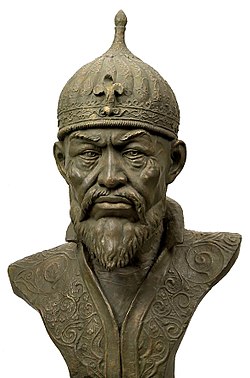
Small, semi-independent states had arisen under the rule of tribal chiefs later in the 14th century. In the 1370s, Amir Timur (Tamerlane), one of the greatest conquerors in human history, captured the Turkmen states once more and established the short-lived Timurid Empire.
Image source: Timur
1405
% complete
The Timurid Empire collapsed after Timur's death in 1405, and the Turkmens became independent once again. The 14th to 16th centuries was a period in which dislocation from the Mongol invasions gave way to new political groupings that have continued to modern day.
Image source: Timurid Empire
1645 - 1663
% complete
The invasion of the Khan of Khiva, Abul Gazi Bahadur Khan, caused difficulties for the Turkmens. Coupled with drought at about the same period, most of the Turkmens within the khanate moved to areas around Ahal, Etrek, Murgap, and Tejen.
Image source: Khanate of Khiva
1690
% complete
In the late 17th century, the confederation fell apart and three senior tribes moved eastward and then southward. From the 16th until the 19th century, Turkmen history was mostly shaped by relations with the states of Iran, Khiva, Bukhara, and Afghanistan.
Image source: Turkmens
1740 - 1747
% complete
Nader, Shah of Persia, conquered Turkmenistan in 1740, but after his assassination in 1747, Turkmen lands were recaptured by the Uzbek khanates of Khiva and Bukhara.
Image source: Nader Shah
1856
% complete
Khiva contested the advance of the Tekes, but ultimately, around 1856, the latter became the sovereign power of the southern and southeastern parts of present Turkmenistan. In the 18th century, Turkoman tribes had already come into contact with the Tsarist Empire.
Image source: Teke (tribe)
1869
% complete
The Russian Empire began to move into the area in 1869 with the establishment of the Caspian Sea port of Krasnovodsk, present-day Türkmenbaşy. After the subjugation of the Emirate of Bukhara (1868) and the Khanate of Khiva (1873), the Turkmen area remained independent.
Image source: Türkmenbaşy, Turkmenistan
1879
% complete
The Transcaspian Railway was started from the shores of the Caspian in 1879 to secure Russian control over the region and provide a rapid military route to the Afghan border. It reached Tashkent in 1897, and in 1906 a direct rail link with European Russia opened across the steppe from Orenburg to Tashkent.
Image source: Trans-Caspian railway
1881
% complete
These wars culminated in the Battle of Geok Tepe in 1881, where General Skobelev massacred 7,000 Turkmens at the desert fortress of Geok Depe near modern Ashgabat; another 8,000 were killed trying to flee across the desert.
Image source: Battle of Geok Tepe
1885
% complete
In 1885 a crisis was precipitated by the Russian annexation of the Pandjeh oasis, to the south of Merv on territory of modern Afghanistan, which nearly led to war with Britain. By 1894, Imperial Russia controlled almost all of Turkmenistan except parts held by Khiva and Bukhara.
Image source: Panjdeh incident
1898
% complete
Until 1898 Transcaspia was part of the Governor-Generalship of the Caucasus, administered from Tiflis, but that year it was made an Oblast of Russian Turkestan and governed from Tashkent. General Kuropatkin's authoritarian methods from Ashgabat later led to a revolt in 1916, and in 1908 Count Pahlen led a reforming commission detailing abuses of power and corruption.
Image source: Transcaspian Oblast
Jul 1, 1918
% complete
Following the October Revolution of 1917, Ashgabat became a base for anti-Bolshevik counter-revolutionaries attacked by the Tashkent Soviet. The Communists succeeded in taking control of Ashgabat in the summer of 1918. In July 1919 anti-Communist allies established independent Transcaspia, with a small British force under General Malleson occupying Ashgabat until 1919.
Image source: Ashgabat
1922 - 1923
% complete
The region was one of the last centers of Basmachi resistance to Bolshevik rule, with the last of the rebellious Turkoman fleeing across the border to Afghanistan and Iran in 1922–23.
Image source: Basmachi movement
Oct 27, 1924
% complete
On October 27, 1924, the Turkestan ASSR was dissolved, leading to the creation of the Turkmen Soviet Socialist Republic as part of the transformation of Turkmenistan from an Islamic and nomadic tribal society to an industrialized Leninist socialist republic during the Soviet era.
Image source: Turkmen Soviet Socialist Republic
Feb 1, 1925
% complete
In February 1925, the Turkmenistan Communist Party held its first Congress in Ashkhabad. The government briefly renamed Ashgabat as Poltoratsk after a local revolutionary, restoring the name 'Ashgabat' in 1927.
Image source: Communist Party of Turkmenistan
Oct 6, 1948
% complete
From the Soviet period onward Ashgabat experienced rapid growth and industrialization, although it was severely disrupted by the October 1948 Ashgabat earthquake, one of the deadliest earthquakes of the 20th century.
Oct 27, 1991
% complete
Turkmenistan became independent on October 27, 1991, amidst the dissolution of the Soviet Union, an event commemorated annually.
Image source: Turkmenistan
Dec 16, 1991 - 1992
% complete
At the 25th Congress of the Communist Party of Turkmenistan in autumn 1991, the party decided to dissolve itself. In its place the Turkmenistan Democratic Party was organized, and on December 16, 1991, Saparmurat Niyazov signed a decree officially conferring TDP membership on former party members.
Image source: Democratic Party of Turkmenistan
Dec 1, 1999
% complete
In December 1999, Turkmenistan's constitution was amended to allow Nyýazow to serve as president for life. He ruled the newly independent country as a totalitarian conservative dictatorship, taking up the title 'Türkmenbaşy,' Leader of the Turkmen, unlike most other former Soviet republics which democratized.
Image source: Saparmurat Niyazov
Jan 1, 2005
% complete
In 2005 Nyýazow announced his country would downgrade its links with the Commonwealth of Independent States and promised free and fair elections by 2010, surprising many Western observers. In late 2004 he had met former Canadian prime minister Jean Chrétien to discuss an oil contract, causing an uproar among opposition circles in Canada.
Dec 21, 2006
% complete
After acknowledging heart disease in November 2006, Nyýazow died unexpectedly on December 21, 2006, leaving no heir-apparent and an unclear line of succession after ruling the country since independence.
Feb 11, 2007
% complete
In an election on February 11, 2007, Gurbanguly Berdimuhamedow was elected president with 89% of the vote and 95% turnout, although the election was condemned by outside observers.
Image source: Gurbanguly Berdimuhamedow
Mar 19, 2007
% complete
On March 19, 2007, Berdimuhamedow reversed one of Nyýazow's most unpopular decrees by giving pensions back to 100,000 elderly people whose pensions Nyýazow had slashed amid an unspecified budget crisis. On March 31, 2007, the 20th Congress of the Halk Maslahaty began in Mary, and he celebrated his 50th birthday on June 29, 2007.
2008
% complete
In 2008, Berdimuhamedow restored the Latin-based names of the months and traditional Persian and Turkic days of the week, which Nyýazow had renamed after himself and his mother, and announced plans to move the gold rotating statue of Nyýazow from Ashgabat's central square. He also announced changes to the national anthem removing references to Nyýazow.
Sep 1, 2008 - Dec 14, 2008
% complete
In September 2008, a new constitution was accepted by the People's Council. Parliamentary elections under the new constitution were subsequently held on December 14, 2008.
Image source: Constitution of Turkmenistan
Feb 12, 2017
% complete
In February 2017, president Gurbanguly Berdimuhamedow was re-elected for a third term in office after receiving 97.69 percent of all votes according to official results, following a tightly controlled and largely ceremonial election.
Image source: 2017 Turkmenistan presidential election
Mar 19, 2022
% complete
On March 19, 2022, Serdar Berdimuhamedow was sworn in as Turkmenistan's new president to succeed his father, who stepped down from political office, establishing a de facto political dynasty in the still largely undemocratized country.
Image source: Serdar Berdimuhamedow
Or browse the full history timeline directory, with more than 2,000 topics.
This History of Turkmenistan timeline was generated with the help of AI, using information found on the internet.
We work hard to keep these timelines accurate, but mistakes do get through. If you spot one, email us at [email protected] and we'll fix it for future visitors.
Generate yours with AI or build it from scratch, for free.
Export your timeline, add your own events, edit or remove AI-generated events, and much more
No credit card required.
Cancel anytime.
Cancel anytime.
You can create an unlimited number of timelines with up to 10 events on each one, customize how they look, export them to PDF, PNG, PowerPoint, CSV, and Excel, and share them with a link. Paid plans raise the event limit and add features like spreadsheet imports and collaborators.
Yes. You can cancel your subscription from your account page at any time, and you will not be charged again. Your subscription stays active for the rest of the period you already paid for.
Yes. We will email you a reminder before the annual renewal, and we will also email you a receipt.
Yes. You can email us within 15 days of any payment, and we will issue you a full refund.
Check out our pricing docs or send us an email anytime: [email protected].