
-
Use Cases
-
Resources
-
Pricing
The history of Kazakhstan spans thousands of years, from early nomadic tribes and the Scythians, through the Silk Road era, Mongol invasions, the Kazakh Khanate founded in 1465, Russian imperial expansion in the 19th century, Soviet collectivization and nuclear testing, to independence in 1991 and its development as a modern Central Asian state. More Less
370 AD
% complete
The Hunnic expansion from the eastern steppes displaced many peoples in present-day Kazakhstan, triggering migrations across Europe and reshaping the ethnic composition of the region.
Image source: Huns
552 AD
% complete
The Gokturk Khaganate, the first major Turkic state, arose on the Mongolian plateau and extended control over much of the territory of modern Kazakhstan, spreading Turkic languages and culture throughout the steppe.
Image source: First Turkic Khaganate
705 AD - 751 AD
% complete
Arab armies advanced into Central Asia, culminating at the Battle of Talas in 751 against the Tang Chinese. Islam gradually spread through southern Kazakhstan's cities such as Taraz and Turkestan.
Image source: Muslim conquest of Transoxiana
756 AD - 940 AD
% complete
After the collapse of the Gokturk Khaganates, Karluk tribes formed a state centered on Semirechye in southeastern Kazakhstan, playing an important role in the Turkic political landscape before being absorbed by the Karakhanids.
840 AD - 1212 AD
% complete
The Karakhanid Khanate was among the first Turkic dynasties to embrace Islam, ruling cities like Balasagun and Taraz and fostering a flourishing of Turkic literature and Islamic scholarship in the region.
Image source: Kara-Khanid Khanate
1219 AD - 1221 AD
% complete
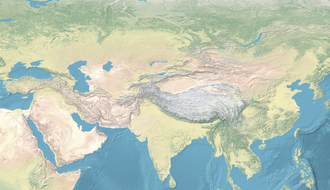
Genghis Khan's forces swept through Central Asia, destroying cities such as Otrar in southern Kazakhstan and incorporating the steppe lands into the Mongol Empire, profoundly altering the region's demographics and politics.
1242 AD
% complete
Following Genghis Khan's death, the western portion of the Mongol Empire, the Golden Horde under Batu Khan, dominated the lands west of the Irtysh River, including much of present-day Kazakhstan.
Image source: Golden Horde
1391 AD - 1395 AD
% complete
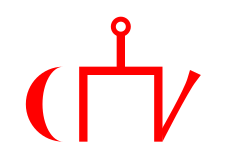
Tamerlane's campaigns shattered the Golden Horde's power, weakening its hold over the Kazakh steppe and paving the way for new khanates to emerge in the fifteenth century.
Image source: Tokhtamysh–Timur war
1428 AD - 1468 AD
% complete
Abu'l-Khayr united eastern Desht-i Kipchak tribes into the Uzbek Khanate. His harsh rule prompted dissident tribes led by Janibek and Kerei to migrate eastward toward Moghulistan.
Image source: Uzbek Khanate
1465 AD
% complete
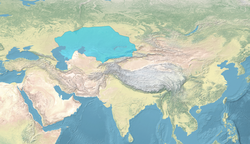
Kerei Khan and Janibek Khan broke away from the Uzbek Khanate and established the Kazakh Khanate along the Chu and Talas rivers, marking the birth of the Kazakh state and identity; this date is celebrated as the origin of Kazakh statehood.
Image source: Kazakh Khanate
1511 AD - 1521 AD
% complete
Under Kasym Khan, the Kazakh Khanate reached about one million subjects and consolidated control over the steppes between the Volga and Irtysh rivers, codifying customary law and expanding Kazakh power.
1643 AD - 1756 AD
% complete
The Dzungar Khanate launched repeated invasions of Kazakh lands, including the devastating 'Great Disaster' of 1723. The wars devastated the Kazakh hordes and pushed them toward seeking Russian protection.
Image source: Kazakh–Dzungar Wars
1731 AD
% complete
Khan Abul Khair of the Little Juz swore allegiance to Empress Anna of Russia, beginning the gradual incorporation of Kazakh territories into the Russian Empire.
Image source: Kazakhstan
1822 AD - 1848 AD
% complete
Through the Statute of 1822 for the Middle Juz and later measures for the Little and Great Juz, St. Petersburg abolished the authority of Kazakh khans, integrating the steppe directly into the imperial administrative system.
1837 AD - 1847 AD
% complete
Kenesary Qasymov led the largest Kazakh resistance movement against Russian imperial expansion. His defeat and death in 1847 marked the end of organized Kazakh state resistance to colonial rule.
Image source: Kenesary Qasymuly
1904 AD
% complete
Railways such as the Trans-Aral line linked Central Asia with European Russia, accelerating migration of Slavic settlers into Kazakhstan and transforming its economy and demographics.
Image source: Turkestan–Siberia Railway
Dec 13, 1917
% complete
In the aftermath of the Russian Revolution, Kazakh nationalist intellectuals proclaimed the Alash Autonomy with its capital at Alash-Qala, but it was suppressed by the Bolsheviks by 1920.
Image source: Alash Autonomy
Aug 26, 1920
% complete
The Bolsheviks created the Kirghiz ASSR (renamed the Kazakh ASSR in 1925) as part of the Russian SFSR, laying the administrative groundwork for eventual Soviet republichood.
Image source: Kazakh Autonomous Socialist Soviet Republic
1930 AD - 1959 AD
% complete
The Karaganda Corrective Labor Camp became one of the largest Gulag complexes, imprisoning hundreds of thousands of deportees, dissidents, and victims of Stalinist purges within Kazakhstan.
Image source: Karlag
1930 AD - 1933 AD
% complete
Forced sedentarization and collectivization triggered a catastrophic famine that killed roughly 1.5 million people, about a quarter of all Kazakhs, and drove mass flight abroad, permanently altering the republic's demography.
Image source: Kazakh famine of 1930–1933
Dec 5, 1936
% complete
Kazakhstan was elevated to full union republic status within the USSR, formally separating it from the Russian SFSR and establishing Almaty as its capital.
Image source: Kazakh Soviet Socialist Republic
1937 AD - 1944 AD
% complete
Stalin's regime deported entire ethnic groups—Germans, Koreans, Chechens, Ingush, Crimean Tatars, Poles, and others—to Kazakhstan, dramatically diversifying its population.
Image source: Population transfer in the Soviet Union
Aug 21, 1947
% complete
The USSR built its primary nuclear weapons testing ground near Semipalatinsk, where over 450 explosions were conducted until 1989, causing severe health and environmental damage to local populations.
Image source: Semipalatinsk Test Site
1954 AD
% complete
Nikita Khrushchev's massive agricultural program plowed up millions of hectares of Kazakh steppe, drawing hundreds of thousands of settlers and briefly making Kazakhstan the USSR's leading grain producer.
Image source: Virgin Lands campaign
Oct 4, 1957
% complete
From Baikonur in southern Kazakhstan, the Soviet Union launched Sputnik 1, the first artificial satellite, and later Yuri Gagarin's historic first human spaceflight in 1961.
Image source: Baikonur Cosmodrome
Dec 17, 1986
% complete
Mass demonstrations erupted in Almaty after Moscow replaced Kazakh party leader Dinmukhamed Kunayev with an outsider. The protests, violently suppressed, became a symbol of rising Kazakh national consciousness.
Image source: Jeltoqsan
Aug 29, 1991
% complete
President Nursultan Nazarbayev closed the Semipalatinsk nuclear testing site, a landmark act of disarmament now commemorated annually as the International Day against Nuclear Tests.
Dec 16, 1991
% complete
In the final days of the Soviet Union, Kazakhstan declared independence, becoming the last Soviet republic to do so and emerging as the world's largest landlocked country.
May 6, 1998
% complete
The capital was officially moved from Almaty to Akmola and renamed Astana, which underwent rapid transformation into a gleaming futuristic city symbolizing the new nation's ambitions.
Image source: Astana
2000 AD
% complete
The discovery of Kashagan, one of the largest oil finds in recent decades, cemented Kazakhstan's role as a major global energy exporter and fueled rapid economic growth through the 2000s.
Image source: Kashagan Field
Jun 15, 2001
% complete
As a founding member of the SCO alongside China, Russia, Kyrgyzstan, Tajikistan, and Uzbekistan, Kazakhstan strengthened regional cooperation on security, trade, and counterterrorism.
Image source: Shanghai Cooperation Organisation
Dec 16, 2011
% complete
Police fired on striking oil workers in Zhanaozen on Kazakhstan's independence day, killing at least 14 people and exposing deep social tensions beneath the country's economic boom.
Image source: Zhanaozen massacre
Jun 10, 2017 - Sep 10, 2017
% complete
Astana hosted the International Exposition themed 'Future Energy', showcasing renewable technologies and marking Kazakhstan's emergence on the world cultural stage.
Image source: Expo 2017
Mar 19, 2019
% complete
Kazakhstan's founding president unexpectedly resigned after nearly three decades in power, handing leadership to Kassym-Jomart Tokayev while retaining influential roles behind the scenes.
Image source: Nursultan Nazarbayev
Mar 23, 2019 - 2022 AD
% complete
Days after his resignation, the capital was renamed Nursultan in honor of the former president; it reverted to Astana in September 2022 amid post-January reforms.
Jan 2, 2022 - Jan 11, 2022
% complete
Protests sparked by fuel price increases escalated into nationwide unrest and violent clashes. Dozens died, CSTO troops were deployed, and President Tokayev subsequently launched sweeping political reforms.
Image source: 2022 Kazakh unrest
Jun 5, 2022
% complete
Voters overwhelmingly approved constitutional amendments designed to decentralize power, reduce the former president's privileges, and transition the country toward what Tokayev called a 'New Kazakhstan'.
Image source: 2022 Kazakh constitutional referendum
Or browse the full history timeline directory, with more than 2,000 topics.
This History of Kazakhstan timeline was generated with the help of AI, using information found on the internet.
We work hard to keep these timelines accurate, but mistakes do get through. If you spot one, email us at [email protected] and we'll fix it for future visitors.
Generate yours with AI or build it from scratch, for free.
Export your timeline, add your own events, edit or remove AI-generated events, and much more
No credit card required.
Cancel anytime.
Cancel anytime.
You can create an unlimited number of timelines with up to 10 events on each one, customize how they look, export them to PDF, PNG, PowerPoint, CSV, and Excel, and share them with a link. Paid plans raise the event limit and add features like spreadsheet imports and collaborators.
Yes. You can cancel your subscription from your account page at any time, and you will not be charged again. Your subscription stays active for the rest of the period you already paid for.
Yes. We will email you a reminder before the annual renewal, and we will also email you a receipt.
Yes. You can email us within 15 days of any payment, and we will issue you a full refund.
Check out our pricing docs or send us an email anytime: [email protected].