-
Use Cases
-
Resources
-
Pricing
Armenia boasts one of the world's oldest histories, with roots tracing back to ancient civilizations of the Armenian Highland. Over millennia, Armenians experienced powerful kingdoms, the adoption of Christianity as a state religion in 301 AD, centuries under Persian, Roman, Byzantine, Arab, and Ottoman rule, devastating tragedies such as the Armenian Genocide, and finally independence from the Soviet Union in 1991. This timeline highlights the major events that shaped Armenia's rich cultural and political heritage. More Less
860 BC
% complete
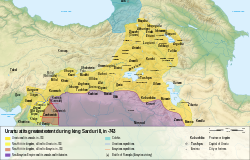
The Kingdom of Urartu emerged around Lake Van in the Armenian highlands, becoming a powerful regional state known for its fortresses, irrigation systems, and conflicts with Assyria. Urartian culture laid important foundations for later Armenian identity.
Image source: Urartu
570 BC - 201 BC
% complete
The Orontid dynasty ruled Armenia as satraps under the Persian Achaemenid Empire and later as independent kings. This period saw the consolidation of the Armenian plateau under a unified administration and early development of Armenian statehood.
Image source: Orontid dynasty
189 BC - 12 AD
% complete
Artaxias I founded the Artaxiad dynasty, expanding Armenia's borders and establishing its capital at Artashat. The kingdom reached considerable power, engaging with Hellenistic culture and rivaling neighboring empires.
95 BC
% complete
Tigranes the Great expanded Armenia into a vast empire stretching from the Caspian to the Mediterranean, earning the title King of Kings. His empire briefly dominated the Near East before succumbing to Roman pressure.
Image source: Tigranes the Great
Oct 6, 69 BC
% complete
Roman general Lucullus defeated Tigranes the Great at Tigranocerta, marking the beginning of the decline of Armenia's short-lived empire and increasing Roman influence over the region.
Image source: Battle of Tigranocerta
52 AD - 428 AD
% complete
A branch of the Parthian Arsacid dynasty took the Armenian throne, ruling for centuries as a buffer between Rome and Parthia. The dynasty oversaw Armenia's Christianization and cultural flourishing.
301 AD
% complete
King Tiridates III adopted Christianity as the state religion after being converted by Gregory the Illuminator, making Armenia the first nation to officially embrace Christianity, more than a decade before the Roman Empire.
Image source: Arsacid dynasty of Armenia
405 AD
% complete
Monk Mesrop Mashtots devised the 36-letter Armenian alphabet to translate scripture and strengthen Armenian identity. The alphabet became a cornerstone of Armenian literature, education, and national consciousness.
Image source: Armenian alphabet
May 26, 451 AD
% complete
Led by Vardan Mamikonian, Armenians fought Sassanid Persia to defend their Christian faith. Though tactically defeated, their resistance led Persia to eventually grant religious freedom, and the battle became a symbol of Armenian resilience.
Image source: Battle of Avarayr
885 AD
% complete
Ashot I was crowned King of Armenia, restoring independence after centuries of Arab rule. The Bagratuni kingdom presided over an era of economic revival, monastic construction, and literary achievement.
Image source: Bagratid Armenia
Aug 26, 1071 AD
% complete
The Seljuk victory over Byzantium opened Anatolia and the Armenian highlands to Turkic migration, leading to the fall of Bagratid Armenia and profound demographic changes across the region.
Image source: Battle of Manzikert
1198 AD - 1375 AD
% complete
After the fall of the homeland kingdoms, Armenians established a powerful state on the Mediterranean coast of Cilicia. It flourished through trade with Europe and Crusader alliances until its conquest by the Mamluks.
Image source: Armenian Kingdom of Cilicia
1375 AD
% complete
Mamluk forces captured Sis, the Cilician capital, ending the last independent Armenian state. This ushered in centuries during which Armenians lived under foreign empires without sovereignty.
1512 AD
% complete
Hakob Meghapart published 'Urbatagirk,' the first printed book in Armenian, in Venice. Armenian printing spread across diaspora communities and played a vital role in preserving language and culture.
Image source: Hakob Meghapart
1514 AD
% complete
Following the Battle of Chaldiran and subsequent Ottoman-Persian wars, the Ottoman Empire gained control of western Armenia, where Armenians lived for centuries as part of the millet system.
Image source: Western Armenia
1555 AD
% complete
The Peace of Amasya divided Armenia between the Ottoman and Safavid empires, placing eastern Armenia under Persian control. Persian rule shaped the region until the Russian expansion of the 19th century.
Image source: Sasanian Armenia
1828 AD
% complete
The Treaty of Turkmenchay transferred Erivan and Nakhichevan khanates to the Russian Empire following the Russo-Persian War. Eastern Armenians came under Russian rule, which brought new administrative and educational opportunities.
Image source: Treaty of Turkmenchay
1894 AD - 1896 AD
% complete
Sultan Abdul Hamid II's forces and Kurdish irregulars massacred between 100,000 and 300,000 Armenians across the Ottoman Empire, drawing international outrage and foreshadowing the genocide to come.
Image source: Hamidian massacres
Apr 1909 AD
% complete
Massacres in the Adana province killed some 20,000 Armenians amid counterrevolutionary turmoil in the Ottoman Empire, further eroding Armenian confidence in living safely under Ottoman rule.
Image source: Adana massacre
Apr 24, 1915 AD
% complete
On April 24, 1915, Ottoman authorities arrested Armenian intellectuals in Constantinople, beginning a campaign of deportations and massacres that killed approximately 1.5 million Armenians and scattered survivors worldwide.
Image source: Armenian genocide
May 28, 1918 AD
% complete
After victories at Sardarabad, Bash-Aparan, and Kara Killisse against Ottoman forces, Armenia declared independence, founding the first modern Armenian republic centered in Yerevan.
Image source: First Republic of Armenia
Aug 10, 1920 AD
% complete
The Treaty of Sèvres promised Armenia substantial territory including portions of Western Armenia. However, Turkish nationalist victory made the treaty moot, leaving Armenian aspirations unfulfilled.
Image source: Treaty of Sèvres
Dec 2, 1920 AD
% complete
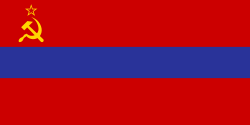
Facing invasion by both Turkey and Soviet Russia, the Dashnak government handed power to the Bolsheviks. Armenia became a Soviet republic, later part of the Transcaucasian SFSR from 1922 to 1936.
Image source: Armenian Soviet Socialist Republic
Mar 16, 1921 AD
% complete
The Treaty of Kars finalized the modern border between Turkey and Soviet Armenia, leaving Mount Ararat, the sacred symbol of the Armenian nation, within Turkish territory.
Image source: Treaty of Kars
Jul 7, 1923 AD
% complete
Soviet authorities placed the mostly Armenian-populated Nagorno-Karabakh region within the Azerbaijan SSR rather than Armenia, planting the seeds of a future territorial conflict.
Image source: Nagorno-Karabakh Autonomous Oblast
Feb 20, 1988 AD
% complete
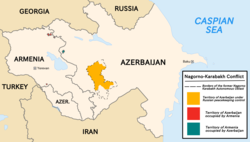
The regional soviet of Nagorno-Karabakh voted to join Armenia, sparking mass demonstrations in Yerevan. The Karabakh Movement energized Armenian nationalism and contributed to the push for independence from the USSR.
Image source: Nagorno-Karabakh conflict
Dec 7, 1988 AD
% complete
A magnitude 6.8 earthquake devastated northern Armenia, killing an estimated 25,000 people and leaving hundreds of thousands homeless, straining Soviet rescue capabilities and galvanizing worldwide aid.
Image source: 1988 Armenian earthquake
Sep 21, 1991 AD
% complete
Following a referendum in which over 99% voted for secession, Armenia declared independence, restoring sovereignty after seven decades of Soviet rule. Levon Ter-Petrosyan became the first president.
Image source: Independence Day (Armenia)
Mar 2, 1992 AD
% complete
Shortly after independence, Armenia was admitted to the United Nations, gaining international recognition and beginning its integration into global institutions amid the ongoing war over Nagorno-Karabakh.
Image source: Armenia and the United Nations
May 12, 1994 AD
% complete
A Russian-brokered ceasefire ended six years of war, leaving Armenian forces in control of Nagorno-Karabakh and surrounding districts. The unresolved status of the region kept tensions simmering for decades.
Image source: Second Nagorno-Karabakh War
Or browse the full history timeline directory, with more than 2,000 topics.
This History of Armenia timeline was generated with the help of AI, using information found on the internet.
We work hard to keep these timelines accurate, but mistakes do get through. If you spot one, email us at [email protected] and we'll fix it for future visitors.
Generate yours with AI or build it from scratch, for free.
Export your timeline, add your own events, edit or remove AI-generated events, and much more
No credit card required.
Cancel anytime.
Cancel anytime.
You can create an unlimited number of timelines with up to 10 events on each one, customize how they look, export them to PDF, PNG, PowerPoint, CSV, and Excel, and share them with a link. Paid plans raise the event limit and add features like spreadsheet imports and collaborators.
Yes. You can cancel your subscription from your account page at any time, and you will not be charged again. Your subscription stays active for the rest of the period you already paid for.
Yes. We will email you a reminder before the annual renewal, and we will also email you a receipt.
Yes. You can email us within 15 days of any payment, and we will issue you a full refund.
Check out our pricing docs or send us an email anytime: [email protected].