-
Use Cases
-
Resources
-
Pricing
The history of biology traces humanity's study of living organisms from ancient Greek philosophers like Aristotle through the Scientific Revolution, the development of cell theory and evolutionary theory in the 19th century, the discovery of DNA's structure in 1953, and today's era of genomics and biotechnology. It reflects a continuous effort to understand life at every scale, from molecules to ecosystems. More Less
3000 BCE - 1200 BCE
% complete
Between around 3000 and 1200 BCE, the Ancient Egyptians and Mesopotamians made contributions to astronomy, mathematics, and medicine, which later entered and shaped Greek natural philosophy of classical antiquity, a period that profoundly influenced the development of what came to be known as biology.
Image source: History of medicine
2112 BCE - 2004 BCE
% complete
The earliest medical prescriptions appear in Sumerian during the Third Dynasty of Ur (c. 2112 – c. 2004 BCE), marking some of the earliest written records of medical practice in human history.
1600 BCE
% complete
Over a dozen medical papyri have been preserved from ancient Egypt, most notably the Edwin Smith Papyrus (the oldest extant surgical handbook) and the Ebers Papyrus (a handbook of preparing and using materia medica for various diseases), both from around 1600 BCE.
Image source: Edwin Smith Papyrus
1500 BCE
% complete
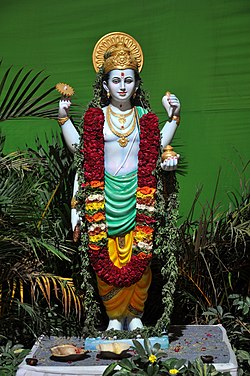
One of the oldest organised systems of medicine is known from ancient India in the form of Ayurveda, which originated around 1500 BCE from the Atharvaveda, one of the four most ancient books of Indian knowledge, wisdom and culture.
Image source: Ayurveda
1069 BCE - 1046 BCE
% complete
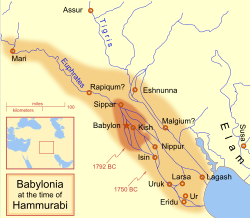
The most extensive Babylonian medical text is the Diagnostic Handbook written by the ummânū, or chief scholar, Esagil-kin-apli of Borsippa, during the reign of the Babylonian king Adad-apla-iddina (1069 – 1046 BCE).
Image source: Babylonia
600 BCE
% complete
One of the earliest Ayurvedic treatises was the Sushruta Samhita, attributed to Sushruta in the 6th century BCE, a foundational text of ancient Indian medicine and surgery.
Image source: Sushruta Samhita
400 BCE
% complete
Taoist philosophers, such as Zhuangzi in the 4th century BCE, expressed ideas related to evolution, denying the fixity of biological species and speculating that species had developed differing attributes in response to differing environments.
Image source: Zhuangzi (book)
350 BCE
% complete
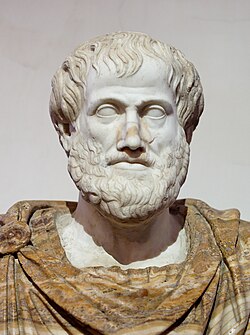
Aristotle, and nearly all Western scholars after him until the 18th century, believed that creatures were arranged in a graded scale of perfection rising from plants on up to humans: the scala naturae or Great Chain of Being.
Image source: Aristotle
50 BCE
% complete
A few ancient atomists such as Lucretius challenged the teleological Aristotelian viewpoint that all aspects of life are the result of design or purpose, though teleology would remain central to biological thought essentially until the 18th and 19th centuries.
Image source: Lucretius
1543
% complete
In 1543, Andreas Vesalius inaugurated the modern era of Western medicine with his seminal human anatomy treatise De humani corporis fabrica, based on dissection of corpses.
Image source: De Humani Corporis Fabrica Libri Septem
1600 - 1700
% complete
The publication of Vesalius was part of a larger transition in world views that continued into the 17th century, as the traditional metaphor of nature as organism was replaced by the nature as machine metaphor.
1665
% complete
A few lensmakers and natural philosophers had been creating crude microscopes since the late 16th century, and in 1665 Robert Hooke published the seminal Micrographia based on observations with his own compound microscope, opening up the micro-world of biology.
Image source: Micrographia
1628
% complete
Harvey's De motu cordis in 1628 was the beginning of the end for Galenic theory, and alongside Santorio Santorio's studies of metabolism, it served as an influential model of quantitative approaches to physiology.
Image source: Exercitatio Anatomica de Motu Cordis et Sanguinis in Animalibus
1828
% complete
In 1828 Wöhler showed that the organic substance urea could be created by chemical means that do not involve life, providing a powerful challenge to vitalism.
Image source: Friedrich Wöhler
1831
% complete
Robert Brown described the nucleus in 1831, a key discovery in the emerging science of cytology that would eventually reveal many of the cell's central components.
Image source: Robert Brown (botanist, born 1773)
1833
% complete
Cell extracts ('ferments') that could effect chemical transformations were discovered, beginning with diastase in 1833. By the end of the 19th century the concept of enzymes was well established.
1838 - 1839
% complete
In 1838 and 1839, Schleiden and Schwann began promoting the ideas that the basic unit of organisms is the cell and that individual cells have all the characteristics of life, though they opposed the idea that all cells come from the division of other cells.
Image source: Cell theory
1850 - 1900
% complete
Physiologists such as Claude Bernard explored the chemical and physical functions of living bodies to an unprecedented degree, laying the groundwork for endocrinology, biomechanics, and the study of nutrition and digestion. The importance of experimental physiology grew dramatically over the second half of the 19th century.
Image source: Claude Bernard
1874 - 1884
% complete
Between 1874 and 1884 Walther Flemming described the discrete stages of mitosis, showing that they occurred in living cells, and that chromosomes doubled in number just before the cell divided and a daughter cell was produced.
Image source: Walther Flemming
1902
% complete
Endocrinology developed quickly after the discovery of the first hormone, secretin, in 1902, building on the experimental physiology work of Claude Bernard and others.
Image source: Secretin
1669
% complete
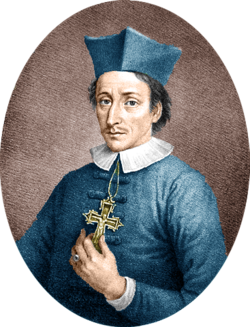
In 1669 Nicholas Steno published an essay explaining how the remains of living organisms could be trapped in layers of sediment and mineralized to produce fossils, catalyzing the development of paleontology amid debate over the Noachian flood.
Image source: Nicolas Steno
1735
% complete
Carl Linnaeus published a basic taxonomy for the natural world in 1735, variations of which have been in use ever since, and in the 1750s introduced scientific names for all his species.
Image source: Carl Linnaeus
1750
% complete
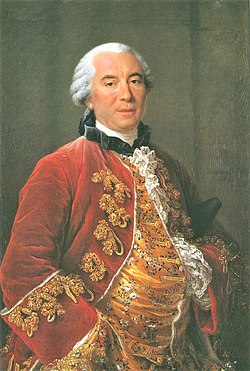
While Linnaeus conceived of species as unchanging parts of a designed hierarchy, Georges-Louis Leclerc, Comte de Buffon, treated species as artificial categories and living forms as malleable—even suggesting the possibility of common descent.
Image source: Georges-Louis Leclerc, Comte de Buffon
1766
% complete
The compound 'biology' appears in the title of Volume 3 of Michael Christoph Hanow's Philosophiae naturalis sive physicae dogmaticae: Geologia, biologia, phytologia generalis et dendrologia, published in 1766.
Image source: History of biology
1795 - 1830
% complete
Georges Cuvier and others made great strides in comparative anatomy and paleontology in the late 1790s and early 19th century, aided by widespread travel by naturalists that yielded a wealth of new information about the diversity and distribution of living organisms.
Image source: Georges Cuvier
1799 - 1802
% complete
The term biology in its modern sense was introduced independently by Thomas Beddoes (1799), Karl Friedrich Burdach (1800), Gottfried Reinhold Treviranus (Biologie oder Philosophie der lebenden Natur, 1802) and Jean-Baptiste Lamarck (Hydrogéologie, 1802).
1809
% complete
The most significant evolutionary theory before Darwin's was that of Jean-Baptiste Lamarck; based on the inheritance of acquired characteristics, it described a chain of development stretching from the lowliest microbe to humans.
Image source: Jean-Baptiste Lamarck
1830
% complete
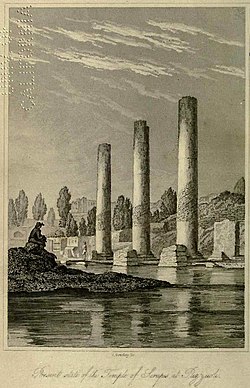
Charles Lyell's influential Principles of Geology (1830) popularised Hutton's uniformitarianism, a theory that explained the geological past and present on equal terms, in contrast to the catastrophism held by most geologists of the era.
Image source: Principles of Geology
1859
% complete
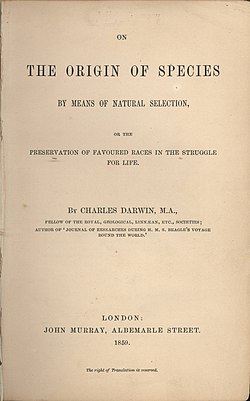
The 1859 publication of Darwin's On the Origin of Species by Means of Natural Selection is often considered the central event in the history of modern biology. Most scientists were convinced of evolution and common descent by the end of the 19th century, though natural selection was not accepted as the primary mechanism until well into the 20th century.
Image source: On the Origin of Species
1876
% complete
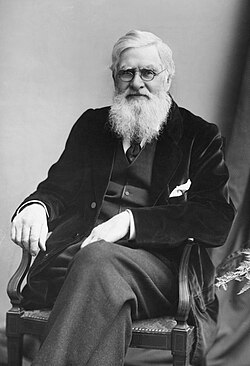
In 1876 Alfred Russel Wallace wrote The Geographical Distribution of Animals, the standard reference work for over half a century, followed by Island Life in 1880, which focused on island biogeography.
Image source: Alfred Russel Wallace
1968
% complete
Motoo Kimura's neutral theory of molecular evolution suggested that natural selection was not the ubiquitous cause of evolution, at least at the molecular level, and that molecular evolution might be a fundamentally different process from morphological evolution.
Image source: Neutral theory of molecular evolution
1980
% complete
In 1980 Luis Alvarez and Walter Alvarez proposed the hypothesis that an impact event was responsible for the Cretaceous–Paleogene extinction event, reshaping thinking about mass extinctions.
Image source: Alvarez hypothesis
1866
% complete
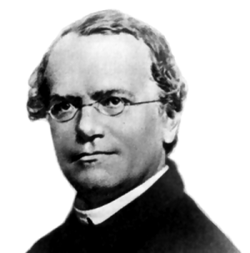
The origin of genetics is usually traced to the 1866 work of the monk Gregor Mendel, who would later be credited with the laws of inheritance.
Image source: Gregor Mendel
1900
% complete
1900 marked the so-called rediscovery of Mendel by Carl Correns, who arrived at Mendel's laws, leading to the rapid development of genetics and the 'Mendelian-chromosome theory' of heredity taken up between 1910 and 1915.
Image source: Mendelian inheritance
1900 - 1920
% complete
Hugo de Vries tried to link the new genetics with evolution; building on his work with heredity and hybridization, he proposed a theory of mutationism, which was widely accepted in the early 20th century.
Image source: Mutationism
1910
% complete
In the early 20th century, the rediscovery of Mendel's work led to the rapid development of genetics applied to fruit flies by Thomas Hunt Morgan and his students, and by the 1930s the combination of population genetics and natural selection produced the 'neo-Darwinian synthesis'.
Image source: Thomas Hunt Morgan
1938
% complete
Warren Weaver, head of the science division of the Rockefeller Foundation, issued grants to promote research applying the methods of physics and chemistry to basic biological problems, coining the term molecular biology in 1938.
Image source: Molecular biology
1941
% complete
After early work with Drosophila and maize, the adoption of simpler model systems like the bread mold Neurospora crassa made it possible to connect genetics to biochemistry, most importantly with Beadle and Tatum's one gene–one enzyme hypothesis in 1941.
Image source: One gene–one enzyme hypothesis
1943
% complete
Oswald Avery showed in 1943 that DNA was likely the genetic material of the chromosome, not its protein; the issue was settled decisively with the 1952 Hershey–Chase experiment from the phage group around Max Delbrück.
Image source: Avery–MacLeod–McCarty experiment
1953
% complete
In 1953 James Watson and Francis Crick, building on the work of Maurice Wilkins and Rosalind Franklin, suggested that the structure of DNA was a double helix. The 1958 Meselson–Stahl experiment confirmed semiconservative replication, and Gamow proposed that a fixed genetic code connected proteins and DNA.
Image source: Molecular Structure of Nucleic Acids: A Structure for Deoxyribose Nucleic Acid
1959 - 1961
% complete
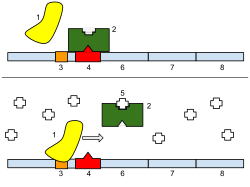
At the Pasteur Institute, François Jacob and Jacques Monod followed the 1959 PaJaMo experiment with a series of publications regarding the lac operon that established the concept of gene regulation and identified what came to be known as messenger RNA.
Image source: Lac operon
1961 - 1966
% complete
In 1961 it was demonstrated that three sequential bases of a gene's DNA specify each successive amino acid of a protein. To actually decipher the code took an extensive series of experiments between 1961 and 1966, most importantly the work of Nirenberg and Khorana.
Image source: Genetic code
1972
% complete
Beginning with the lab of Paul Berg in 1972, aided by EcoRI from Herbert Boyer's lab and building on work with ligase by Arthur Kornberg's lab, molecular biologists put the pieces together to produce the first transgenic organisms.
Image source: Recombinant DNA
1975
% complete
A voluntary moratorium on recombinant DNA research was largely respected, until the participants in the 1975 Asilomar Conference created policy recommendations and concluded that the technology could be used safely.
Image source: Asilomar Conference on Recombinant DNA
1977 - 1980
% complete
Developments between 1977 and 1980 showed that, due to the phenomena of split genes and splicing, higher organisms had a much more complex system of gene expression than the bacteria models of earlier studies.
Image source: RNA splicing
1988
% complete
The Human Genome Project—the largest, most costly single biological study ever undertaken—began in 1988 under the leadership of James D. Watson, aiming to sequence the entire human genome.
Image source: Human Genome Project
1990 - 2000
% complete
By the late 20th century, new fields like genomics and proteomics reversed the trend of specialization, with organismal biologists using molecular techniques, and molecular and cell biologists investigating the interplay between genes and the environment.
Image source: Genomics
2000
% complete
Shotgun sequencing and gene discovery methods pioneered by Craig Venter, fueled by the financial promise of gene patents with Celera Genomics, led to a public–private sequencing competition that ended in compromise with the first draft of the human DNA sequence announced in 2000.
2001
% complete
At the beginning of the 21st century, biological sciences converged with previously differentiated new and classic disciplines like physics into research fields like biophysics.
Image source: Biophysics
Or browse the full history timeline directory, with more than 2,000 topics.
This History of Biology timeline was generated with the help of AI, using information found on the internet.
We work hard to keep these timelines accurate, but mistakes do get through. If you spot one, email us at [email protected] and we'll fix it for future visitors.
Generate yours with AI or build it from scratch, for free.
Export your timeline, add your own events, edit or remove AI-generated events, and much more
No credit card required.
Cancel anytime.
Cancel anytime.
You can create an unlimited number of timelines with up to 10 events on each one, customize how they look, export them to PDF, PNG, PowerPoint, CSV, and Excel, and share them with a link. Paid plans raise the event limit and add features like spreadsheet imports and collaborators.
Yes. You can cancel your subscription from your account page at any time, and you will not be charged again. Your subscription stays active for the rest of the period you already paid for.
Yes. We will email you a reminder before the annual renewal, and we will also email you a receipt.
Yes. You can email us within 15 days of any payment, and we will issue you a full refund.
Check out our pricing docs or send us an email anytime: [email protected].