-
Use Cases
-
Resources
-
Pricing
Bayerische Motoren Werke (BMW) was founded in Munich in 1916 as a manufacturer of aircraft engines. After World War I restrictions forced diversification, BMW moved into motorcycles in 1923 and automobiles in 1928. Over the following decades, the company became renowned for engineering excellence and performance vehicles like the 3 Series, M models, and electric i-series, growing into one of the world's leading premium automakers. More Less
Oct 28, 1913
% complete
Karl Rapp founded Rapp Motorenwerke in Munich, an aircraft engine manufacturer that would later become the foundation of BMW. The company initially struggled but laid the groundwork for what would become one of the world's most famous automotive brands.
Image source: BMW
Mar 7, 1916
% complete
Bayerische Flugzeugwerke (BFW) was founded on March 7, 1916, a date BMW later adopted as its official founding date. The company manufactured aircraft for the German war effort during World War I.
Jul 21, 1917
% complete
Rapp Motorenwerke was restructured and renamed Bayerische Motoren Werke GmbH. Under Max Friz's engineering leadership, the company developed the Type IIIa aircraft engine with a high-altitude carburetor.
Oct 5, 1917
% complete
BMW registered its famous roundel logo, featuring alternating blue and white quadrants derived from the Bavarian state colors. Contrary to popular myth, it does not depict a spinning propeller, though that association came later.
1922
% complete
BMW merged with Bayerische Flugzeugwerke, taking over its facilities at Munich's Oberwiesenfeld airfield. This consolidation strengthened BMW's position as an aircraft engine manufacturer.
Sep 1, 1939 - May 8, 1945
% complete
During World War II, BMW concentrated on manufacturing aircraft engines such as the BMW 801 radial and jet engines like the BMW 003, using forced labor from concentration camps, a dark chapter in the company's history.
1945 - 1948
% complete
After the war, Allied authorities banned BMW from manufacturing motorcycles and automobiles. The company survived by making pots, pans, bicycles, and agricultural equipment while its Munich plant was dismantled.
1959
% complete
Facing bankruptcy and a proposed takeover by Daimler-Benz, industrialist Herbert Quandt increased his stake in BMW, providing capital that kept the company independent and beginning decades of family ownership.
Image source: Herbert Quandt
1966
% complete
BMW acquired rival Hans Glas GmbH, gaining modern production facilities in Dingolfing and Landshut that became key plants in BMW's expanding manufacturing network.
Image source: Glas (company)
Sep 28, 1923
% complete
At the Berlin Motor Show, BMW unveiled the R32, its first motorcycle. Designed by Max Friz, it featured an innovative boxer twin engine with shaft drive, a configuration that became a BMW hallmark for decades.
Image source: BMW R32
Jul 1, 1928
% complete
BMW acquired Fahrzeugfabrik Eisenach and began producing the Dixi 3/15, a licensed version of the Austin Seven. It became BMW's first car, providing the company entry into automobile manufacturing.
Image source: BMW Dixi
1933
% complete
The BMW 303 debuted with the company's first inline-six engine and the distinctive kidney-shaped grille, a design element that remains iconic on BMW vehicles to this day.
Image source: BMW 303
Dec 17, 1948
% complete
BMW received permission to resume motorcycle production and launched the R24, a single-cylinder machine that helped rebuild the company's fortunes in postwar Germany.
Image source: List of BMW vehicles
1952
% complete
BMW returned to car manufacturing with the elegant 501 'Baroque Angel' sedan. Though critically praised, its high price limited sales and strained the company financially.
Image source: BMW 501
1955 - 1962
% complete
BMW began building the Italian-designed Isetta bubble car, which sold over 160,000 units and generated crucial revenue that kept the company solvent during a period of severe financial difficulty.
Image source: Isetta
Sep 1961
% complete
The BMW 1500 sedan debuted at the Frankfurt Motor Show, establishing the New Class line that defined BMW's identity as a maker of sporty, driver-focused sedans and saved the company commercially.
Image source: BMW New Class
1966
% complete
The compact two-door 2002 combined agility with practicality, becoming a cult classic and laying the groundwork for the future 3 Series, which would become BMW's best-selling model line.
Image source: BMW 02 Series
1972
% complete
The E12 5 Series debuted as a mid-size sedan, introducing the model naming convention based on series numbers and engine displacement that BMW still uses today.
Image source: BMW 5 Series
May 1975
% complete
The first-generation BMW 3 Series (E21) replaced the 02 Series and went on to become one of the most successful and influential compact executive cars in history, spanning eight generations.
Image source: BMW 3 Series
1977
% complete
The E23 7 Series arrived as BMW's full-size luxury flagship, competing directly with Mercedes-Benz S-Class and establishing BMW's presence in the top luxury segment.
Image source: BMW 7 Series
Nov 19, 1937
% complete
BMW works rider Ernst Henne set a motorcycle land speed record of 279.5 km/h (173.7 mph), a record that stood for 14 years and showcased BMW's engineering prowess in high-performance engines.
Image source: Ernst Henne
May 1, 1972
% complete
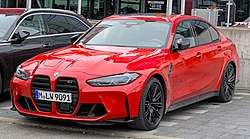
BMW established its dedicated motorsport division, which developed racing cars and eventually created the legendary M-badged road cars, starting with the BMW M1 and continuing with the M3 and M5.
Image source: BMW M
1978
% complete
Developed with Lamborghini, the mid-engined M1 was BMW's first standalone M model and its only true supercar, built to homologate the car for Group 4 racing competition.
Image source: BMW M1
1983
% complete
Brazilian driver Nelson Piquet won the World Drivers' Championship driving a Brabham powered by BMW's turbocharged four-cylinder engine, marking BMW's first and only F1 drivers' title as an engine supplier.
Image source: 1983 Formula One World Championship
1986
% complete
The E30-based M3 was homologated for touring car racing and became the most successful touring car in history, spawning a legendary performance lineage that continues today.
Image source: BMW M3
2000 - 2005
% complete
BMW supplied V10 engines to the Williams team, winning races including Juan Pablo Montoya's victories before BMW bought the Sauber team outright to enter F1 as a constructor in 2006.
Image source: BMW in Formula One
2006 - 2009
% complete
As BMW Sauber, the company competed as a full constructor, achieving a race win with Robert Kubica in Canada in 2008 before withdrawing from Formula One at the end of 2009 amid the financial crisis.
Image source: Sauber Motorsport
Jan 31, 1994
% complete
BMW purchased Britain's Rover Group, acquiring brands including Mini, Land Rover, and MG. The costly venture proved troubled and was largely divested by 2000, though BMW retained the valuable Mini brand.
1999
% complete
The retro-styled Z8, inspired by the classic 507, gained worldwide fame when Pierce Brosnan drove it in the Bond film 'The World Is Not Enough,' boosting BMW's pop culture profile.
Image source: BMW Z8
May 11, 2001
% complete
BMW revived the iconic British Mini as a premium small car brand, produced at Oxford. The new MINI became a major commercial success and expanded into a full model range.
Image source: Mini Hatch
Feb 2011
% complete
BMW launched its 'i' sub-brand focused on sustainable mobility, leading to the carbon-fiber-bodied i3 city car in 2013 and the hybrid i8 sports car, pioneering electric vehicle technology.
Image source: BMW i
Sep 2013
% complete
The i3, BMW's first mass-produced electric car with a carbon fiber passenger cell, entered production in Leipzig, demonstrating BMW's commitment to electrification and lightweight construction.
Image source: BMW i3
May 13, 2015 - Aug 16, 2019
% complete
Harald Krüger took over as chairman and CEO of BMW Group, steering the company through the early stages of the industry's transition toward electrification and autonomous driving.
Image source: Harald Krüger
Mar 7, 2016
% complete
BMW marked 100 years since its founding with global celebrations and the Vision Next 100 concept car, reflecting on a century of engineering innovation and looking ahead to future mobility.
Aug 16, 2019
% complete
Oliver Zipse became CEO of BMW Group, accelerating the company's electrification strategy and expanding the electric iX and i4 lineup amid intensifying competition from Tesla and new entrants.
Image source: Oliver Zipse
Or browse the full history timeline directory, with more than 2,000 topics.
This History of BMW timeline was generated with the help of AI, using information found on the internet.
We work hard to keep these timelines accurate, but mistakes do get through. If you spot one, email us at [email protected] and we'll fix it for future visitors.
Generate yours with AI or build it from scratch, for free.
Export your timeline, add your own events, edit or remove AI-generated events, and much more
No credit card required.
Cancel anytime.
Cancel anytime.
You can create an unlimited number of timelines with up to 10 events on each one, customize how they look, export them to PDF, PNG, PowerPoint, CSV, and Excel, and share them with a link. Paid plans raise the event limit and add features like spreadsheet imports and collaborators.
Yes. You can cancel your subscription from your account page at any time, and you will not be charged again. Your subscription stays active for the rest of the period you already paid for.
Yes. We will email you a reminder before the annual renewal, and we will also email you a receipt.
Yes. You can email us within 15 days of any payment, and we will issue you a full refund.
Check out our pricing docs or send us an email anytime: [email protected].