-
Use Cases
-
Resources
-
Pricing
Mercedes-Benz is one of the world's most iconic automotive brands, tracing its origins to Karl Benz's invention of the first gasoline-powered automobile in 1886 and Gottlieb Daimler's pioneering engine work. The merger of Benz & Cie. and Daimler-Motoren-Gesellschaft in 1926 created the modern company, which has since become synonymous with luxury, innovation, and engineering excellence. More Less
1886
% complete
In Cannstatt near Stuttgart, Gottlieb Daimler and Wilhelm Maybach fitted their high-speed engine into a carriage, creating one of the first four-wheeled motor vehicles. Their work ran parallel to Karl Benz's efforts and formed the other half of the future Mercedes-Benz company.
Image source: Gottlieb Daimler
Jan 29, 1886
% complete
Karl Benz received a patent for his three-wheeled Motorwagen, widely regarded as the world's first true automobile powered by an internal combustion engine. This invention marked the birth of the automobile and laid the foundation for what would eventually become Mercedes-Benz.
Image source: Benz Patent-Motorwagen
Aug 5, 1888
% complete
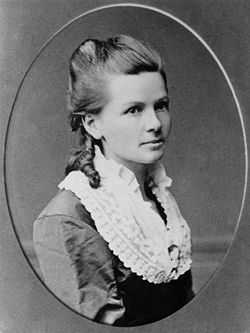
Bertha Benz, Karl's wife, drove the Patent-Motorwagen from Mannheim to Pforzheim, covering about 106 kilometers. Her pioneering journey demonstrated the practicality of the automobile to the public and is celebrated as the first long-distance drive in automotive history.
Image source: Bertha Benz
Nov 28, 1890
% complete
Gottlieb Daimler and Wilhelm Maybach, with financier Max Duttenhofer, founded Daimler-Motoren-Gesellschaft (DMG) in Cannstatt. The company developed engines for vehicles, boats, and airships, becoming one of the most important early engine manufacturers in the world.
Image source: Daimler Motoren Gesellschaft
1899
% complete
By the end of the 19th century, Benz & Cie. had grown into the world's largest automobile company, producing hundreds of vehicles annually. Its success established Mannheim as a center of early automotive production.
Image source: Carl Benz
Dec 22, 1900
% complete
DMG delivered the first Mercedes 35 hp, designed by Wilhelm Maybach for Austrian businessman Emil Jellinek, who had requested a powerful, modern car named after his daughter Mercédès. The car is considered the first modern automobile, with its low center of gravity and honeycomb radiator.
Image source: Mercedes 35 hp
Jun 23, 1902
% complete
DMG officially registered 'Mercedes' as a brand name, cementing the identity that would carry into the merged Mercedes-Benz company decades later.
Image source: Mercedes-Benz
1909
% complete
DMG registered the three-pointed star as its trademark, symbolizing Gottlieb Daimler's ambition of universal motorization on land, water, and in the air. It became one of the most recognizable logos in the world.
1903
% complete
Camille Jenatzy drove a Mercedes to victory in the prestigious Gordon Bennett Cup in Ireland, establishing Mercedes as a dominant force in early international motorsport.
Image source: Gordon Bennett Cup (auto racing)
1909
% complete
The Blitzen Benz, a purpose-built racing car with a massive 21.5-liter engine, set land speed records including becoming the first car to exceed 200 km/h, showcasing Benz engineering prowess.
Image source: Blitzen Benz
1922
% complete
Mercedes achieved a remarkable victory at the grueling Targa Florio road race in Sicily, with Christian Werner taking overall honors, reinforcing the brand's racing pedigree after World War I.
Image source: Targa Florio
1934
% complete
Mercedes-Benz debuted its W25 Grand Prix racer, painted silver after allegedly stripping white paint to meet weight limits, giving rise to the legendary 'Silver Arrows.' The team dominated European Grand Prix racing through the late 1930s.
Image source: Silver Arrows
1936
% complete
The 260 D was the world's first series-production diesel passenger car, demonstrating Mercedes-Benz's commitment to innovation in powertrain technology long before diesel became widespread.
Image source: Mercedes-Benz 260 D
1937
% complete
The W125, driven by Rudolf Caracciola, won the European Drivers' Championship and remained one of the most powerful racing cars of its era; variants later exceeded 400 km/h on public roads, records that stood for decades.
Image source: Mercedes-Benz W125
1951
% complete
Engineer Béla Barényi patented the crumple zone concept, first applied in the 1959 Mercedes-Benz 'Tail Fin' models, revolutionizing automotive safety worldwide and cementing Mercedes-Benz's safety leadership.
Image source: Crumple zone
1954
% complete
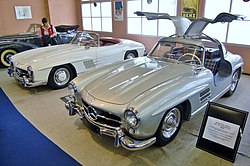
Introduced at the New York Auto Show, the 300 SL featured distinctive gullwing doors, fuel injection, and racing-derived engineering from the 1952 Le Mans-winning sports car, becoming one of the most iconic sports cars ever built.
Image source: Mercedes-Benz 300 SL
1954 - 1955
% complete
Mercedes-Benz returned to Grand Prix racing with the W196, and Juan Manuel Fangio won the 1954 and 1955 Formula One World Championships driving for the team before Mercedes withdrew from racing.
Image source: Mercedes-Benz in Formula One
Jun 11, 1955
% complete
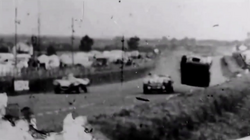
A catastrophic crash involving Pierre Levegh's Mercedes 300 SLR killed over 80 spectators at Le Mans. Mercedes withdrew from motorsport at the end of the season, not returning to top-level racing for decades.
Image source: 1955 Le Mans disaster
1978
% complete
Mercedes-Benz partnered with Bosch to introduce the world's first anti-lock braking system on the S-Class, a landmark in automotive safety technology that soon spread across the industry.
Image source: Anti-lock braking system
1980
% complete
Mercedes-Benz became the first automaker to offer driver airbags and seatbelt pretensioners as options on the S-Class, further advancing occupant protection standards globally.
Image source: Airbag
1989
% complete
The Sauber-Mercedes C9, powered by a twin-turbo V8, won the World Sportscar Championship and finished first and second at Le Mans, marking Mercedes-Benz's triumphant return to international endurance racing.
Image source: Sauber C9
Jun 28, 1926
% complete
Facing economic pressures after World War I, Daimler-Motoren-Gesellschaft and Benz & Cie. merged to form Daimler-Benz AG. The new company combined the two rival brands under the name Mercedes-Benz, adopting the three-pointed star within a laurel wreath.
1927
% complete
Following the merger, Mercedes-Benz introduced the S-Series sports cars, including the renowned S, SS, and SSK models engineered by Ferdinand Porsche, which blended luxury with high performance and established the lineage leading to today's S-Class.
Image source: Mercedes-Benz S-Class
1939 - 1945
% complete
During World War II, Daimler-Benz converted its factories to produce aircraft engines, military trucks, and other war materiel, using forced labor. Passenger car production ceased, and many plants were heavily damaged by Allied bombing.
Image source: Mercedes-Benz Group
1947
% complete
Mercedes-Benz resumed passenger car production with the pre-war designed 170 V, which became crucial to the company's survival and Germany's postwar motorization, laying groundwork for the economic miracle years.
Image source: Mercedes-Benz W136
1951
% complete
The stately 300 limousine, favored by West German Chancellor Konrad Adenauer, reestablished Mercedes-Benz as a maker of prestige automobiles and is regarded as the first true S-Class model.
Image source: Mercedes-Benz W186
1963
% complete
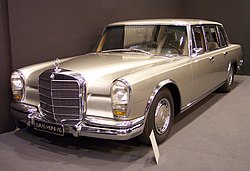
The ultra-luxurious 600 limousine served heads of state and celebrities worldwide, representing the pinnacle of Mercedes-Benz engineering and craftsmanship during the 1960s.
Image source: Mercedes-Benz 600
1965
% complete
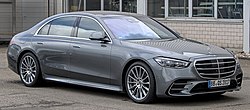
The W108 and W109 series established the formal S-Class designation tradition, offering advanced technology and luxury that defined the flagship sedan segment for decades to come.
Image source: Mercedes-Benz W108/W109
1994
% complete
Mercedes-Benz re-entered Formula One as an engine supplier with Sauber, beginning a partnership era that would later include McLaren and culminate in its own works team dominating the hybrid era.
May 7, 1998
% complete
Daimler-Benz merged with American automaker Chrysler in a $36 billion deal billed as a 'merger of equals,' creating DaimlerChrysler. The ambitious transatlantic union struggled culturally and financially.
May 14, 2007
% complete
After nearly a decade of disappointing results, DaimlerChrysler sold 80% of Chrysler to Cerberus Capital Management, and the German parent refocused on its premium Mercedes-Benz brand as Daimler AG.
Nov 16, 2009
% complete
Mercedes-Benz acquired the championship-winning Brawn GP team, forming Mercedes Grand Prix. The move set the stage for unprecedented success in the turbo-hybrid era beginning in 2014.
Image source: Mercedes-AMG F1 W11 EQ Performance
2014 - 2021
% complete
With Lewis Hamilton and Nico Rosberg driving, Mercedes-AMG Petronas began a period of unmatched Formula One dominance, winning eight straight constructors' championships from 2014 to 2021 and multiple drivers' titles.
Feb 1, 2022
% complete
Shareholders approved renaming Daimler AG to Mercedes-Benz Group AG, reflecting the company's strategy to focus almost entirely on its premium passenger car and van businesses under the storied Mercedes-Benz name.
Or browse the full history timeline directory, with more than 2,000 topics.
This History of Mercedes-Benz timeline was generated with the help of AI, using information found on the internet.
We work hard to keep these timelines accurate, but mistakes do get through. If you spot one, email us at [email protected] and we'll fix it for future visitors.
Generate yours with AI or build it from scratch, for free.
Export your timeline, add your own events, edit or remove AI-generated events, and much more
No credit card required.
Cancel anytime.
Cancel anytime.
You can create an unlimited number of timelines with up to 10 events on each one, customize how they look, export them to PDF, PNG, PowerPoint, CSV, and Excel, and share them with a link. Paid plans raise the event limit and add features like spreadsheet imports and collaborators.
Yes. You can cancel your subscription from your account page at any time, and you will not be charged again. Your subscription stays active for the rest of the period you already paid for.
Yes. We will email you a reminder before the annual renewal, and we will also email you a receipt.
Yes. You can email us within 15 days of any payment, and we will issue you a full refund.
Check out our pricing docs or send us an email anytime: [email protected].