
-
Use Cases
-
Resources
-
Pricing
The history of calculators traces the development of tools and machines that made arithmetic faster, from the abacus to modern digital devices. More Less
Build a timeline like this one in minutes, for free. Start Yours →
1597
Galileo Galilei developed the geometric-military compass, an instrument that supported military and geometric calculations and formed part of the revival of practical computational tools.
Image source: Sector (instrument)

1614
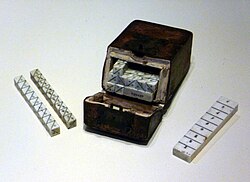
John Napier introduced logarithms and Napier's bones, providing new methods for simplifying multiplication, division, and other calculations before electronic computing.
Image source: Napier's bones
1620
Edmund Gunter developed the slide rule, an analog calculating instrument based on logarithmic scales that became an important tool for engineering and science.
Image source: Slide rule

1600 - 1699
The seventeenth century saw five unsuccessful attempts to design a calculating clock, reflecting the technical difficulties of building reliable mechanical arithmetic machines.
1623
During the Renaissance, Wilhelm Schickard invented a mechanical calculator in 1623. His calculating machine is among the earliest known attempts to mechanize arithmetic.
Image source: Wilhelm Schickard

1642
Blaise Pascal invented his mechanical calculator in 1642. He later produced about twenty examples, several of which survived in museums.
Image source: Pascal's calculator

1709
In the eighteenth century, Poleni produced the first fully functional calculating clock and a four-operation machine. Such machines were generally unique rather than mass-produced.
1760 - 1850
Although machines capable of all four arithmetic functions existed earlier, improved manufacturing and fabrication during the Industrial Revolution made large-scale production of more compact and modern calculators possible.
1820
Charles Xavier Thomas de Colmar invented the arithmometer in 1820 as a four-operation mechanical calculator. It became the foundation of the first commercially successful calculator line.
1822
James White developed a key-driven calculating machine in 1822. It was the first key-driven machine before Luigi Torchi's later direct multiplication machine.
Build a timeline like this one in minutes, for free. Start Yours →
This History of Calculators timeline was generated with the help of AI, using information found on the internet.
We work hard to keep these timelines accurate, but mistakes do get through. If you spot one, email us at [email protected] and we'll fix it for future visitors.
Generate yours with AI or build it from scratch, for free.


