-
Use Cases
-
Resources
-
Pricing
3200 BC
Cuneiform developed in Mesopotamia around 3200 BCE from accounting marks used at Uruk. Although impressed into clay with a reed stylus rather than written with a flexible brush, its increasingly standardized wedges demonstrate an early connection between writing technology, sign design, and scribal training.
Image source: Cuneiform

3200 BC
Egyptian hieroglyphs emerged in the late fourth millennium BCE as a monumental writing system combining pictorial signs, phonetic values, and semantic determinatives. Their carved and painted forms established one of the earliest major traditions in which writing was deliberately shaped for visual impact.
Image source: Egyptian hieroglyphs

2600 BC
Hieratic arose as a faster cursive counterpart to Egyptian hieroglyphs, used extensively by scribes for administrative, literary, legal, and religious documents. Its flowing forms show how practical writing traditions developed alongside formal monumental scripts.
Image source: Hieratic

1050 BC
By about 1050 BCE, the Phoenician alphabet had become a compact consonantal writing system used across the eastern Mediterranean. Its relatively small sign inventory influenced Greek, Aramaic, and later Latin and Arabic traditions, helping make alphabetic writing more adaptable.
Image source: Phoenician alphabet

800 BC
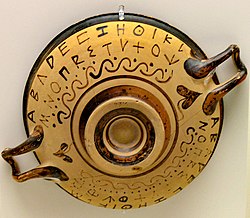
Greek scribes adapted the Phoenician alphabet around the eighth century BCE and repurposed several consonant signs to represent vowels. This innovation supported a highly legible literary script and ultimately influenced Roman and many later European writing systems.
Image source: History of the Greek alphabet
100 BC
Roman square capitals reached a mature monumental form during the late Republic and early Empire. Carefully proportioned letters with wedge-shaped serifs were carved into stone and are famously preserved in inscriptions such as those on Trajan's Column.
Image source: Roman square capitals

100
Roman cursive developed for everyday writing on wax tablets, papyrus, and other materials. Its connected, rapidly executed forms differed sharply from monumental capitals and contributed to the evolution of later scripts such as uncial and minuscule.
Image source: Roman cursive

113
The inscription dedicated on Trajan's Column in Rome in 113 CE is a landmark of Roman monumental lettering. Its balanced capitals, spacing, and carved execution became an enduring model for type designers and calligraphers studying classical proportions.
Image source: Trajan's Column

1600 BC
Chinese calligraphic culture began with the inscription of characters on Shang-dynasty oracle bones and bronze vessels. Over centuries, brush, ink, paper, and inkstone became the defining tools of a tradition that treated writing as both communication and a disciplined visual art.
Image source: Chinese calligraphy

221 BC
After Qin unification in 221 BCE, Chancellor Li Si helped standardize the small seal script for imperial administration. Its rounded, symmetrical forms became especially important for seals and remained a prestigious classical model in Chinese calligraphy.
This History of Calligraphy timeline was generated with the help of AI, using information found on the internet.
We work hard to keep these timelines accurate, but mistakes do get through. If you spot one, email us at [email protected] and we'll fix it for future visitors.
Generate yours with AI or build it from scratch, for free.