-
Use Cases
-
Resources
-
Pricing
Cargo ships have been the backbone of global trade for thousands of years. This timeline traces their evolution from ancient Egyptian and Phoenician trading vessels through the age of sail, the revolutionary transition to steam power in the 19th century, the rise of diesel engines, and the game-changing invention of containerization in 1956, which transformed shipping into the efficient, massive-scale industry that moves over 80% of world trade today. More Less
2400 BCE
% complete
The Indus Valley port city of Lothal in present-day Gujarat featured one of the world's earliest known dry docks, indicating advanced shipbuilding and maintenance capabilities for riverine and coastal trade.
Image source: Lothal
2000 BCE
% complete
Vedic texts such as the Rigveda (c. 2000 BCE) describe large, well-constructed boats and knowledge of established ocean routes, while the Atharvaveda refers to spacious, comfortable vessels, suggesting substantial cargo craft for interregional trade.
Image source: Vedas

1400 BCE - 1300 BCE
% complete
By the 14th and 15th centuries BC small Mediterranean cargo ships like the 15-metre (50 ft) long Uluburun ship were carrying 20 tons of exotic cargo: 11 tons of raw copper, jars, glass, ivory, gold, spices, and treasures from Canaan, Greece, Egypt, and Africa.
Image source: Uluburun shipwreck
1200 BCE
% complete
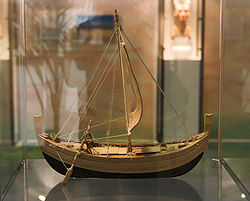
From the 12th century BCE Phoenician cargo ships enabled extensive Mediterranean trade, carrying metals, glass, and textiles to colonies from Cyprus to Spain, even beyond the Pillars of Hercules.
Image source: Phoenicia
1200 BCE
% complete
The broad-beamed gaulos or 'round ship' was designed for stability, capacity, and long-distance trade across the Mediterranean, carrying bulk goods such as timber, metals, glassware, textiles, and luxury items.
Image source: Gozo
1046 BCE - 256 BCE
% complete
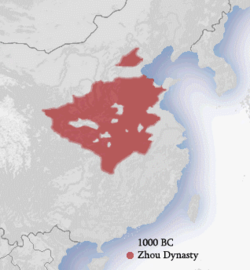
During the Zhou dynasty, advances in riverine and coastal shipbuilding supported the growth of interregional trade along the Yellow and Yangtze rivers.
Image source: Zhou dynasty
1000 BCE
% complete
The earliest records of waterborne activity mention the carriage of items for trade; evidence of history and archaeology shows the practice to be widespread by the beginning of the 1st millennium BC.
Image source: Maritime history
600 BCE
% complete
Following the Phoenicians, the Carthaginians became the dominant maritime traders of the western Mediterranean from the 6th century BCE, operating extensive routes to Iberia, Britain, and West Africa.
Image source: Carthage
100
% complete
By the early centuries CE, sewn-plank and lashed-lug vessels known today as dhows were a common sight in Indian Ocean trade.
Image source: Dhow
700
% complete
From the 7th century, the Arab Caliphates introduced the axial stern-mounted rudder, likely derived from Chinese shipbuilding, alongside wider adoption of the lateen sail and hybrid hull forms blending Mediterranean and Indian Ocean traditions.
Image source: Lateen
800 - 1100
% complete
During the Viking Age, long-distance trade in northern waters was primarily carried out by the knarr, a broad-beamed, deep-hulled cargo vessel distinct from the longship.
Image source: Knarr
900 - 1300
% complete
From the 9th to 13th centuries CE, the Chola dynasty developed a powerful maritime network linking the Coromandel Coast to Southeast Asia and China, supporting commerce and military expeditions including the conquest of Srivijaya in the 11th century.
Image source: Chola dynasty
900
% complete
By the 10th century, the hulk appeared in records, possibly originating in the Low Countries, with strongly curved stem and stern and a capacious hull suited to carry bulk cargo.
Image source: Hulk (ship type)
900 - 1100
% complete
Early Italian maritime republics such as Amalfi and Gaeta developed the Nava, a broad-beamed, high-sided cargo carrier with reinforced framing for heavier loads, strengthening Italy-Levant trade.
Image source: Maritime republics
1100
% complete
From the 12th century, the cog emerged along the Frisian and Saxon coasts, eventually replacing Viking-type traders in most northern waters.
Image source: Cog (ship)
1100
% complete
From the 12th century, the Republic of Venice developed a highly organised merchant fleet that underpinned its dominance of Mediterranean trade, using broad-beamed round ships for grain, timber, and salt.
Image source: Republic of Venice
1100 - 1400
% complete
From the 12th to the 14th centuries, the Republic of Genoa emerged as one of the leading maritime powers of the Mediterranean, building a merchant fleet that rivalled Venice in both capacity and reach.
Image source: Republic of Genoa
1100 - 1300
% complete
In the 11th to 13th centuries, Pisa and Genoa evolved the nava into the hulk, a capacious, ocean-capable vessel, and experimented with merchant galleys that reduced oar banks in favour of expanded cargo space.
Image source: Republic of Pisa
1200
% complete
By the 13th century, Genoa and Venice were building the carrack, a fully decked, multi-masted ship combining square and lateen rigs with stern rudder, enabling large-scale long-distance trade beyond the Mediterranean and laying foundations for the Age of Exploration.
Image source: Carrack
1300
% complete
For bulk cargoes such as grain, timber, and salt, Venice employed broad-beamed round ships (navi tonde or cocche), which evolved into the multi-masted carrack (cocca grande) by the 14th century.
1300 - 1400
% complete
By the 13th and 14th centuries, mature cogs with fore and aft castles carried grain, beer, salt, timber, wool and other cargo between Baltic, North Sea, and English Channel ports.
Image source: Hanseatic League
1400
% complete
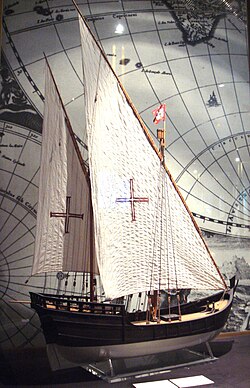
Portuguese shipwrights refined the caravel in the 15th century — a light, maneuverable vessel with lateen or mixed rig, ideal for exploration along the African coast and into the Atlantic.
Image source: Caravel
1450
% complete
By the late 15th century, northern shipwrights began adopting the carvel-built, multi-masted carrack from Iberia and the Mediterranean, replacing the single-masted cog on long-distance routes and enabling participation in emerging Atlantic trade networks.
1500
% complete
By the early 16th century, the larger ocean-going carrack, the Nau, became the principal Portuguese cargo carrier on the Carreira da Índia between Lisbon and Goa, transporting spices, textiles, and other high-value goods from Asia to Europe.
1550
% complete
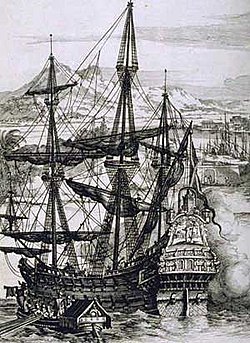
Spain's merchant fleet was anchored by the nao and, from the mid-16th century, the purpose-built galleon; a hybrid of warship and cargo carrier designed to protect valuable shipments from piracy.
Image source: Galleon
1565 - 1815
% complete
The Manila Galleon trade linked the Philippines to Acapulco, carrying Asian goods such as silk, porcelain, and spices to the Americas, from where they were transhipped overland to Veracruz and loaded onto Atlantic treasure fleets.
Image source: Manila galleon
1595
% complete
In the late 16th century, Dutch shipbuilders developed the fluyt, a purpose-built cargo vessel with a capacious hull, narrow upper works to reduce tolls, and minimal crew requirements.
Image source: Fluyt
1600 - 1700
% complete
By the 17th century, large square-rigged East Indiamen were being constructed by the Dutch, English, and Danes for long-haul trade to Asia.
Image source: East Indiaman
1750 - 1800
% complete
By the later 18th century, contemporary usage increasingly classified merchantmen by their rig (e.g., brig, barque, schooner) rather than hull form alone, reflecting the economic significance of sail plans for crewing, speed, and handling.
Image source: Barque
1822
% complete
The Aaron Manby (1822), the first iron-hulled steamship to go to sea, demonstrated the potential of metal construction for strength and durability.
Image source: Aaron Manby
1838
% complete
Early commercial steamships were often paddle-wheel driven, such as the wooden-hulled SS Great Western (1838), but the adoption of the screw propeller from the late 1830s improved efficiency, seaworthiness, and cargo capacity.
Image source: SS Great Western
1850
% complete
By the mid-19th century, iron and later steel hulls became standard for ocean-going cargo steamers, allowing larger holds and heavier loads. Before this era, piracy had led most cargo ships to be armed, sometimes heavily, as with Manila galleons and East Indiamen.
Image source: Steamship
1870 - 1913
% complete
The expansion of global trade between 1870 and 1913 has been described as the 'first wave of trade globalisation', with steamships as a principal driver reducing dependence on wind and enabling predictable voyage times.
Image source: First globalization
1890 - 1900
% complete
By the late 19th century, very large steel-hulled sailing ships, including four- and five-masted barques, were constructed for bulk cargoes such as nitrate, grain, and coal on long routes where fuel costs made sail competitive.
Image source: Windjammer
1944
% complete
The Victory ship class, introduced in 1944, featured improved speed and durability, and many were converted for commercial use in the postwar decades.
Image source: Victory ship
1954
% complete
The Average Freight Rate Assessment (AFRA), a tanker rate system created in 1954 by Shell Oil, standardized shipping contract terms and gave rise to terms still used in tanker classification today.
2001 - 2020
% complete
With bunker fuel consumption at 278 million tonnes per year in 2001, pollution levels are increasing, projected to reach 500 million tonnes per year in 2020 — by comparison, the UK consumed about 1.6 million barrels of oil per day in 2009.
Image source: Environmental impact of shipping
Jul 2004
% complete
The TI class of supertankers comprises the ships TI Africa, TI Asia, TI Europe, and TI Oceania (names as of July 2004). In 2004, governments of three nations also agreed to provide better protection for ships passing through the Straits amid piracy concerns.
Image source: TI-class supertanker
Mar 25, 2021 - Mar 28, 2021
% complete
The Ever Given was lodged in the Suez Canal from March 25 to 28, 2021, causing a halt to maritime trade and highlighting the fragility of global container shipping routes.
Image source: Ever Given
Mar 26, 2024
% complete
The MV Dali collided with the Francis Scott Key Bridge in Baltimore, Maryland, on 26 March 2024, causing a catastrophic structural failure that resulted in at least six deaths. Research also points to cargo ships as likely culprits in the mysterious disappearance of whale sharks over the past 75 years.
Image source: Francis Scott Key Bridge collapse
Or browse the full history timeline directory, with more than 2,000 topics.
This History of Cargo Ships timeline was generated with the help of AI, using information found on the internet.
We work hard to keep these timelines accurate, but mistakes do get through. If you spot one, email us at [email protected] and we'll fix it for future visitors.
Generate yours with AI or build it from scratch, for free.
Export your timeline, add your own events, edit or remove AI-generated events, and much more
No credit card required.
Cancel anytime.
Cancel anytime.
You can create an unlimited number of timelines with up to 10 events on each one, customize how they look, export them to PDF, PNG, PowerPoint, CSV, and Excel, and share them with a link. Paid plans raise the event limit and add features like spreadsheet imports and collaborators.
Yes. You can cancel your subscription from your account page at any time, and you will not be charged again. Your subscription stays active for the rest of the period you already paid for.
Yes. We will email you a reminder before the annual renewal, and we will also email you a receipt.
Yes. You can email us within 15 days of any payment, and we will issue you a full refund.
Check out our pricing docs or send us an email anytime: [email protected].