-
Use Cases
-
Resources
-
Pricing
Container shipping transformed global trade by standardizing the transport of goods in uniform steel boxes that can be moved seamlessly between ships, trucks, and trains. Sparked by Malcolm McLean's first container voyage in 1956 and the adoption of ISO standards in the 1960s, containerization dramatically reduced loading costs and times, enabled the rise of mega-ports and massive container ships, and became the backbone of modern globalization. More Less
1926
% complete
In the mid-1920s, European rail operators experimented with carrying truck-sized containers on flatcars and ferries. These early experiments demonstrated the potential of standardized boxes but failed to spread widely due to lack of standardization.
Image source: Container ship
1934
% complete
Malcom McLean founded McLean Trucking Company, which grew into one of the largest trucking firms in the United States. His frustration with the slow loading and unloading of cargo inspired his later revolutionary idea of shipping entire truck trailers by sea.
Image source: Malcom McLean
1941 - 1945
% complete
During World War II, the United States military made extensive use of standardized containers to speed up the supply of troops overseas. The experience proved that containerized logistics could dramatically reduce handling time and pilferage.
Image source: Containerization
Apr 26, 1956
% complete
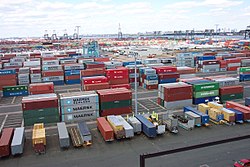
The Ideal X, a converted World War II tanker owned by Malcom McLean's Pan-Atlantic Steamship Company, sailed from Newark to Houston carrying 58 metal containers stacked on its deck. This voyage is widely regarded as the birth of modern container shipping.
Image source: SS Ideal X
1958
% complete
Matson Navigation launched container service between the US West Coast and Hawaii using purpose-built container cranes at Alameda, cutting port turnaround times for Hawaiian routes from weeks to days.
Image source: Matson, Inc.
1960
% complete
McLean's company was renamed Sea-Land Service and became a pioneer in integrated door-to-door intermodal transport, combining trucks, ships, and eventually trains under one company.
Image source: SeaLand
1961
% complete
The International Organization for Standardization published standards defining corner fittings, dimensions, and strengths for freight containers, enabling any crane, truck, or ship anywhere in the world to handle the same box.
Image source: ISO 668
1962
% complete
The Port of New York Authority opened a dedicated container terminal at Port Elizabeth, New Jersey, one of the world's first, cementing the New York area as the leading gateway for Atlantic container traffic.
Image source: Port Newark–Elizabeth Marine Terminal
1965 - 1973
% complete
The massive American supply effort in Vietnam relied heavily on containerized shipments through ports like Cam Ranh Bay and Da Nang, demonstrating at enormous scale how containers could slash costs and congestion.
Image source: Intermodal container
Apr 1966
% complete
Sea-Land extended containerization across the Atlantic with weekly service between the US East Coast and Rotterdam, Bremerhaven, and Grangemouth, forcing traditional break-bulk shipping lines to respond.
1966
% complete
Rotterdam invested heavily in container handling infrastructure and emerged as Europe's dominant container hub, pioneering large-scale automated terminal operations along the Maasvlakte.
Image source: Port of Rotterdam
1967
% complete
American President Lines converted vessels for container service on Pacific routes, opening containerized trade between Asia and North America and accelerating Asia's export-led growth.
Image source: American President Lines
1967
% complete
The Port of Felixstowe embraced containerization early and grew into Britain's largest container port, illustrating how smaller ports willing to invest in cranes and deep water displaced older industrial ports.
Image source: Port of Felixstowe
1970 - 1980
% complete
Newly industrializing economies such as Japan, South Korea, and Taiwan built container ports and factories side by side, making cheap, reliable container transport a foundation of their export-driven development strategies.
Image source: Economy of Taiwan
1970 - 1973
% complete
After selling Sea-Land, McLean returned to build a fleet of fast, fuel-efficient container ships for United States Lines, pushing ship design toward ever-larger specialized container vessels.
Image source: United States Lines
1971
% complete
Singapore's national carrier Neptune Orient Lines launched container services linking Southeast Asia with Europe and North America, supporting Singapore's transformation into a premier transshipment hub.
Image source: Neptune Orient Lines
1974
% complete
A.P. Moller-Maersk deployed its first cellular container ships and steadily expanded, eventually becoming the world's largest container line through relentless investment in capacity and efficiency.
Image source: Maersk
1975
% complete
Ships designed to fit the Panama Canal's locks, known as Panamax vessels, defined a generation of container ships around 4,000 TEU, shaping global route networks until wider canals and larger ships changed the calculus.
Image source: Panamax
1984
% complete
The US Shipping Act of 1984 liberalized rate-setting and allowed carrier alliances and independent port choices, intensifying competition and driving down the cost of moving goods across oceans.
Image source: Shipping Act of 1984
1984
% complete
Taiwan's Evergreen Marine launched continuous eastbound and westbound round-the-world services with identical sister ships, an audacious network innovation that captured headlines and market share.
Image source: Evergreen Marine Corporation
1988
% complete
Carriers began deploying container ships too wide for the Panama Canal, exceeding 4,300 TEU. Ports worldwide raced to deepen channels, widen basins, and install larger gantry cranes.
1990 - 2000
% complete
With container freight now a trivial share of product cost, manufacturers split production across continents. The rise of just-in-time inventory and global value chains rested directly on cheap container transport.
Image source: Supply chain
1995 - 2005
% complete
Chinese coastal cities like Shanghai and Shenzhen poured billions into container terminals. By the early 2000s Chinese ports dominated global throughput rankings, reflecting China's emergence as the world's factory.
Image source: Port of Shanghai
Sep 2006
% complete
The Emma Maersk entered service capable of carrying roughly 15,000 TEU, shattering size records. Her efficiency gains pressured rivals and triggered a new arms race in ultra-large container vessels.
Image source: Emma Mærsk
2008 - 2010
% complete
Trade volumes collapsed during the financial crisis, leaving carriers with too many ships. Freight rates plummeted, companies idled vessels in 'ghost fleets,' and several lines required bailouts or exited the industry.
Image source: Great Recession
2015
% complete
The world's two largest carriers formed the 2M Alliance to share vessel space and cut costs. Both ordered ships approaching 20,000 TEU, exemplifying industry consolidation and scale competition.
Jun 26, 2016
% complete
After nearly a decade of construction, the Panama Canal opened new locks accommodating Neopanamax ships up to roughly 14,000 TEU, rerouting trade flows between Asia and the US East Coast.
Image source: Panama Canal expansion project
Aug 31, 2016
% complete
South Korea's Hanjin Shipping, once the world's seventh-largest container line, filed for receivership after creditors withdrew support. Ships were stranded at sea and dozens of ports refused access, exposing industry fragility.
Image source: Hanjin Shipping
2017
% complete
Carrier consolidation left three dominant alliances — 2M, Ocean Alliance, and THE Alliance — controlling the vast majority of East–West container capacity, fundamentally reshaping competition and port relationships.
Image source: COSCO Shipping Lines
2018 - Aug 2021
% complete
Terminals in Rotterdam, Singapore, and Qingdao adopted remote-controlled cranes and autonomous vehicles, while the IMO's 2020 sulfur cap and decarbonization targets pushed carriers toward cleaner fuels and greener operations.
Image source: International Maritime Organization
Mar 2020 - 2022
% complete
Pandemic-era lockdowns and surging consumer demand created record congestion, with hundreds of ships waiting off Los Angeles and Long Beach. Freight rates rose more than tenfold, revealing how dependent modern commerce is on container flows.
Image source: Impact of the COVID-19 pandemic on motorsport
Mar 23, 2021 - Mar 29, 2021
% complete
The 20,000-TEU Ever Given ran aground in the Suez Canal, blocking one of the world's most vital trade arteries for six days. Hundreds of vessels queued while salvage crews refloated the ship, highlighting chokepoint risks in mega-ship logistics.
Image source: 2021 Suez Canal obstruction
Or browse the full history timeline directory, with more than 2,000 topics.
This History of Container Shipping timeline was generated with the help of AI, using information found on the internet.
We work hard to keep these timelines accurate, but mistakes do get through. If you spot one, email us at [email protected] and we'll fix it for future visitors.
Generate yours with AI or build it from scratch, for free.
Export your timeline, add your own events, edit or remove AI-generated events, and much more
No credit card required.
Cancel anytime.
Cancel anytime.
You can create an unlimited number of timelines with up to 10 events on each one, customize how they look, export them to PDF, PNG, PowerPoint, CSV, and Excel, and share them with a link. Paid plans raise the event limit and add features like spreadsheet imports and collaborators.
Yes. You can cancel your subscription from your account page at any time, and you will not be charged again. Your subscription stays active for the rest of the period you already paid for.
Yes. We will email you a reminder before the annual renewal, and we will also email you a receipt.
Yes. You can email us within 15 days of any payment, and we will issue you a full refund.
Check out our pricing docs or send us an email anytime: [email protected].