-
Use Cases
-
Resources
-
Pricing
The history of coffee traces the journey of one of the world's most beloved beverages, beginning with its discovery in Ethiopia, its cultivation and trade in Yemen and the Arab world, its spread through European coffeehouses, colonial plantations in the Americas and Asia, and its evolution into a modern global industry of specialty brews and café culture. More Less
1400
% complete
Sufi monasteries in Yemen began cultivating coffee plants and brewing the roasted beans into a drink used to stay awake during nighttime religious devotions. The port of Mocha became the world's primary marketplace for coffee.
Image source: History of coffee
1615
% complete
Venetian merchants brought coffee to Europe through Mediterranean trade routes. Initially viewed with suspicion as a 'Muslim drink,' it gained acceptance after Pope Clement VIII reportedly blessed the beverage around 1600.
Image source: History of coffee
1512
% complete
Coffeehouses known as qahveh khaneh appeared in Mecca, becoming social hubs where people gathered to drink coffee, converse, listen to music, and play games. They spread rapidly across the Ottoman Empire despite occasional bans by religious authorities.
Image source: Coffeehouse
1554
% complete
The first coffeehouses opened in Constantinople (Istanbul), and Turkish coffee preparation—boiling finely ground beans in a cezve—became a refined cultural tradition that spread throughout the empire's vast territories.
Image source: Turkish coffee
1650
% complete
A Jewish entrepreneur named Jacob opened England's first coffeehouse in Oxford near the university. London's first coffeehouse followed in 1652, founded by Pasqua Rosée, sparking a coffeehouse boom in the capital.
1652
% complete
For the price of a penny, patrons could buy a cup of coffee and engage in intellectual conversation with writers, politicians, and businessmen. These 'penny universities' became centers of Enlightenment debate and news exchange.
Image source: English coffeehouses in the 17th and 18th centuries
Dec 23, 1675 - Jan 1676
% complete
Fearing that coffeehouses were hotbeds of sedition and political dissent, King Charles II issued a proclamation closing them. The ban was withdrawn within days due to public outcry, cementing the coffeehouse's role in English public life.
1686
% complete
Edward Lloyd's coffeehouse on Tower Street became a meeting place for shipowners, merchants, and insurers. It evolved into Lloyd's of London, one of the world's most famous insurance markets, demonstrating how coffeehouses incubated major institutions.
Image source: Lloyd's of London
1686
% complete
Café Procope, founded by Sicilian Francesco Procopio dei Coltelli, became Paris's first true café. It attracted luminaries like Voltaire, Rousseau, and later Benjamin Franklin, playing a notable role in French intellectual life.
Image source: Café Procope
1773
% complete
Boston taverns and coffeehouses like the Green Dragon served as gathering places for the Sons of Liberty, where plans for the American Revolution—including the Boston Tea Party—were reportedly hatched over coffee and conversation.
Image source: Green Dragon Tavern
Dec 16, 1773
% complete
After colonists protested British taxation by dumping tea into Boston Harbor, drinking tea became seen as unpatriotic. Coffee rapidly replaced tea as America's beverage of choice, a preference that persists today.
Image source: Boston Tea Party
1670
% complete
The Sufi saint Baba Budan smuggled seven fertile coffee beans out of Yemen by strapping them to his chest, breaking the Arab monopoly on coffee cultivation. He planted them in the hills of Karnataka, India, founding a new coffee-growing region.
1699
% complete
The Dutch East India Company successfully cultivated coffee in Java, creating the first large-scale coffee plantation outside Africa and Arabia. 'Java' became synonymous with coffee itself, and Dutch dominance broke the Yemeni monopoly on European supply.
Image source: Coffee production in Indonesia
1723
% complete
French naval officer Gabriel de Clieu transported a coffee seedling across the Atlantic, famously sharing his limited water ration with the fragile plant during a drought at sea. It thrived in Martinique, seeding coffee cultivation across the Caribbean and Latin America.
Image source: Gabriel de Clieu
1727
% complete
Francisco de Melo Palheta smuggled coffee seedlings from French Guiana into Brazil, allegedly aided by an affair with the governor's wife who hid seeds in his bouquet. Brazil would grow to become the world's largest coffee producer, a position it still holds.
1790
% complete
On the eve of the Haitian Revolution, the French colony of Saint-Domingue supplied roughly half of the world's coffee using enslaved labor. The revolution devastated its plantations, shifting global production toward Latin America.
1840 - 1880
% complete
Coffee became Brazil's dominant export, driving railroad construction, immigration, and the growth of São Paulo. The 'coffee barons' amassed enormous wealth, though the industry relied heavily on enslaved labor until abolition in 1888.
1962 - 1989
% complete
Producing and consuming nations signed the International Coffee Agreement to stabilize prices through export quotas. Its collapse in 1989 triggered a price crash that reshaped the global coffee trade and spurred specialty coffee movements.
Image source: International Coffee Agreement
1988
% complete
The Max Havelaar Foundation introduced the first Fairtrade certification for coffee in the Netherlands, guaranteeing farmers minimum prices. Fair trade labeling grew into a global movement promoting ethical sourcing and sustainable livelihoods for growers.
Image source: Fair trade coffee
2001 - 2002
% complete
After the International Coffee Agreement collapsed, oversupply drove prices to historic lows, devastating smallholder farmers worldwide. The crisis prompted reforms, quality-focused initiatives, and greater consumer awareness of coffee economics.
Image source: Coffee production in Colombia
1850
% complete
James A. Folger began roasting and selling coffee to gold miners in San Francisco during the California Gold Rush. His company grew into one of America's largest coffee brands, pioneering mass-market packaged coffee.
Image source: Folgers
1865
% complete
Jabez and John Arbuckle pioneered pre-roasted, packaged coffee sold in one-pound paper bags, branding it Ariosa. Their innovation made consistent quality coffee available nationwide and transformed coffee retailing in America.
Image source: John Arbuckle (businessman)
1881
% complete
Alfred Bernard patented an early process for making soluble coffee powder. Later refinements by Japanese chemist Satori Kato (1901) and George Constant Washington (1910) led to commercially viable instant coffee products.
Image source: Instant coffee
1884
% complete
Italian inventor Angelo Moriondo received a patent for a steam-driven machine that brewed coffee quickly in bulk. Luigi Bezzera and Desiderio Pavoni later refined the design, giving birth to modern espresso culture in Italy.
Image source: Angelo Moriondo
1907
% complete
President Theodore Roosevelt reportedly praised a cup of Maxwell House coffee as 'good to the last drop.' The phrase became one of advertising's most enduring slogans, helping Maxwell House dominate the American market for decades.
Image source: Maxwell House
1952
% complete
An advertising campaign funded by the Pan-American Coffee Bureau popularized the concept of the 'coffee break' among American workers. The campaign was so successful that the mid-work coffee pause became an institutionalized workplace ritual.
Image source: Break (work)
1971
% complete
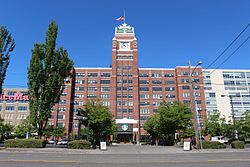
Three partners opened the first Starbucks store in Seattle's Pike Place Market, selling roasted whole beans. Under Howard Schultz's leadership from the 1980s, Starbucks transformed into a global chain that popularized espresso drinks worldwide.
Image source: Starbucks
1974
% complete
Coffee trader Erna Knutsen coined 'specialty coffee' to describe beans from distinctive microclimates with unique flavor profiles. Her advocacy helped launch the third-wave movement emphasizing origin, quality, and artisanal roasting.
1986
% complete
Nestlé launched Nespresso's capsule system, offering convenient single-serve espresso at home. Despite environmental criticism over waste, single-serve brewing grew into a multi-billion-dollar segment reshaping home coffee consumption.
Image source: Nespresso
2000
% complete
The first World Barista Championship was organized in Monte Carlo, establishing an annual global competition celebrating espresso craftsmanship. It elevated the professional status of baristas and spread technical standards across the specialty coffee industry.
Image source: World Barista Championship
2002
% complete
Roasters and cafés began treating coffee like fine wine, emphasizing single-origin beans, direct trade relationships, precise brewing methods such as pour-over, and latte art. Independent specialty shops proliferated worldwide, elevating coffee craftsmanship.
Or browse the full history timeline directory, with more than 2,000 topics.
This History of Coffee timeline was generated with the help of AI, using information found on the internet.
We work hard to keep these timelines accurate, but mistakes do get through. If you spot one, email us at [email protected] and we'll fix it for future visitors.
Generate yours with AI or build it from scratch, for free.
Export your timeline, add your own events, edit or remove AI-generated events, and much more
No credit card required.
Cancel anytime.
Cancel anytime.
You can create an unlimited number of timelines with up to 10 events on each one, customize how they look, export them to PDF, PNG, PowerPoint, CSV, and Excel, and share them with a link. Paid plans raise the event limit and add features like spreadsheet imports and collaborators.
Yes. You can cancel your subscription from your account page at any time, and you will not be charged again. Your subscription stays active for the rest of the period you already paid for.
Yes. We will email you a reminder before the annual renewal, and we will also email you a receipt.
Yes. You can email us within 15 days of any payment, and we will issue you a full refund.
Check out our pricing docs or send us an email anytime: [email protected].