
-
Use Cases
-
Resources
-
Pricing
Comic-Con International, originally known as the Golden State Comic Book Convention, began in San Diego in 1970 as a small gathering of comic book fans. Founded by Shel Dorf and a group of enthusiasts, it grew over five decades into the world's premier pop culture event, expanding to include movies, television, gaming, and cosplay, and launching countless franchises while drawing over 130,000 attendees annually. More Less
Mar 21, 1970
% complete
A group of comic book fans including Shel Dorf, Richard Alf, and Ken Krueger organized the first one-day 'San Diego's Golden State Comic-Con' in San Diego. The modest gathering featured guests like Jack Kirby and drew around 300 attendees, laying the foundation for what would become the world's largest comic and popular arts convention.
Image source: San Diego Comic-Con
Mar 21, 1970
% complete
Legendary Marvel artist Jack Kirby appeared as a guest at the inaugural convention, lending credibility to the young event. Kirby's participation highlighted Comic-Con's early focus on celebrating comic book creators directly with fans.
Image source: Jack Kirby
Nov 21, 1970 - Nov 22, 1970
% complete
The organizers staged a second event later in 1970 under the new name 'San Diego Comic-Con,' adopting the name that would stick permanently. Held at the El Cortez Hotel, this two-day convention helped establish an annual tradition and attracted a growing base of comic enthusiasts.
Jan 1, 1971
% complete
The convention formally incorporated as San Diego Comic Conventions, Inc., a nonprofit organization dedicated to creating awareness of and appreciation for comics and related popular art forms. This structure allowed it to reinvest proceeds into future events.
Aug 6, 1971 - Aug 8, 1971
% complete
The third annual convention relocated to the California Tower in Balboa Park, offering more space as attendance grew. This move signaled the convention's increasing popularity and its ambition to become a major regional fan gathering.
Jan 1, 1972
% complete
The convention introduced its distinctive logo featuring a stylized eye, designed to represent observation and appreciation of popular arts. The eye became one of the most recognizable symbols in fandom culture.
Jan 1, 1974
% complete
Comic-Con created the Inkpot Award to honor contributions to comics, science fiction, fantasy, film, television, animation, and fandom. Recipients over the decades have included Ray Bradbury, Stan Lee, and many other luminaries of popular culture.
Image source: Inkpot Award
Jul 1, 1979
% complete
After years of moving between hotels and venues, Comic-Con found a more permanent home at the San Diego Convention and Performing Arts Center, accommodating its steadily expanding roster of panels, exhibits, and attendees.
Jan 1, 1988
% complete
Comic-Con began administering the Will Eisner Comic Industry Awards, often called the 'Oscars of comics.' Named after legendary cartoonist Will Eisner, the awards recognize creative excellence in American comic books each year at the convention.
Image source: Eisner Awards
Jan 1, 1990
% complete
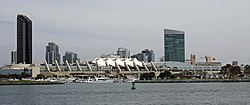
The opening of the modern San Diego Convention Center on the downtown waterfront gave Comic-Con a large, purpose-built venue. Attendance surged through the 1990s as the convention broadened beyond comics into film, television, and gaming.
Image source: San Diego Convention Center
Jan 1, 1995
% complete
The organization rebranded itself as Comic-Con International: San Diego, reflecting its growing international scope and influence. The name change underscored the convention's evolution from a local fan gathering into a global pop culture institution.
Jan 1, 2000
% complete
As demand grew, the convention extended from three days to four full days, typically running Thursday through Sunday. Preview night was later added, making the effective experience five days long for many attendees.
Jan 1, 2010
% complete
Costume play evolved into a defining feature of the convention, with elaborate handmade costumes, masquerade contests, and cosplay-focused programming. Many attendees now consider dressing up as essential to the Comic-Con experience as the panels themselves.
Image source: Cosplay
Apr 1, 2010
% complete
For the first time in its history, Comic-Con completely sold out all four-day passes months before the event. The milestone demonstrated explosive demand and led to ongoing debates about capacity, badges, and accessibility.
Jan 1, 2012
% complete
After considering moves to Los Angeles and Anaheim, Comic-Con agreed to remain in San Diego through 2021 following negotiations over Convention Center expansion. The decision preserved the symbiotic relationship between the city and the event.
Jan 1, 2015
% complete
Annual attendance reached approximately 167,000 badge holders, straining hotel capacity across the city. The convention had become so large that discussions about capping growth or relocating intensified among organizers and city officials.
Jul 20, 2001
% complete
New Line Cinema presented footage from The Fellowship of the Ring to an enthusiastic Comic-Con crowd, demonstrating Hollywood's growing interest in using the convention to build buzz for genre films. This marked the beginning of studios' love affair with Comic-Con.
Jan 1, 2003
% complete
Studios increasingly reserved the massive Hall H ballroom for exclusive footage reveals and star-studded panels. Lines stretching overnight became a defining ritual of Comic-Con culture, with fans camping out for seats at marquee presentations.
Image source: William H. Macy
Jul 24, 2008
% complete
Summit Entertainment's Twilight panel attracted thousands of devoted fans, some camping for days, signaling Comic-Con's expanding appeal beyond traditional comic readers to broader pop culture fandoms, especially young adult audiences.
Image source: Twilight (2008 film)
Jul 26, 2008
% complete
Marvel Studios brought Robert Downey Jr. and the cast of Iron Man to Hall H, energizing the crowd ahead of the film that launched the Marvel Cinematic Universe. The appearance cemented Comic-Con as the premier launchpad for superhero blockbusters.
Image source: Iron Man (2008 film)
Jul 22, 2010 - Jul 25, 2010
% complete
Disney transformed a San Diego waterfront hangar into a glowing recreation of Flynn's Arcade and staged a surprise Daft Punk concert, showcasing how studios began staging elaborate offsite activations that turned the entire city into an extension of the convention.
Image source: Tron: Legacy
Jul 23, 2010
% complete
Marvel stunned Hall H by bringing out the entire Avengers cast together on stage for the first time, with Samuel L. Jackson narrating their introductions. The moment became one of the most celebrated panels in Comic-Con history.
Image source: The Avengers (2012 film)
Jul 1, 2011
% complete
HBO's Game of Thrones began holding annual Hall H panels featuring cast reveals, teaser trailers, and surprise announcements like the cameo casting of Ed Sheeran. The show exemplified television's central role in the modern Comic-Con era.
Image source: Game of Thrones
Jul 21, 2012
% complete
Warner Bros. used Comic-Con to launch its DC cinematic ambitions, presenting exclusive Man of Steel material and announcing plans for a Justice League film, intensifying the Marvel-versus-DC rivalry played out annually in Hall H.
Image source: Man of Steel (film)
Nov 1, 2015
% complete
Comic-Con International announced plans for a year-round museum in San Diego's Balboa Park, aiming to preserve and celebrate popular arts history. The museum opened its doors in 2021, extending the convention's presence beyond its annual summer event.
Image source: Comic-Con Museum
Jul 18, 2019 - Jul 21, 2019
% complete
The convention marked five decades since its founding with special retrospectives, anniversary merchandise, and tributes to its founders. From 300 attendees in 1970 to over 130,000, the golden anniversary celebrated an extraordinary fan-driven success story.
Apr 17, 2020
% complete
Organizers canceled the in-person 2020 convention for the first time in its 50-year history due to the COVID-19 pandemic. The cancellation marked a historic disruption and prompted the creation of virtual alternatives.
Jul 22, 2020 - Jul 26, 2020
% complete
With the physical event canceled, Comic-Con pivoted to a free online edition featuring streamed panels, virtual exhibitor booths, and interactive experiences. Millions accessed content globally, though many lamented the loss of in-person energy.
Nov 26, 2021 - Nov 28, 2021
% complete
Comic-Con returned as an in-person event with a smaller, special Thanksgiving-weekend edition held at the San Diego Convention Center. Attendance was limited and health protocols were enforced, serving as a cautious bridge back to normal operations.
Jul 21, 2022 - Jul 24, 2022
% complete
The convention resumed its traditional late-July slot with a robust lineup of panels, premieres, and activations. Marvel's Hall H presentation unveiled the Multiverse Saga roadmap, reaffirming Comic-Con's status as pop culture's biggest stage.
Or browse the full history timeline directory, with more than 2,000 topics.
This History of Comic-Con timeline was generated with the help of AI, using information found on the internet.
We work hard to keep these timelines accurate, but mistakes do get through. If you spot one, email us at [email protected] and we'll fix it for future visitors.
Generate yours with AI or build it from scratch, for free.
Export your timeline, add your own events, edit or remove AI-generated events, and much more
No credit card required.
Cancel anytime.
Cancel anytime.
You can create an unlimited number of timelines with up to 10 events on each one, customize how they look, export them to PDF, PNG, PowerPoint, CSV, and Excel, and share them with a link. Paid plans raise the event limit and add features like spreadsheet imports and collaborators.
Yes. You can cancel your subscription from your account page at any time, and you will not be charged again. Your subscription stays active for the rest of the period you already paid for.
Yes. We will email you a reminder before the annual renewal, and we will also email you a receipt.
Yes. You can email us within 15 days of any payment, and we will issue you a full refund.
Check out our pricing docs or send us an email anytime: [email protected].