
-
Use Cases
-
Resources
-
Pricing
The history of cookbooks spans thousands of years, beginning with ancient recipe collections carved on clay tablets and evolving through medieval manuscript cookbooks, the invention of printed recipe books after Gutenberg's press, and the rise of modern culinary authors. Cookbooks reflect not only changing tastes and ingredients but also social history, technology, and culture across civilizations. More Less
400 BC
% complete
Large fragments from Archestratus, the ancient Greek poet who wrote about fine dining and where to find the best dishes across the Mediterranean, survive as an early example of written culinary commentary.
Image source: Archestratus
100
% complete
An early version of the Apicius cookbook was first compiled sometime in the 1st century and has often been attributed to the Roman gourmet Marcus Gavius Apicius, though modern research has cast this attribution in doubt.
Image source: Apicius
400
% complete
The current text of the Latin cookbook Apicius appears to have been compiled in the late 4th or early 5th century. It became one of the most influential works on Roman cuisine and its first print edition appeared in 1483.
900
% complete
The earliest known cookbooks in Arabic include al-Warraq's work, an early 10th-century compendium of recipes drawn from the 9th and 10th centuries, documenting the rich cuisine of the medieval Islamic world.
Image source: Cookbook
1200
% complete
After a long interval since Late Antiquity, the first recipe books began appearing in Europe in the late thirteenth century; the earliest genuinely medieval recipes survive in a Danish manuscript from around 1300 copying older texts.
1226
% complete
Al-Baghdadi wrote a celebrated 13th-century Arabic cookbook that joined al-Warraq's compendium among the earliest known cookbooks in the Arabic language.
1270
% complete
One of the earliest surviving Chinese-language cookbooks, 'Madame Wu's' Wushi Zhongkuilu dates from the late 13th century and preserves Song-era Chinese home cooking traditions.
1324
% complete
The Valencian manuscript Llibre de Sent Soví, dating from 1324, is a key Southern European medieval cookbook alongside the Catalan Llibre de totes maneres de potatges de menjar.
Image source: Crema catalana
1330
% complete
Hu Sihui's Yinshan Zhengyao (Important Principles of Food and Drink), believed to be from 1330, is another of the earliest surviving Chinese cookbooks, blending Chinese and Mongolian culinary knowledge.
Image source: Yinshan zhengyao
1350
% complete
The Venetian mid-14th-century Libro per Cuoco is a notable Italian collection containing 135 recipes arranged alphabetically, exemplifying the revival of cookbooks in Southern Europe.
Image source: Ravioli
1380
% complete
Le Viandier ('The Provisioner') was compiled in the late 14th century by Guillaume Tirel, master chef for two French kings, and is probably the most famous French medieval cookbook collection.
Image source: Le Viandier
1390
% complete
The Forme of Cury, written in the fourteenth century, is among the earliest English-language cookbooks, recording the elaborate cuisine of the English royal court.
Image source: The Forme of Cury
1393
% complete
Le Menagier de Paris ('The Householder of Paris') was a household book written by an anonymous middle-class Parisian in the 1390s, offering recipes along with household management advice.
Image source: Le Ménagier de Paris
1420
% complete
Du fait de cuisine is another notable Medieval French cookbook, written in 1420, contributing to the flourishing tradition of late-medieval gastronomic literature.
1459
% complete
Sanga yorok, a Korean cookbook, was written in 1459 by the physician Jeon Soon, providing one of the earliest recorded collections of Korean recipes.
1475
% complete
The printed De honesta voluptate et valetudine ('On honourable pleasure'), first published in 1475, was one of the first cookbooks based on Renaissance ideals and has been described as 'the anthology that closed the book on medieval Italian cooking'.
Image source: De honesta voluptate et valetudine
1483
% complete
The first print edition of Apicius, the classic Roman cookbook whose current text dates to the late 4th or early 5th century, was published in 1483, bringing ancient Roman cuisine to Renaissance readers.
1485
% complete
Kuchenmeysterey ('Kitchen Mastery'), published in 1485, was the first printed German cookbook, marking the spread of printed culinary texts in Northern Europe.
Image source: Cookbook
1584
% complete
In 1584, an Italian chef recorded his suspicions regarding his servants stealing from him and noted how he needed to supervise them, illustrating the household tensions captured in early modern cookbooks.
1668
% complete
In 1668, Italian chef Francesco Liberati included a list of specific reasons why cooks should abstain from alcohol in his household cookbook, reflecting the moral concerns embedded in culinary writing.
1670
% complete
Written around 1670 by Chang Kyehyang, Ŭmsik timibang is the oldest Korean cookbook first written by a woman, marking a milestone for women's authorship in culinary literature.
Image source: Ŭmsik timibang
1680
% complete
Arte de Cocina, Pastelaria, Vizcocheria e Conservaria was written by Francisco Martinez Montiño, palace cook of King Philip II of Spain, becoming an influential Spanish culinary text.
1742
% complete
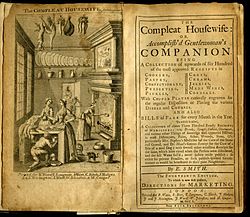
In 1742, Eliza Smith's The Compleat Housewife; or, Accomplished Gentlewoman's Companion was published in North America, bringing popular English domestic cookery to American readers.
1792
% complete
In 1792, Yuan Mei published Recipes from the Garden of Contentment, which criticized the corruption of Chinese cuisine by the Manchu and remains a landmark of Chinese gastronomic writing.
1796
% complete
American Cookery, written by Amelia Simmons and published in Hartford, Connecticut, was the first known American cookbook, establishing a distinctly American culinary identity.
Image source: American Cookery
1845 - 1914
% complete
Eliza Acton's pioneering Modern Cookery for Private Families (1845) was aimed at the domestic reader rather than the professional cook or chef, shaping modern cookery writing. It remained in print until 1914.
Image source: Eliza Acton
1857 - 1861
% complete
Isabella Beeton, influenced by Eliza Acton's work, published Mrs Beeton's Book of Household Management in 24 monthly parts between 1857 and 1861, becoming an iconic Victorian guide to domestic life.
Image source: Mrs. Beeton's Book of Household Management
1885
% complete
In 1885 the Virginia Cookery Book was published by Mary Stuart Smith, adding to the growing tradition of regional American cookery writing.
Image source: Mary Stuart Smith
1896
% complete
In 1896 the American cook Fannie Farmer (1857–1915) published The Boston Cooking-School Cook Book, which contained some 1,849 recipes and standardized measurements for American kitchens.
Image source: Fannie Farmer
1901
% complete
The Cook's Decameron: A Study In Taste, Containing Over Two Hundred Recipes For Italian Dishes was published in 1901 by Mrs., introducing Italian cuisine to English-speaking readers.
Image source: The Cook's Decameron
1908
% complete
The Edmonds Cookery Book by T.J., first published in 1908, went on to become New Zealand's best-selling book, a beloved staple of Kiwi kitchens.
Image source: Edmonds Cookery Book
1931
% complete
The Household Searchlight Recipe Book by Ida Migliario, Zorada Z., and others was published in 1931, serving generations of American home cooks with practical family recipes.
1954
% complete
The Alice B. Toklas Cookbook, published in 1954, blended memoir and recipes from Toklas's life with Gertrude Stein in Paris, becoming a literary culinary classic.
Image source: The Alice B. Toklas Cook Book
1956
% complete
Cooking with the Chinese Flavor, published in 1956, was the first of several books by Lin Tsuifeng ('Mrs.') that introduced Chinese home cooking techniques and flavors to Western audiences.
Image source: Lin Yutang
1957 - 1986
% complete
Carmen Aboy Valldejuli authored influential Caribbean cookbooks including The Art of Caribbean Cookery (Doubleday, 1957), Puerto Rican Cookery (Pelican Publishing, 1983), and Juntos en la Cocina (1986), co-authored with her husband Luis F. Valldejuli.
Image source: Pasteles
1958
% complete
Published in 1958 by the National Council of Negro Women, The Historical Cookbook of the American Negro includes recipes that illuminate histories of Black resistance, such as 'Nat Turner Crackling Bread.'
Image source: National Council of Negro Women
1976
% complete
The People's Philadelphia Cookbook, published in 1976 by grassroots organization The People's Fund, includes recipes from members of the Black Panther Party, The United Farm Workers, and the Gay Activist Alliance of Philadelphia.
1992
% complete
Since 1992, Gooseberry Patch has been publishing community-style cookbooks, building its brand around shared recipes contributed by home cooks across communities.
Image source: Gooseberry Patch
Or browse the full history timeline directory, with more than 2,000 topics.
This History of Cookbooks timeline was generated with the help of AI, using information found on the internet.
We work hard to keep these timelines accurate, but mistakes do get through. If you spot one, email us at [email protected] and we'll fix it for future visitors.
Generate yours with AI or build it from scratch, for free.
Export your timeline, add your own events, edit or remove AI-generated events, and much more
No credit card required.
Cancel anytime.
Cancel anytime.
You can create an unlimited number of timelines with up to 10 events on each one, customize how they look, export them to PDF, PNG, PowerPoint, CSV, and Excel, and share them with a link. Paid plans raise the event limit and add features like spreadsheet imports and collaborators.
Yes. You can cancel your subscription from your account page at any time, and you will not be charged again. Your subscription stays active for the rest of the period you already paid for.
Yes. We will email you a reminder before the annual renewal, and we will also email you a receipt.
Yes. You can email us within 15 days of any payment, and we will issue you a full refund.
Check out our pricing docs or send us an email anytime: [email protected].