-
Use Cases
-
Resources
-
Pricing
1646 - 1726
% complete
The Irish farmer Robert Cook (1646–1726) was a vegan who predated the term; he did not eat any animal products and did not wear wool or leather, on account of his Protestant interpretation of biblical verses.
Image source: Veganism
1800 - 1899
% complete
Vegetarianism established itself as a significant movement in 19th-century Britain and the United States, laying the groundwork for later vegan developments.
Image source: Vegetarianism
1813
% complete
In 1813, the poet Percy Bysshe Shelley published A Vindication of Natural Diet, advocating 'abstinence from animal food and spirituous liquors'.
Image source: A Vindication of Natural Diet
1815
% complete
In 1815, William Lambe, a London physician, said that his 'water and vegetable diet' could cure anything from tuberculosis to acne.
1834
% complete
In Massachusetts, Amos Bronson Alcott, father of the novelist Louisa May Alcott, opened the Temple School in 1834, promoting his dietary and ethical ideals.
Image source: Amos Bronson Alcott
1838
% complete
In England, James Pierrepont Greaves founded the Concordium, a vegan community at Alcott House on Ham Common, in 1838.
Image source: Papal States
1844
% complete
Amos Bronson Alcott opened Fruitlands in Massachusetts in 1844, a utopian community practicing strict avoidance of animal products.
Image source: Fruitlands (transcendental center)
1849
% complete
The first known vegan cookbook was Asenath Nicholson's Kitchen Philosophy for Vegetarians, published in 1849.
Image source: Asenath Nicholson
Nov 1931
% complete
During a visit to London in 1931, Mahatma Gandhi—who had joined the Vegetarian Society's executive committee when he lived in London from 1888 to 1891—gave a speech arguing that it ought to promote a meat-free diet as a matter of morality, not health.
Image source: Mahatma Gandhi
1910
% complete
Rupert Wheldon's No Animal Food: Two Essays and 100 Recipes was published in 1910, an early work advocating a diet free of all animal products.
Image source: Rupert H. Wheldon
Aug 1944
% complete
In August 1944, several members of the Vegetarian Society asked that a section of its newsletter be devoted to non-dairy vegetarianism.
Image source: The Vegan Society
Nov 1944
% complete
When the request for a non-dairy section was denied, Donald Watson, secretary of the Leicester branch, set up a new quarterly newsletter, The Vegan News, in November 1944. The term 'veganism' was coined in 1944 by Donald and Dorothy Watson.
Image source: Donald Watson
Nov 1945
% complete
The Vegan News changed its name to The Vegan in November 1945, by which time it had 500 subscribers.
1946
% complete
In 1946, Henderson published a work on vegan diets, followed by Kathleen V.'s Aids to a Vegan Diet for Children, providing practical guidance on animal-free eating.
Image source: Vegan nutrition
1947
% complete
In 1947, Watson wrote: 'The vegan renounces it as superstitious that human life depends upon the exploitation of these creatures whose feelings are much the same as our own'.
1948
% complete
The American Vegan Society was founded in 1948 by Catherine Nimmo and Rubin Abramowitz in California, who distributed Watson's newsletter. From 1948, The Vegan's front page read: 'Advocating living without exploitation'.
1949
% complete
Leslie Cross, an early and influential vice-president of The Vegan Society, said in 1949 that veganism was 'the abolition of the exploitation of animals by man'.
1951
% complete
In 1951, the Society published its definition of veganism as 'the doctrine that man should live without exploiting animals'. A 2021 study found this to be the most popular definition amongst vegans from a number of other prominent definitions.
1956
% complete
In 1956, The Vegan Society's vice-president Leslie Cross founded the Plantmilk Society, which in 1965, as Plantmilk Ltd and later Plamil Foods, began production of one of the first widely distributed soy milks in the Western world.
Image source: Plamil Foods
1959
% complete
Beauty Without Cruelty, founded as a charity in 1959, was one of the earliest manufacturers and certifiers of animal-free personal care products.
1962
% complete
According to Joanne Stepaniak, the word vegan was first published independently in 1962 by the Oxford Illustrated Dictionary, defined as 'a vegetarian who eats no butter, eggs, cheese, or milk'.
1971
% complete
One of the most influential vegetarian books of that time was Frances Moore Lappé's 1971 Diet for a Small Planet, which linked meat consumption to resource waste and world hunger.
Image source: Diet for a Small Planet
1980
% complete
From the 1980s onward, veganism became strongly associated with the punk subculture. This association continues into the 21st century, as evidenced by the prominence of vegan punk events such as Fluff Fest in Europe.
Image source: Anarcho-punk
1983
% complete
Advocates produced a series of books recommending vegan or vegetarian diets, including McDougall's The McDougall Plan (1983), John Robbins's Diet for a New America (1987), which associated meat production with environmental damage, and Dean Ornish's Program for Reversing Heart Disease (1990).
Image source: John A. McDougall
2005 - 2011
% complete
A wave of influential media followed: Earthlings (2005), Campbell's The China Study (2005), Rory Freedman and Kim Barnouin's Skinny Bitch (2005), Jonathan Safran Foer's Eating Animals (2009), and the film Forks Over Knives (2011) brought vegan ideas to mass audiences.
2010
% complete
The Vegetarian Butcher (De Vegetarische Slager), the first known vegetarian butcher shop selling mock meats, opened in the Netherlands in 2010, while America's first vegan butcher, the Herbivorous Butcher, opened in Minneapolis in 2016. The global mock-meat market increased by 18 percent between 2005 and 2010.
Image source: The Vegetarian Butcher
2011
% complete
In 2011, Europe's first vegan supermarkets appeared in Germany: Veganz in Berlin and Vegilicious in Dortmund.
Image source: Veganz
2011 - 2013
% complete
In the U.K., the plant milk market increased by 155 percent in two years, from 36 million litres in 2011 to 92 million litres in 2013. By 2016, 49% of Americans were drinking plant milk, and there was a 185% increase in new vegan products between 2012 and 2016 in the U.K.
Image source: Plant milk
2016 - 2022
% complete
In 2017, the United States School Nutrition Association found 14% of school districts were serving vegan school meals compared to 11.5% in 2016. Growth continued with lunches added by Los Angeles, California in 2018, Portland, Maine in 2019, and New York City in 2022.
2017 - 2019
% complete
Since 2017, more than 12,500 chain restaurant locations have begun offering Beyond Meat and Impossible Foods products, including Carl's Jr., with the U.S. mock-meat market growing 37% between 2017 and 2019. The U.S. market for vegan food was valued at $3.9 billion in 2017.
Image source: Beyond Meat
Jan 2021
% complete
In January 2021, 582,538 people from 209 countries and territories signed up for Veganuary, breaking the previous year's record of 400,000. In 2021, Greta Thunberg also called for more vegan food production and consumption worldwide.
Image source: Veganuary
1990
% complete
Carol Adams's premier work, The Sexual Politics of Meat: A Feminist-Vegetarian Critical Theory (1990), noted the relationship between feminism and meat consumption. In her speech 'Why feminist-vegan now?', adapted from her address at the 'Minding Animals' conference in Newcastle, Australia (2009), she recalled that the connection came to her in October 1974.
Image source: Carol J. Adams
1995
% complete
The term 'ethical vegan' was popularized in 1995 by Brian A. Cross, distinguishing dietary choices from veganism as a broader moral philosophy. Dietary veganism is in contrast to ethical veganism, defined as a philosophical belief protected under the UK's Equality Act 2010.
Image source: Veganism
2011
% complete
Feminist scholar Angella Duvnjak wrote in 'Joining the Dots: Some Reflections on Feminist-Vegan Political Practice and Choice' (2011) that she was met with opposition when she pointed out the connection between feminist and vegan ideals, even though the connection seemed more than obvious to her and other scholars.
Sep 2013
% complete
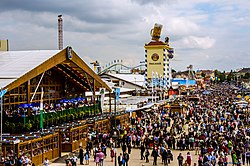
In 2013, the Oktoberfest in Munich, traditionally a meat-heavy event, offered vegan dishes for the first time in its 200-year history.
Image source: Oktoberfest
2017
% complete
The EU bans labeling vegan products with dairy-related words like 'almond milk', a rule instated in 2017. As of 2019, six countries in Europe apply higher VAT rates to vegan plant milk than to cow milk, which pro-vegan activists have called discrimination.
2017
% complete
In Portugal, starting in 2017, public administration canteens and cafeterias such as schools, prisons and social services must offer at least one vegan option at every meal.
2020
% complete
In the United Kingdom, an employment tribunal ruled in 2020 that the Equality Act 2010 protects 'ethical veganism', a belief it defined as veganism extending beyond diet to all areas of life and motivated by concern for animals. In Ontario, Canada, veganism was ruled not to be a protected belief in 2023, following earlier guidance from the Ontario Human Rights Commission in 2015.
2021
% complete
In 2021, the International Organization for Standardization published standard ISO 23662 on definitions and technical criteria for foods and food ingredients suitable for vegetarians or vegans and for labelling and claims. This followed Germany's Ministry for Consumer Protection approving a definition for vegan-suitable food on 22 April 2016.
Image source: International Organization for Standardization
2003
% complete
In 2003 two major North American dietitians' associations claimed that well-planned vegan diets were suitable for all life stages, boosting mainstream credibility.
2006
% complete
According to a 2006 United Nations Food and Agriculture Organization report, Livestock's Long Shadow, around 26% of the planet's terrestrial surface is devoted to livestock grazing, and livestock consumed 1,174 million tonnes of food in 2002—including 670 million tonnes of cereals, one-third of the global harvest.
Image source: Livestock's Long Shadow
2010
% complete
A 2010 UN report, Assessing the Environmental Impacts of Consumption and Production, argued that animal products 'in general require more resources and cause higher emissions than plant-based alternatives'. A 2015 study also determined that significant biodiversity loss can be attributed to the growing demand for meat.
Image source: Assessing the Environmental Impacts of Consumption and Production
2017
% complete
A 2017 World Wildlife Fund study found that 60% of biodiversity loss can be attributed to the vast scale of feed crop cultivation needed to rear tens of billions of farm animals. Also in 2017, 15,364 world scientists signed a warning to humanity calling for 'promoting dietary shifts towards mostly plant-based foods'.
Image source: World Wide Fund for Nature
2018
% complete
A 2018 study found that global adoption of plant-exclusive diets would reduce agricultural land use by 76% (3.1 billion hectares, an area the size of Africa) and cut total global greenhouse gas emissions by 28%. In the same year, Jacy Reese Anthis's book The End of Animal Farming argued that veganism will completely replace animal-based food by 2100.
Image source: Environmental impacts of animal agriculture
Aug 8, 2019
% complete
On 8 August 2019, the IPCC released a summary of its special report asserting that a shift towards plant-exclusive diets would help mitigate and adapt to climate change. The 2019 IPBES Global Assessment Report had also found that industrial agriculture and overfishing are primary drivers of the extinction crisis. The Economist declared 2019 'the year of the vegan'.
Image source: Special Report on Climate Change and Land
2023
% complete
A 2023 study published in Nature Food found that a vegan diet vastly decreases the impact on the environment from food production, reducing emissions, water pollution and land use by 75%, reducing destruction of wildlife by 66%, and water usage by 54%. Another 2023 systematic review found no evidence of considerable health effects, while noting issues with selection bias and sample sizes.
Image source: Plant-based diet
2024
% complete
As of 2024, the German Society for Nutrition holds that for healthy adults a vegan diet can be healthful when B12 is supplemented and the diet is well-planned so critical nutrients are provided. As of 2022, 45% of government nutritional guidelines discuss vegan meat or milk alternatives, or both.
Or browse the full history timeline directory, with more than 2,000 topics.
This History of Veganism timeline was generated with the help of AI, using information found on the internet.
We work hard to keep these timelines accurate, but mistakes do get through. If you spot one, email us at [email protected] and we'll fix it for future visitors.
Generate yours with AI or build it from scratch, for free.
Export your timeline, add your own events, edit or remove AI-generated events, and much more
No credit card required.
Cancel anytime.
Cancel anytime.
You can create an unlimited number of timelines with up to 10 events on each one, customize how they look, export them to PDF, PNG, PowerPoint, CSV, and Excel, and share them with a link. Paid plans raise the event limit and add features like spreadsheet imports and collaborators.
Yes. You can cancel your subscription from your account page at any time, and you will not be charged again. Your subscription stays active for the rest of the period you already paid for.
Yes. We will email you a reminder before the annual renewal, and we will also email you a receipt.
Yes. You can email us within 15 days of any payment, and we will issue you a full refund.
Check out our pricing docs or send us an email anytime: [email protected].