-
Use Cases
-
Resources
-
Pricing
The history of Cyprus spans thousands of years, shaped by its strategic location in the Eastern Mediterranean. Inhabited since the Neolithic period, the island was ruled successively by Assyrians, Egyptians, Persians, Greeks, Romans, Byzantines, Lusignans, Venetians, Ottomans, and finally the British before gaining independence in 1960. Intercommunal tensions between Greek Cypriots and Turkish Cypriots led to the Turkish invasion of 1974 and the ongoing division of the island into the Republic of Cyprus and the self-declared Turkish Republic of Northern Cyprus, recognized only by Turkey. More Less
2500 BC - 1050 BC
% complete
During the Bronze Age, Cyprus became renowned for its abundant copper deposits. The island's metal was traded across the Mediterranean, linking Cyprus with Egypt, the Levant, and the Aegean, and giving rise to the island's ancient name for copper: 'kypros'.
Image source: Ancient history of Cyprus
1200 BC
% complete
Following the collapse of Mycenaean civilization, Greek settlers arrived in Cyprus in successive waves after around 1200 BC. They founded city-kingdoms such as Salamis and Paphos, establishing the Greek language and culture that have shaped Cypriot identity ever since.
Image source: Mycenaean Greece
707 BC - 669 BC
% complete
The Assyrian Empire under Sargon II claimed dominion over the Cypriot city-kingdoms around 707 BC. Although Cypriot rulers paid tribute to Assyria, they retained substantial local autonomy, and Assyrian control faded with the empire's decline.
570 BC
% complete
Pharaoh Amasis II of Egypt conquered Cyprus around 570 BC, making the island a tribute-paying subject. This brief period of Egyptian control ended when the rising Persian Empire absorbed both Egypt and Cyprus.
Image source: Amasis II
545 BC - 333 BC
% complete
Cyprus fell under Persian Achaemenid control in the mid-6th century BC. The city-kingdoms were allowed considerable independence under client kings, though they were expected to support Persia militarily, including during Xerxes' campaigns against Greece.
Image source: Achaemenid Empire
333 BC
% complete
After his victory at Issus, Alexander the Great secured the submission of the Cypriot city-kingdoms in 333 BC. The island became a vital naval base for Alexander's campaigns against Phoenicia and Egypt, ending centuries of Persian dominance.
Image source: Wars of Alexander the Great
294 BC - 58 BC
% complete
Following the wars of Alexander's successors, Cyprus came under the control of Ptolemy I of Egypt in 294 BC. For over two centuries it served as a strategic province of Hellenistic Egypt, rich in copper and grain.
Image source: Ptolemaic Kingdom
58 BC
% complete
Rome annexed Cyprus in 58 BC through the actions of the tribune Clodius Pulcher, who stripped King Ptolemy of Cyprus of his throne. The island later became a senatorial Roman province, integrated into the empire's eastern Mediterranean world.
Image source: Roman Cyprus
45 AD
% complete
On their first missionary journey, Paul and Barnabas traveled across Cyprus, converting the Roman proconsul Sergius Paulus at Paphos. This mission made Cyprus one of the first lands governed by a Christian official and founded the autocephalous Church of Cyprus.
Image source: Church of Cyprus
332 AD - 342 AD
% complete
A series of powerful earthquakes in the early 4th century destroyed many Cypriot cities, including Salamis. Emperor Constantius II aided reconstruction, and Salamis was rebuilt and renamed Constantia, becoming the island's capital.
Image source: Salamis, Cyprus
649 AD - 965 AD
% complete
Beginning with Muawiyah's raid in 649 AD, Arab fleets repeatedly attacked Cyprus during the Byzantine-Arab wars. For centuries the island suffered as a contested frontier zone, at times nominally shared between Byzantium and the Caliphate.
Image source: Arab–Byzantine wars
965 AD
% complete
Emperor Nikephoros II Phokas expelled Arab forces from Cyprus in 965, restoring full Byzantine control after three centuries of raids and condominium. The island then enjoyed renewed prosperity under imperial administration.
Image source: Nikephoros II Phokas
1184 AD - 1191 AD
% complete
In 1184, Isaac Komnenos declared himself ruler of Cyprus, breaking away from the weakening Byzantine Empire. His self-styled 'emperor' rule lasted until Richard the Lionheart arrived during the Third Crusade and captured the island.
Image source: Isaac Komnenos of Cyprus
May 1191
% complete
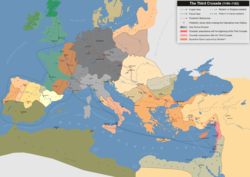
While en route to the Holy Land during the Third Crusade, England's Richard I seized Cyprus after defeating Isaac Komnenos. He married Berengaria of Navarre at Limassol, crowning her Queen of England on Cypriot soil.
Image source: Third Crusade
1192 - 1489
% complete
Guy of Lusignan purchased Cyprus from the Templars and established a Crusader kingdom in 1192. The Lusignan dynasty ruled for nearly three centuries, blending French feudal culture with Greek Orthodox traditions of the island's population.
Image source: Kingdom of Cyprus
1373
% complete
Amid a war between Genoa and the Lusignan kingdom triggered by the murder of a Genoese nobleman, Genoa seized the port city of Famagusta in 1373. It remained a wealthy Genoese colony until Venice acquired it in 1464.
Image source: Famagusta
1489 - 1571
% complete
When Queen Caterina Cornaro, the last Lusignan monarch, abdicated in favor of the Republic of Venice in 1489, Cyprus became a Venetian colony. Venice fortified the island heavily, especially Nicosia and Famagusta, against Ottoman expansion.
Image source: Venetian Cyprus
Jul 1, 1570 - Aug 1, 1571
% complete
Ottoman forces invaded Cyprus in July 1570, capturing Nicosia after a bloody siege and taking Famagusta in August 1571 following a heroic ten-month defense led by Marcantonio Bragadin. The fall of Cyprus shocked Christian Europe shortly before the Battle of Lepanto.
Image source: Ottoman–Venetian War (1570–1573)
1572
% complete
After the conquest, the Ottoman Empire resettled Anatolian Muslim farmers and soldiers on the island, laying the foundations of the Turkish Cypriot community. Cyprus was organized into an Ottoman eyalet administered from Nicosia.
Jul 1878 - Nov 1914
% complete
Under the secret Cyprus Convention of 1878, Britain took administrative control of the island in exchange for supporting the Ottoman Empire against Russia. When the Ottomans joined World War I on the German side, Britain formally annexed Cyprus in November 1914.
Image source: British Cyprus
Aug 13, 1913
% complete
Michael Christodoulou Mouskos, who would become Archbishop Makarios III, the spiritual leader of the Greek Cypriots and first President of independent Cyprus, was born near Paphos in 1913. His leadership would dominate mid-20th-century Cypriot politics.
Image source: Makarios III
1925
% complete
Following the Treaty of Lausanne in 1923, in which Turkey renounced all claims to the island, Britain declared Cyprus a crown colony in 1925, placing it under direct colonial administration with a governor appointed from London.
Apr 1, 1955 - Mar 1959
% complete
The Greek Cypriot organization EOKA, led by Colonel Georgios Grivas with support from Archbishop Makarios, began an armed campaign for union of Cyprus with Greece (enosis). The insurgency prompted emergency rule, arrests, and negotiations that eventually reshaped the island's status.
Image source: Cyprus Emergency
Feb 1959
% complete
Agreements brokered among Britain, Greece, and Turkey in Zürich and London in February 1959 set out the framework for Cypriot independence rather than enosis. They established a bicommunal constitution and guaranteed the involvement of Greece, Turkey, and Britain in the new state.
Image source: London and Zürich Agreements
Aug 16, 1960
% complete
Cyprus emerged as an independent republic on August 16, 1960, with Archbishop Makarios III as its first president and Dr. Fazıl Küçük as vice president. Britain retained sovereignty over two military bases, Akrotiri and Dhekelia.
Dec 1963 - 1964
% complete
Constitutional disputes between Greek and Turkish Cypriots erupted into deadly intercommunal clashes beginning in December 1963. Hundreds died, Turkish Cypriots withdrew into enclaves, and UN peacekeeping forces (UNFICYP) were deployed in March 1964, remaining to this day.
Image source: Bloody Christmas (1963)
Jul 15, 1974
% complete
On July 15, 1974, the Greek junta backed a coup by Cypriot nationalists that overthrew President Makarios III, seeking union with Greece. The coup provided Turkey with a pretext to intervene militarily five days later, triggering the island's partition.
Jul 20, 1974 - Aug 18, 1974
% complete
Turkey invaded northern Cyprus on July 20, 1974, citing its role as a guarantor power. By mid-August Turkish forces controlled roughly 36% of the island. About 160,000 Greek Cypriots fled south and some 50,000 Turkish Cypriots moved north, dividing the island de facto along the Green Line.
Image source: Turkish invasion of Cyprus
Nov 15, 1983
% complete
The Turkish Cypriot leadership proclaimed the Turkish Republic of Northern Cyprus in November 1983 under Rauf Denktaş. Only Turkey has recognized the state; the international community considers it occupied territory of the Republic of Cyprus.
Image source: Northern Cyprus
Apr 24, 2004
% complete
UN Secretary-General Kofi Annan's reunification plan was voted on simultaneously in both communities. While Turkish Cypriots approved it by nearly 65%, Greek Cypriots rejected it overwhelmingly, leaving the island divided when it entered the EU a week later.
May 1, 2004
% complete
On May 1, 2004, the Republic of Cyprus acceded to the European Union as a whole, although EU law is suspended in the north due to the ongoing division. Membership anchored the island economically and politically within Europe.
Image source: Northern Cyprus–European Union relations
Jan 1, 2008
% complete
Cyprus replaced the Cypriot pound with the euro on January 1, 2008, joining the Eurozone. The transition marked a major step in integrating the island's services-driven economy into the European financial system.
Image source: Economy of Cyprus
2011
% complete
Significant offshore natural gas reserves were identified in Cyprus's exclusive economic zone starting in 2011, notably at the Aphrodite field. The discoveries promised economic transformation but also heightened regional tensions with Turkey over drilling rights.
Image source: Energy in Cyprus
2012 - 2013
% complete
Exposure to Greek debt and losses in Cypriot banks triggered a severe crisis. In March 2013, Cyprus accepted a €10 billion bailout from the EU and IMF, which imposed an unprecedented 'bail-in' of uninsured depositors, shaking confidence but stabilizing the economy.
Image source: 2012–2013 Cypriot financial crisis
Or browse the full history timeline directory, with more than 2,000 topics.
This History of Cyprus timeline was generated with the help of AI, using information found on the internet.
We work hard to keep these timelines accurate, but mistakes do get through. If you spot one, email us at [email protected] and we'll fix it for future visitors.
Generate yours with AI or build it from scratch, for free.
Export your timeline, add your own events, edit or remove AI-generated events, and much more
No credit card required.
Cancel anytime.
Cancel anytime.
You can create an unlimited number of timelines with up to 10 events on each one, customize how they look, export them to PDF, PNG, PowerPoint, CSV, and Excel, and share them with a link. Paid plans raise the event limit and add features like spreadsheet imports and collaborators.
Yes. You can cancel your subscription from your account page at any time, and you will not be charged again. Your subscription stays active for the rest of the period you already paid for.
Yes. We will email you a reminder before the annual renewal, and we will also email you a receipt.
Yes. You can email us within 15 days of any payment, and we will issue you a full refund.
Check out our pricing docs or send us an email anytime: [email protected].