-
Use Cases
-
Resources
-
Pricing
The history of department stores traces the development of large-scale retail establishments that offered a wide variety of goods under one roof. Beginning in mid-19th century Europe with pioneers like Paris's Bon Marché, department stores revolutionized shopping by introducing fixed prices, elaborate displays, and consumer culture. The concept spread rapidly to America and beyond, with iconic stores such as Macy's, Harrods, and Sears shaping urban life and commerce for over a century. More Less
1836
% complete
Kendall, Milne & Co., later known simply as Kendals, opened in Manchester and became one of England's earliest department stores, expanding from drapery into a wide array of goods sold across separate departments.
Image source: Kendals
1838
% complete
Emerson Muschamp Bainbridge opened a drapery shop in Newcastle upon Tyne that is often cited as Britain's first department store, introducing the practice of dividing merchandise into distinct departments under one roof.
Image source: Bainbridge's
1848
% complete
Irish immigrant A.T. Stewart opened his landmark 'Marble Dry Goods Palace' on Broadway, one of America's first large-scale retail emporiums. He pioneered fixed pricing and catering to middle-class shoppers, laying groundwork for American department stores.
Image source: Alexander Turney Stewart
1852
% complete
Aristide Boucicaut transformed a small Parisian shop into the world's first modern department store, pioneering fixed prices, free entry, and generous return policies. His innovations in merchandising and marketing created the template for department stores worldwide.
Image source: Le Bon Marché
Oct 28, 1858
% complete
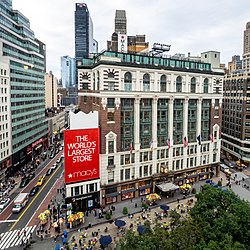
R.H. Macy opened a small dry goods store on Sixth Avenue in New York City. Through aggressive advertising, innovative pricing, and the famous red star logo, it grew into Macy's, which would become one of the world's most famous department stores.
Image source: Macy's
1868
% complete
Marshall Field established his grand retail palace on State Street, which grew into a legendary shopping destination known for its luxurious interiors, elaborate holiday windows, and the famous Frango mints.
Image source: Marshall Field's
1877
% complete
John Wanamaker converted an abandoned freight depot in Philadelphia into 'Grand Depot,' often considered America's first true department store, offering many departments under one roof with fixed prices.
Image source: Wanamaker's
1879
% complete
Selfridge joined Chicago's Marshall Field's and helped transform it into a retail powerhouse, coining slogans like 'Give the lady what she wants' and championing customer service innovations that reshaped retail culture.
1891
% complete
'The Iron Palace,' named for its iron-and-glass construction, opened in Mexico City as Latin America's pioneering department store, bringing European luxury retail traditions to Mexican consumers.
Image source: El Palacio de Hierro
1904
% complete
Tokyo kimono retailer Mitsukoshi Gofuku Ten declared itself Japan's first 'department store' (depāto), blending traditional Japanese craftsmanship with Western-style merchandising and helping launch Japan's distinctive department store culture.
Image source: Mitsukoshi
1911
% complete
Sidney Myer built his Melbourne emporium into Australia's leading department store, pioneering bargain sales and customer-friendly practices that made Myer a household name across Australia.
Image source: Myer
1913
% complete
The centuries-old fur trading company began converting its Canadian outposts into urban department stores during the early twentieth century, eventually becoming a major Canadian retail chain before acquiring other storied brands.
Image source: Hudson's Bay Company
Jun 8, 1934
% complete
Ramón Areces founded El Corte Inglés as a children's tailor shop that grew into Spain's largest department store chain, eventually becoming one of Europe's biggest retailers and absorbing rival Galerías Preciados in 1995.
Image source: El Corte Inglés
1943
% complete
Pepín Fernández founded Galerías Preciados in Madrid, introducing modern department store retailing to Spain and dominating Spanish retail until competition from El Corte Inglés led to its closure decades later.
Image source: Galerías Preciados
1902
% complete
Macy's opened its massive new store at Herald Square, which expanded over the years into one of the largest department stores in the world, becoming an iconic New York shopping destination.
Image source: Macy's Herald Square
1905
% complete
After a devastating fire in 1883 destroyed Harrods' premises, the Brompton Road store was progressively rebuilt into a grand Edwardian palace of retail, complete with electric lights, elevators, and luxury food halls.
Image source: Harrods
Mar 15, 1909
% complete
American Harry Gordon Selfridge opened his lavish London store, revolutionizing British retail with open displays, restaurants, roof gardens, and treating shopping as entertainment. The opening drew enormous crowds to Oxford Street.
Image source: Selfridges
1912
% complete
The Théophile Bader brothers unveiled their spectacular Boulevard Haussmann store crowned by a stunning glass dome, making shopping a theatrical experience and establishing Paris as a global capital of grand magasin retailing.
Image source: Galeries Lafayette
Nov 27, 1924
% complete
Macy's launched its now-legendary Thanksgiving parade through Manhattan, originally featuring live zoo animals. It evolved into a beloved annual spectacle with giant helium balloons, cementing department stores' role in American cultural traditions.
Image source: Macy's Thanksgiving Day Parade
1929
% complete
Federated Department Stores was formed to consolidate regional department stores including Abraham & Straus, Filene's, Lazarus, and Bloomingdale's, beginning a trend of consolidation that would reshape American retail ownership.
Image source: Macy's, Inc.
1970
% complete
Under chairman Marvin Traub, Bloomingdale's reinvented itself as a trend-setting fashion authority, with celebrity events, designer exclusives, and themed shops that made the East Side flagship a cultural phenomenon.
Image source: Bloomingdale's
1925
% complete
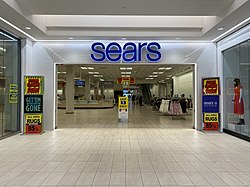
Catalog giant Sears opened its first retail stores in Chicago suburbs, adapting to the rise of automobile-based shopping and eventually becoming America's largest retailer before its long decline.
Image source: Sears
1950 - 1969
% complete
As Americans moved to suburbs, department anchors like Sears, JCPenney, and May Company anchored the booming shopping mall boom, fundamentally shifting retail away from downtown flagship locations.
Image source: Shopping mall
May 1, 1962
% complete
The Dayton Company opened the first Target store in Minnesota, part of the discount revolution alongside Kmart and Walmart that began eroding traditional department stores' dominance in general merchandise.
Image source: Target Corporation
1963
% complete
JCPenney opened its first full-line mall-based department store, transitioning from rural catalog merchant to major national department chain, peaking as one of America's biggest retailers in subsequent decades.
Image source: JCPenney
1990
% complete
Minneapolis-based Dayton Hudson Corporation acquired Chicago's beloved Marshall Field's, an early sign of the consolidation wave that would see historic regional department store names disappear under national owners.
Jul 16, 1995
% complete
Jeff Bezos launched Amazon as an online bookstore that grew into a retail colossus. E-commerce increasingly siphoned sales from department stores, forcing the industry into decades of restructuring and closures.
Image source: Amazon (company)
2005 - 2006
% complete
After acquiring the May Company, Federated Department Stores converted hundreds of storied regional names like Marshall Field's, Hecht's, and Kaufmann's into Macy's, sparking consumer backlash but completing national brand unification.
Oct 15, 2018
% complete
Once America's retail titan, Sears filed for Chapter 11 bankruptcy after years of declining sales, store closures, and competition from online rivals — a symbol of the traditional department store era's decline.
Mar 2020 - 2021
% complete
Lockdowns and the surge in online shopping devastated department store chains, triggering bankruptcies like Neiman Marcus and JCPenney and permanent closure of hundreds of stores, accelerating the industry's transformation.
Or browse the full history timeline directory, with more than 2,000 topics.
This History of Department Stores timeline was generated with the help of AI, using information found on the internet.
We work hard to keep these timelines accurate, but mistakes do get through. If you spot one, email us at [email protected] and we'll fix it for future visitors.
Generate yours with AI or build it from scratch, for free.
Export your timeline, add your own events, edit or remove AI-generated events, and much more
No credit card required.
Cancel anytime.
Cancel anytime.
You can create an unlimited number of timelines with up to 10 events on each one, customize how they look, export them to PDF, PNG, PowerPoint, CSV, and Excel, and share them with a link. Paid plans raise the event limit and add features like spreadsheet imports and collaborators.
Yes. You can cancel your subscription from your account page at any time, and you will not be charged again. Your subscription stays active for the rest of the period you already paid for.
Yes. We will email you a reminder before the annual renewal, and we will also email you a receipt.
Yes. You can email us within 15 days of any payment, and we will issue you a full refund.
Check out our pricing docs or send us an email anytime: [email protected].